
Building an Academic CV for Study Abroad Applications: Structure, Mistakes & Examples
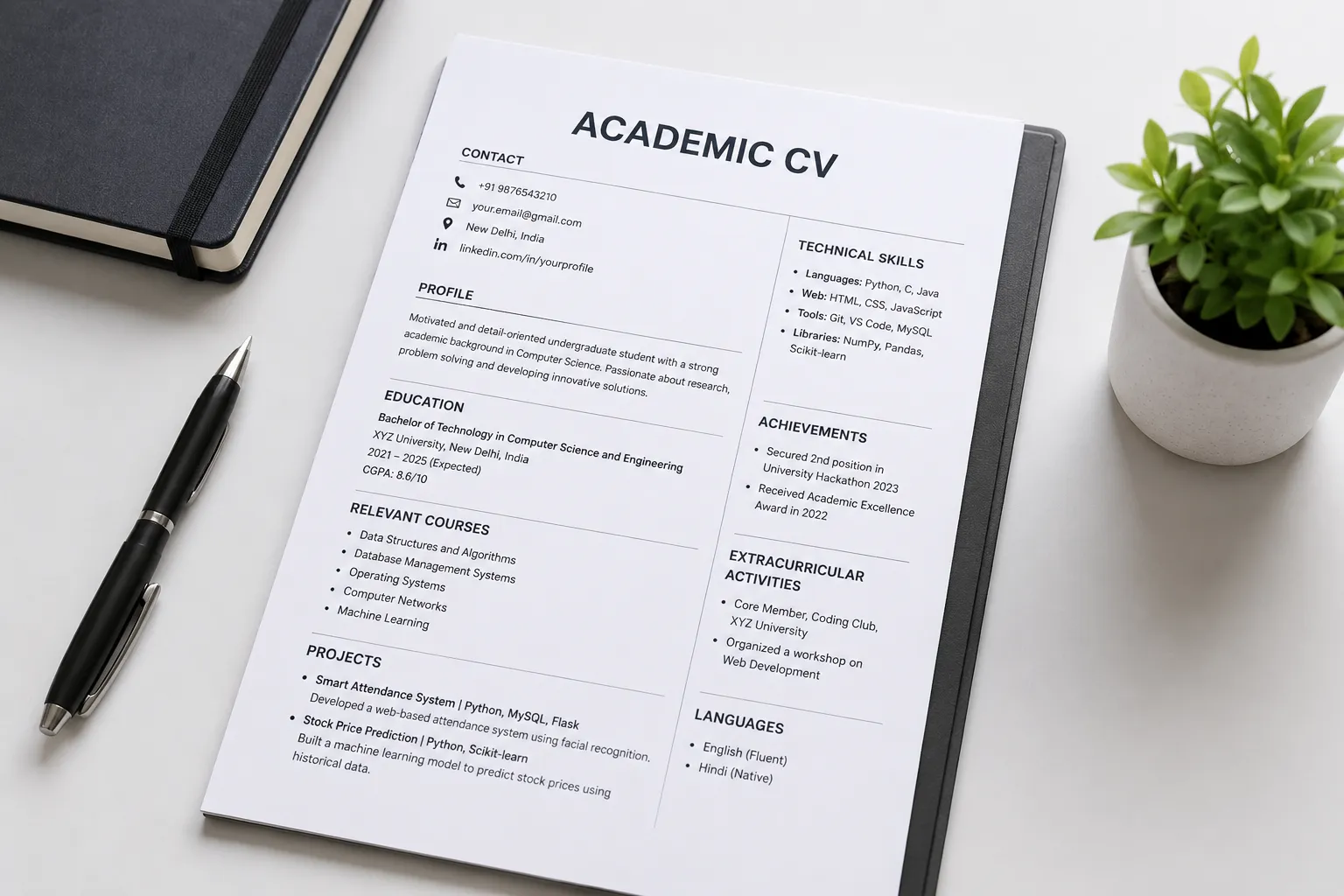
Your academic CV is the one document in a study abroad application that shows an admissions committee, at a glance, what you have actually done. Your SOP explains why you want the course, your recommendation letters give someone else's view, and your CV is the evidence. Yet it is also the document most applicants write last, in a hurry, from an old job resume.
This guide explains how to build an academic CV for study abroad applications: how it differs from a resume, what to include and in what order, before-and-after examples, the mistakes that weaken strong profiles, and a checklist to run before you submit. It is written for Master's and PhD applications abroad, and bachelor's applicants can adapt it by leaning on projects, coursework and leadership.
Academic CV vs Resume: The Critical Distinction
A resume is a short, selective document for a job: usually one page, tailored to a role and built around skills and results. An academic CV is a fuller record of your academic life, covering education, research, publications, teaching, awards and technical skills, arranged so a reader can judge your potential for advanced study.
- Purpose: A resume shows employability, while an academic CV shows readiness for advanced study and research.
- Order: Education and research come first, and work experience comes later.
- Length: An academic CV is usually longer than a resume, but longer is not better. Every line has to earn its place.
- Content: Publications, conference presentations, research projects, lab or software skills and academic awards belong here. Career objectives and hobbies usually do not.
- Audience: The reader is often a professor or a committee member, not a recruiter.
If you are applying for a PhD, your CV also supports your professor outreach, because a supervisor will often open it before replying to your first email.
What Admissions Committees Look for in an Academic CV
Committees read many applications, so your CV needs to answer four questions quickly:
- Does your academic background suit this programme?
- Is there evidence of research or independent project work, even at a small scale?
- Are your claims specific and believable?
- Does the CV agree with your SOP and recommendation letters?
Clear structure and honest detail answer all four. Padding answers none of them.
The Structure of a Strong Academic CV
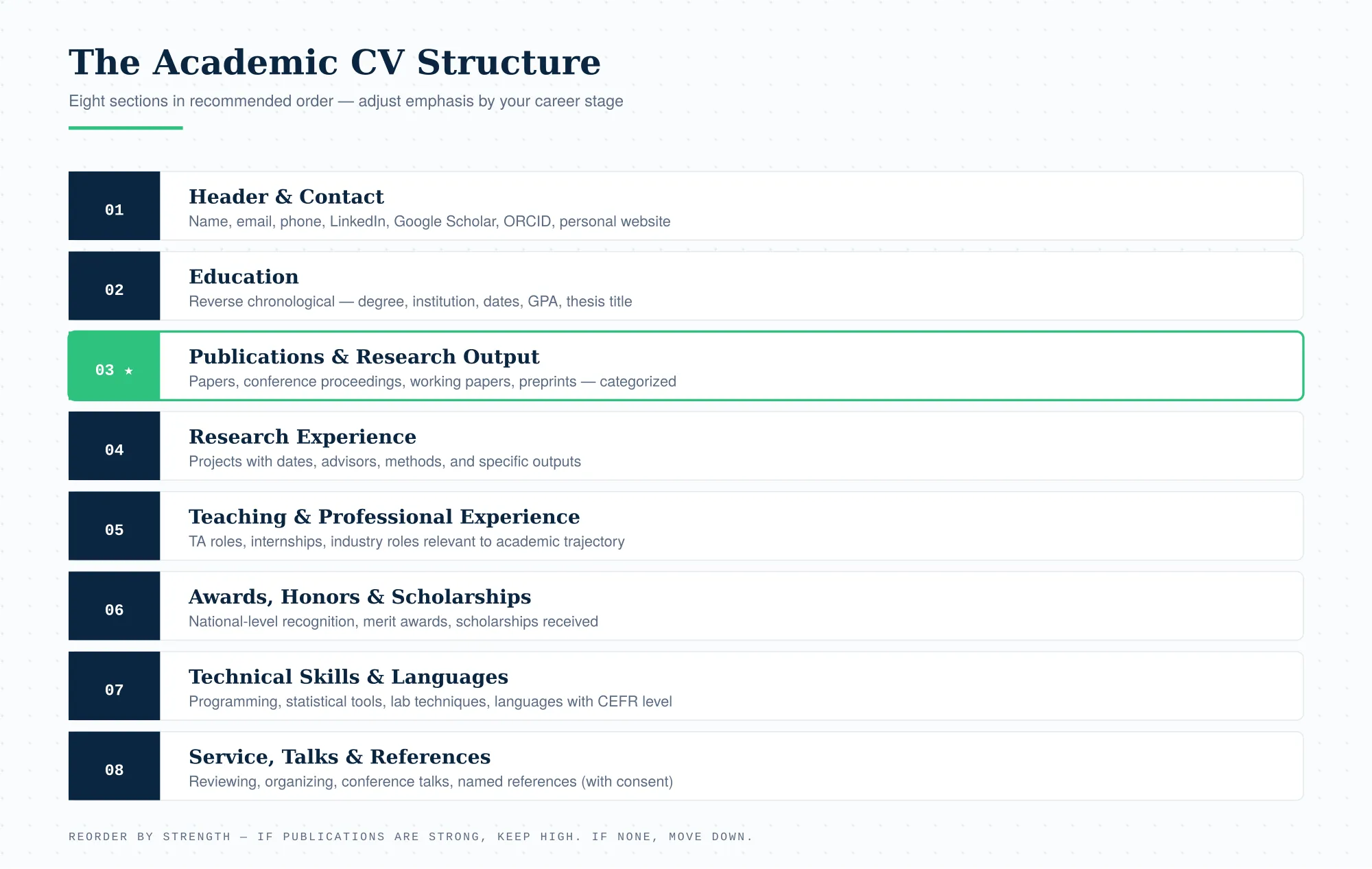
Use the order below for most Master's and PhD applications. Always check the university's own instructions first, because formats and page limits vary by country and programme.
1. Header and contact details
Give your full name, a professional email address, phone number, city and country, and a LinkedIn or ORCID link if you have one.
2. Short academic profile (optional)
Write two or three factual lines covering your field, your strongest area and the direction you want to take. If the application asks for a separate statement, skip this and let your SOP do the work.
3. Education
List degrees in reverse chronological order with the institution, programme, dates and grade or CGPA in the format the university expects. Add relevant coursework, and your thesis or dissertation title and supervisor if you have them.
4. Research experience and projects
This is often the strongest section. For each project, state the title, where and with whom you did it, the dates, the methods or tools you used, and what you produced. A final-year project, a lab placement or a data analysis assignment all count when you describe them precisely.
5. Publications and presentations
List papers, conference presentations and posters in one consistent citation style, with their status (published, accepted or under review). Only list what is real and verifiable. If you are unsure about a journal, read how to verify a journal before submitting, and see what a peer-reviewed paper actually changes in a funded application.
6. Work, teaching and internships
Include only roles that show relevant skills, such as teaching assistance, research internships or industry projects. Keep each to two or three bullet points.
7. Scholarships, awards and honours
List merit scholarships, ranks, competitive fellowships and academic prizes, with the year and the awarding body.
8. Skills
Add technical skills (software, lab methods, programming languages), languages and test scores such as IELTS or TOEFL where relevant. Be honest about your level.
9. References (optional)
Add referee names only if the application asks for them, and tell your referees before you do.
How Long Should an Academic CV Be, and How Should It Look?
For Master's applications, one to two pages is a safe target. For PhD applications, two to three pages is common when you have genuine research or publication history, and longer only if the content justifies it. If the university sets a limit, follow it exactly.
Use one readable font, consistent date formats, clear headings and short bullet points. Avoid colour blocks, skill bars, decorative templates and dense paragraphs. Include a photo only if the country or programme expects one. Save the file as a PDF with a clear name, such as Firstname-Lastname-Academic-CV.pdf.
Academic CV Examples: Before and After
These illustrative examples show how to turn vague entries into specific ones. Replace the details with your own, and never add anything you did not do.
Research project
Before: Did a project on air quality.
After: Final-year project: analysed twelve months of air-quality data from three monitoring stations using Python (pandas, matplotlib) to compare seasonal pollutant trends. Supervised by Dr. [Name]; presented at the department symposium.
Teaching experience
Before: Worked as a teaching assistant and helped students.
After: Teaching assistant, Introductory Statistics (two semesters): ran weekly problem sessions and marked assignments against a shared rubric.
Skills
Before: Good at computers and research.
After: Python (pandas, scikit-learn), R, SPSS; systematic literature review (PRISMA); reference management in Zotero.
The pattern is simple: an action verb, what you did, how you did it, and what it produced.
Common Academic CV Mistakes
- Using a job resume template: Objective statements, photos and skill bars take up space and signal that the CV was not written for academic readers.
- Sending the same CV everywhere: A CV for a data science Master's should lead with different projects than one for a public health PhD. Reorder and trim for each programme.
- Listing duties instead of outputs: "Responsible for lab work" says nothing. Say what you did, with which method, and what came out of it.
- Padding the page: When every certificate and club is listed, the two things that matter get lost. Cut anything that does not support your case.
- Ignoring country and programme norms: A study abroad CV is read differently by each university, and UK, European and US programmes can expect different lengths and ordering, so read each set of instructions.
- Including claims you cannot verify: Overstating a role, listing a paper that is not accepted, or citing a doubtful journal can damage the whole application.
- Contradicting your SOP or recommenders: If your CV says you led a project and your referee calls you a team member, the committee will notice.
- Leaving typos and inconsistent formatting: Small errors suggest the same carelessness in your research.
How Your CV Fits With the Rest of Your Application
Your CV, SOP, recommendation letters and (for research degrees) research proposal should tell one consistent story. Your SOP for studying abroad explains your motivation, your CV provides the evidence, and your letters of recommendation confirm it from the outside.
For a PhD, your CV should also line up with your research proposal for a PhD abroad and with the email you send when you contact a PhD supervisor.
If you are unsure whether your profile is ready, a readiness check before applying can save a full application cycle.
Study Abroad CV Checklist Before You Submit
- It follows the university's format and page limit.
- Education and research appear before work experience.
- Every entry says what you did, how, and what it produced.
- Dates, grades and names match your transcripts and other documents.
- Every publication and reference is real, current and verifiable.
- It is consistent with your SOP and referees' letters.
- Formatting, fonts and date styles are consistent throughout.
- It has been proofread by someone else and saved as a PDF.
Frequently Asked Questions
One to two pages is usually enough, unless the university specifies a limit. Follow the programme's instructions over any general rule.
Yes. Lead with education, projects, relevant coursework, internships, awards and technical skills, and describe each one precisely. Publications strengthen a CV, but they are not required for most Master's applications.
Keep one master CV, then adapt the order, emphasis and length for each programme and country.
Get Your Academic CV Reviewed
An academic CV for study abroad is easy to get almost right and still lose strength: the wrong order, vague entries or a mismatch with the SOP. LiftMyGrade's admissions team works on CVs alongside SOPs and LORs as part of a full application plan built around your target programmes.
Start with the free readiness assessment to see where your profile stands, or read how we work and browse all our services.
We do not promise admission outcomes, only a clearer, stronger and honest application.