
How to Write a Research Proposal for PhD Abroad: Structure, Examples & Mistakes
Your research proposal is the single most consequential document in a PhD application. A weak proposal sinks an otherwise strong profile. A sharp one can attract supervisor interest, unlock funding, and elevate an average academic record.
Most rejections at the PhD level aren't about grades or test scores — they're about proposals that don't demonstrate research thinking. A vague topic. A method that doesn't fit the question. A literature gap that doesn't exist. Or worst, a proposal so generic it could have been written for any department.
This guide walks you through the structure that admissions committees and prospective supervisors actually want to see — and the mistakes that quietly kill proposals.
What a Research Proposal Actually Does
A research proposal isn't a writing test. It's an argument. It argues that:
- There's an interesting, defensible research question worth answering
- The question has a gap in current knowledge that your work would fill
- You have a realistic methodology to actually answer it
- You are the right person to do this work — and this department is the right place
If a reader finishes your proposal without being able to clearly state your research question and why it matters, the proposal has failed — regardless of how elegantly it's written.
The Standard Structure That Works
Most strong proposals follow a recognizable 6–7 section structure. Length varies by country: 1,500–2,500 words in the UK/Europe; 1,000–2,000 in the US (where proposals are often part of the SOP or a separate research statement); 3,000–5,000 in Australia for research Master's and PhDs.
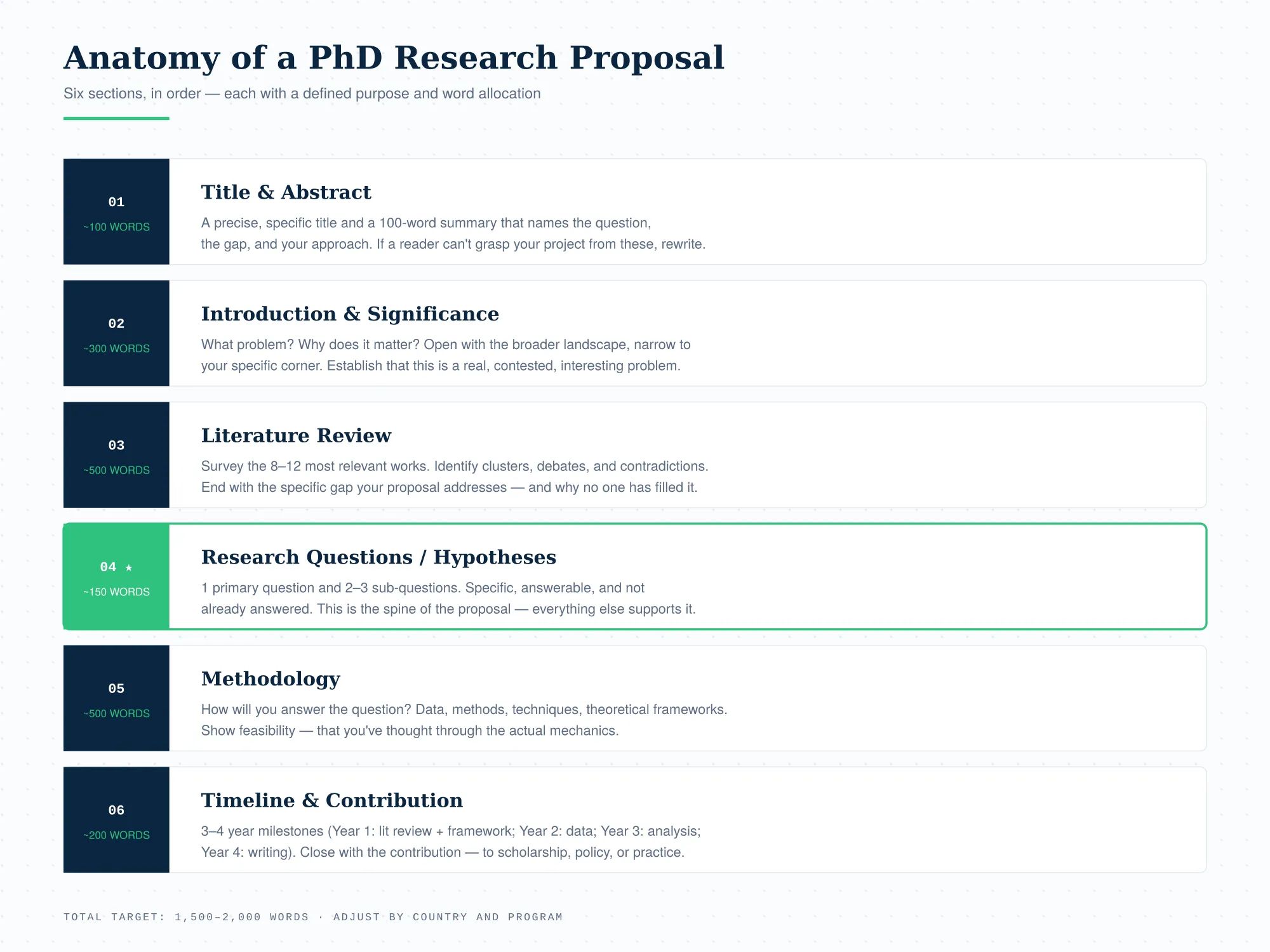
Section-by-Section Notes
The Research Question Is Everything
If you take only one thing from this guide: the entire proposal lives or dies on your research question. A weak question — "I want to study sustainability in agriculture" — kills even an elegantly written proposal. A specific, answerable question — "How do smallholder farmers in semi-arid Karnataka adapt cropping decisions to weather forecast information when access is mediated by extension officers?" — gives every other section something to support.
Test your question with three filters:
- Specific? Could two researchers read it and agree on what's being asked?
- Answerable? Is there a method that could actually produce evidence for or against?
- Original? Has someone published the answer already?
Most rejected proposals fail one or more of these tests.
Literature Review Is About the Gap, Not the Wall
The mistake most students make in the literature review: they write a wall of summaries. "Smith (2018) studied X. Jones (2020) examined Y. Patel (2022) found Z."
Admissions committees don't want a wall of summaries. They want clusters and contradictions. Group works thematically. Show where scholars agree. Show where they disagree. End with the gap your work fills — and make it clear that the gap is real, not invented.
Methodology Must Match the Question
A common failure: ambitious questions paired with methods that can't answer them. If your question is causal ("Does X cause Y?"), you need methods that establish causality — natural experiments, RCTs, instrumental variables. Description alone won't cut it.
Show that you understand the methodological tradeoffs. Acknowledge limitations honestly. Reviewers respect honesty more than overclaiming.
Timeline Signals Realism
A 3-year PhD with "Year 1: do everything, Year 2: write, Year 3: defend" signals naivety. A realistic timeline — with literature work in Year 1, primary data collection in Year 2, analysis and chapter drafting in Year 3, defense in Year 4 — signals that you've actually thought about how PhDs progress.
Country-Specific Differences
- United Kingdom & Europe — Strongest emphasis on a standalone research proposal. Most universities require 1,500–2,500 words. Some (Oxford, Cambridge, LSE) require longer. Methodology and literature review weighted heavily.
- United States — Proposals are often integrated into the SOP or submitted as a separate "research statement." Length 1,000–2,000 words. US committees weight research fit with departmental strengths and supervisor alignment more than UK ones.
- Germany & Netherlands — Often required when applying to specific PhD positions or research groups. The proposal must align with the existing project description on the funder's page. Reading the funder's call carefully is essential.
- Australia — Research Master's and PhD applications usually require 2,000–3,500 word proposals. Strong emphasis on theoretical frameworks and engagement with Australian-relevant research where applicable.
The Mistakes That Get Proposals Rejected
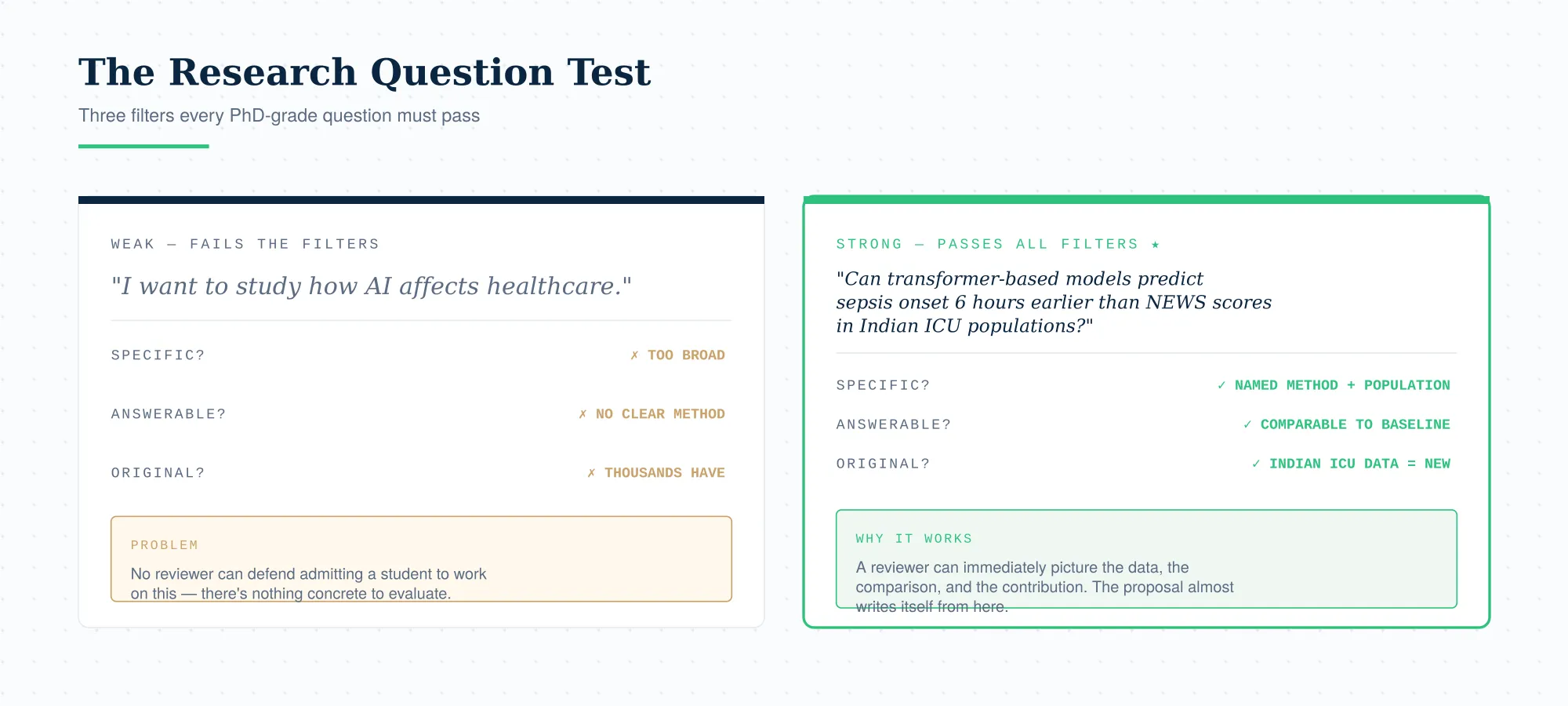
- The "fishing expedition" proposal. "I plan to explore how AI affects healthcare." Too broad to be answered. Specific questions only.
- The "literature is empty" claim. "No one has studied X" — when in fact ten people have, and you didn't read their papers. Reviewers will know.
- Method-first, question-second. Writing a proposal organized around methods you want to use ("I will run regressions") rather than questions that need answering. Method follows question, not the other way around.
- Generic across applications. Submitting the same proposal to five universities without tailoring it to each department's strengths. Detectable, and a signal that you're not committed to that specific program.
- Overstating the contribution. "This will revolutionize the field" — almost never true at the PhD-proposal stage. Modesty about contribution paired with clarity about specifics is far more credible.
- Ignoring your supervisor's work. If you're naming a supervisor in your proposal (which you should), your literature review should engage with their published work. Failing to cite a prospective supervisor's relevant paper is a serious red flag.
How LiftmyGrade Supports Research Proposals
Research proposal development is built into our PhD & Research Abroad pathway. Our mentors work with applicants on:
- Question refinement — moving from broad interest to specific, defensible question
- Literature mapping — identifying the 8–12 works that anchor your gap argument
- Methodology design — matching methods to questions, surfacing tradeoffs early
- Supervisor alignment — tuning the proposal to specific prospective supervisors' active research
- Iteration — most strong proposals go through 4–6 drafts; we structure that process
We don't write proposals for students. We help students develop the research thinking that produces a strong proposal — because that thinking is what they'll need throughout the PhD itself.
Frequently Asked Questions
1,500–2,500 words for most UK and European programs. 1,000–2,000 for US (often integrated with SOP). 2,000–3,500 for Australia. Always check the specific program's instructions — exceeding limits is read as inability to follow guidelines.
Both — and the strongest proposals find genuine overlap. Your proposal should be authentic to your interests AND should clearly connect to the supervisor's active research. If you can't find that overlap, you may be applying to the wrong supervisor.
Yes, often. PhD topics evolve through the first year of coursework, literature deeper-dives, and supervisor conversations. The proposal demonstrates that you can think like a researcher — not that you'll execute exactly that project.
No — for most fields. You need a credible plan for how you'll get data, not the data itself. Some empirical fields appreciate pilot data if you have it, but it's not required.
An SOP tells your story. A research proposal makes a research argument. The SOP is about you; the proposal is about the work. For PhD applications, you typically need both — and they should reinforce each other, not duplicate.
Ready to Develop Your Research Proposal?
A strong research proposal isn't written. It's developed — over months of reading, refining, and testing your question against your literature.
Explore LiftmyGrade's PhD & Research Abroad pathway to see how structured research mentorship turns rough research interests into proposals that get funded offers.
The work starts before the proposal. So should you.