
Why Publishing a Paper is an Added Advantage for Post-Graduate Students Applying Abroad

A peer-reviewed publication on your CV does something that no test score, no GPA, and no extracurricular can do. It tells the admissions committee that you have already operated, even briefly, as a researcher.
That single shift — from "promising student" to "early researcher" — changes how your file is read. For Master's applicants, it can be the deciding factor between an admit and a waitlist. For PhD applicants, it's increasingly the difference between a funded offer and a rejection.
And yet most Indian post-graduate applicants apply without ever attempting publication. They assume it's reserved for elite students, top labs, or people years deeper into their field. None of that is true. This guide explains why publication matters more than students think — and how to actually do it before you apply.
The Credential vs Signal Distinction
Every part of your application sends one of two kinds of evidence: a credential or a signal.
- A credential is a verified attribute. Your GPA is a credential. Your IELTS score is a credential. They prove you cleared a bar.
- A signal is evidence of how you operate. A research project is a signal. A patent is a signal. A publication is the strongest signal a 22-year-old can carry into a post-graduate application.
Credentials get you past the initial filter. Signals decide whether you get admitted, and whether you get funded.
Why? Because credentials are easy to compare and impossible to differentiate. Twenty applicants will have a 9.0 GPA and 320 GRE. One of them will have a publication. The committee remembers that one.
What "Publication" Actually Means for a Post-Graduate Applicant
Most students hear "publication" and think Nature, Cell, or some other journal that takes a decade of postdoctoral work to reach. That's the wrong reference class. For a Master's or PhD applicant, "publication" includes a much broader and more accessible set of venues.
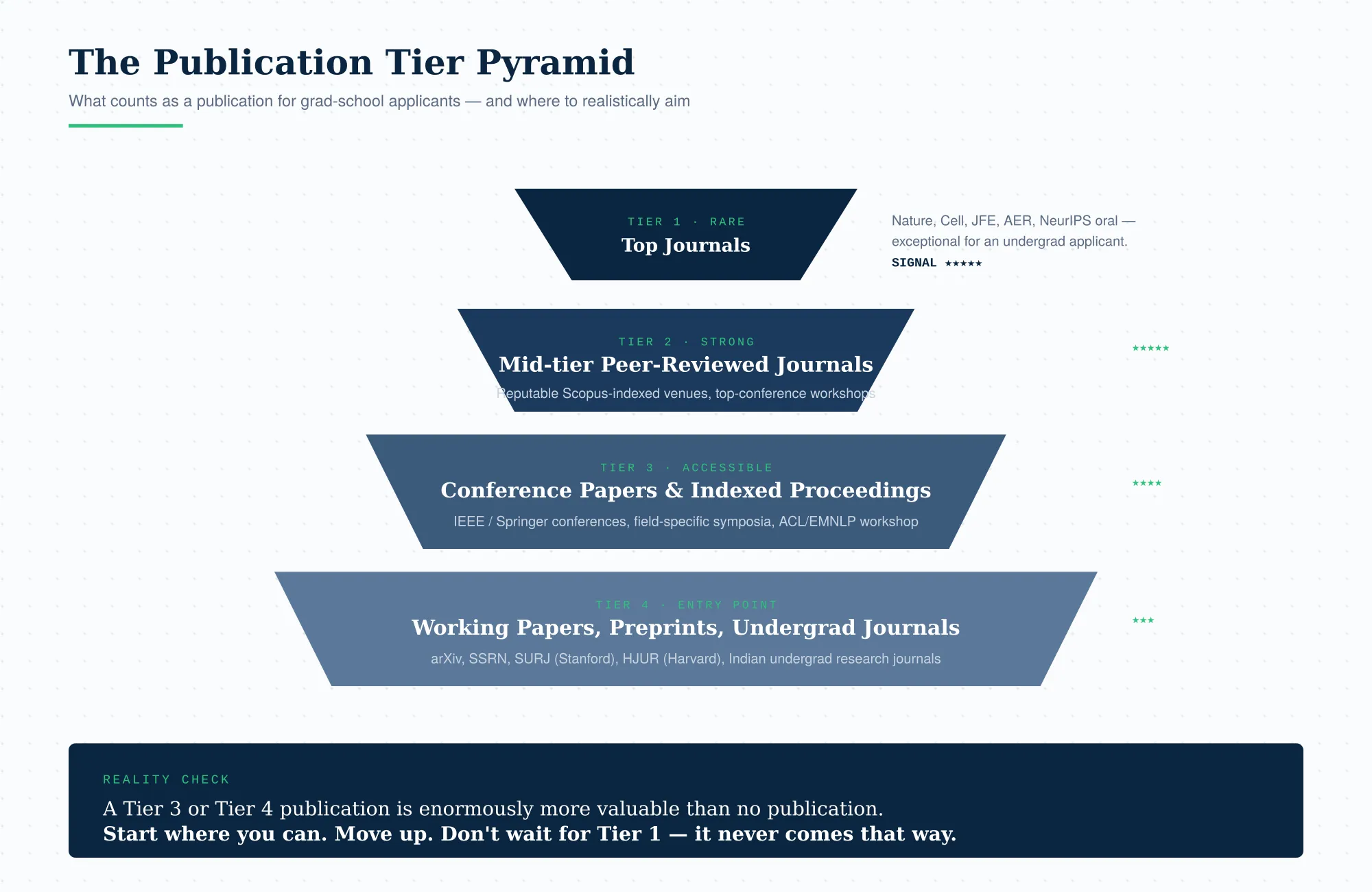
The pyramid is wider at the base for a reason: more students can realistically produce a Tier 3 or Tier 4 publication than they think. The point isn't to land Nature. The point is to publish anything peer-reviewed — because the difference between "no publication" and "one publication" is much larger than the difference between "one publication" and "two publications."
How a Publication Changes Your Application
Specifically, a publication changes how the committee evaluates four things in your file:
- Your demonstrated research ability. Your transcript shows that you can take courses. A publication shows that you can produce knowledge — define a question, design a method, generate findings, defend them through peer review. That's a categorically different signal from coursework performance.
- The credibility of your research statement. When your SOP claims "I want to work on natural language understanding," the committee silently asks: do you actually know what working on it looks like? A publication answers this question before you have to argue it. You don't claim research interest; you evidence it.
- Your fit with potential supervisors. Professors looking for PhD students prefer candidates who've already produced research, however modest. A publication signals that they won't have to teach you from scratch how to think like a researcher. The marginal supervisor effort drops, and so the marginal admission decision tilts in your favor.
- Your scholarship competitiveness. Most major scholarships — Fulbright-Nehru, Commonwealth, DAAD, J.N. Tata — weight research output meaningfully. Two otherwise-equivalent applicants will tilt toward the one with a publication. For PhD-track Master's funded admissions, the effect is even larger.
The Math on Funded Admissions
We don't claim precise numbers — admissions don't publish them — but the directional pattern across LiftmyGrade's PhD-track and competitive Master's applicants is consistent:
- Students with zero publications typically clear initial filters at top programs only when other parts of the profile are unusually strong (GPA, test scores, recommendations from known names).
- Students with one published or working paper clear initial filters meaningfully more often, and funded admission probability roughly doubles in competitive programs.
- Students with two or more publications, especially with one in a recognized venue, become serious candidates for top-funded programs they would otherwise not crack.
The marginal value of publication number two and three is smaller. The marginal value of publication number one is enormous. This is why we tell every serious PhD or research-track Master's aspirant: get the first one.
Where Indian Students Realistically Publish
A non-exhaustive but realistic map of accessible venues for grad-school applicants from India:
- Computer Science / AI / ML: Workshop tracks at NeurIPS, ICML, ACL, EMNLP, KDD; second-tier conferences (PAKDD, ECML-PKDD, ICDM); IEEE/Springer conferences hosted by Indian institutes; arXiv preprints (not peer-reviewed but still valuable).
- Economics / Finance: SSRN working papers; conferences hosted by ISI, IIM, Indian School of Business; undergraduate research journals at top US universities; Royal Economic Society and similar UG-friendly outlets.
- Engineering: IEEE conferences across India; ASME proceedings; Indian Journal of Engineering & Materials Sciences; international symposia where the conference fee covers proceedings.
- Pure sciences: Indian Academy of Sciences journals; symposium proceedings hosted by IISc, IITs; international workshops in your sub-discipline.
- Humanities and social sciences: Undergraduate research journals (SURJ, HJUR, Columbia Undergraduate Research Journal); op-eds in The Hindu, Indian Express; specialized humanities journals that explicitly accept undergraduate submissions.
The point isn't to pick the easiest. It's to pick a venue your supervisor or co-author thinks is legitimate.
A 9-Month Roadmap to Your First Publication
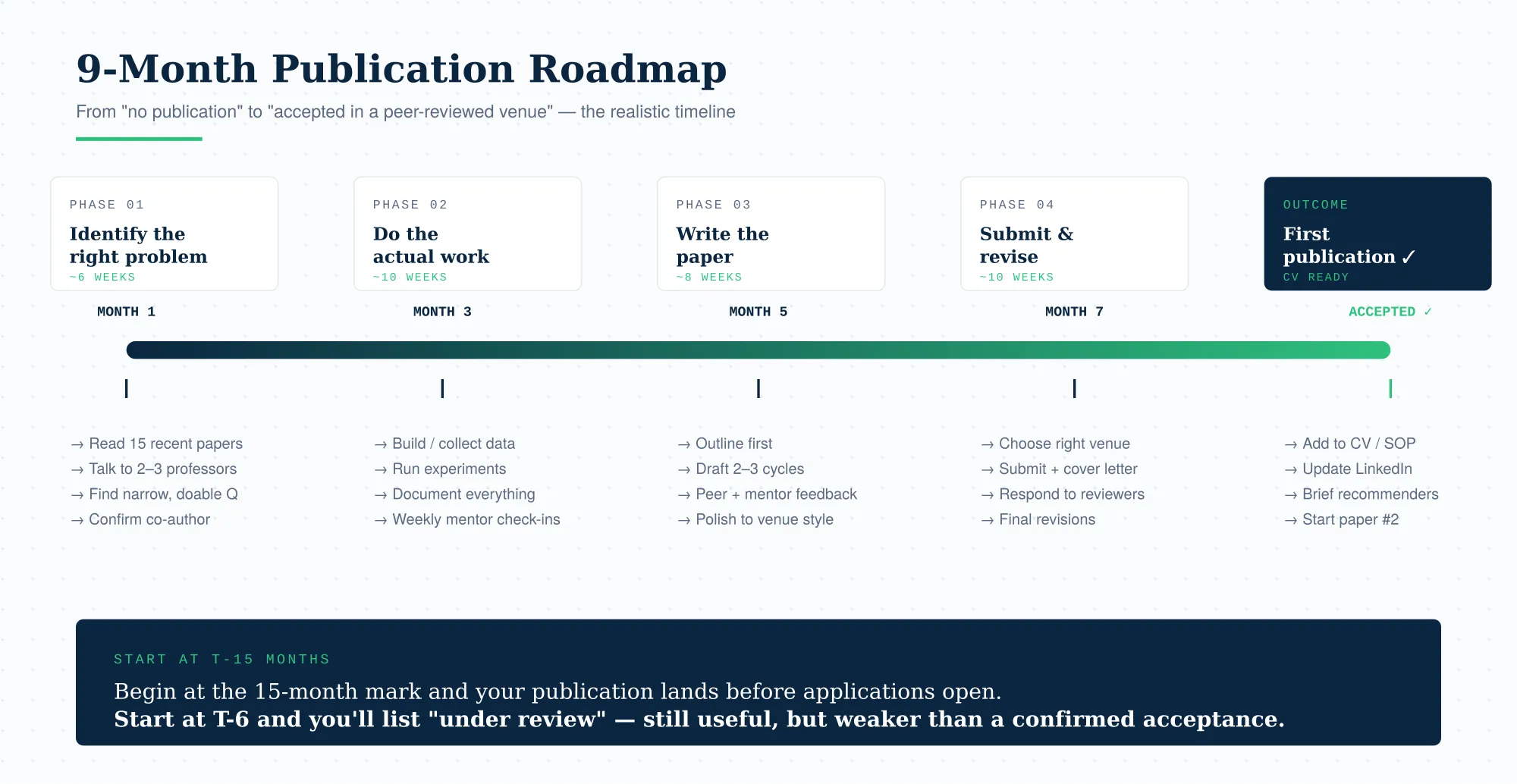
If you're 12–15 months from applying and have no publication yet, here's how to get one:
Talk to 2–3 professors in your department. Find a question that's narrow, answerable with the resources you have, and interesting to at least one professor who'll co-author. Don't try to invent a problem from scratch — work on an extension of existing work.
Run the experiments, gather the data, build the model, write the analysis. Be honest about timelines — research takes longer than you think.
Most undergraduates underweight this stage. Writing is where research becomes a publication. Plan 6–8 weeks for a first draft, peer feedback, and revisions.
Choose your venue based on review timelines. Some conferences review in 2–3 months; some journals take 6+. Plan with that in mind so the result lands on your CV before applications close.
Common Publication Myths to Discard
- "I need to be at IIT or IISc to publish." Wrong. Strong publication output comes from determined students at every kind of institution.
- "My professor won't help me publish." Often false. Most professors will co-author with a motivated student who does the actual work. The barrier is usually that students don't ask, or ask too vaguely.
- "I need a unique, never-explored idea." No. Almost all publishable undergraduate work is an extension or replication of existing research — that's how the system is designed.
- "Indian venues don't count abroad." Indian-hosted venues with international participation and indexed proceedings count fine. Don't snobbishly avoid them.
- "I have to wait until I'm in a Master's program to publish." No. Many top admits at US/UK programs already had publications going into their applications.
How LiftmyGrade Supports Publication Pathways
Publication support is built into LiftmyGrade's Master's and PhD pathways — not as a side service, but as one of the highest-leverage activities a serious applicant can pursue. We work with students on:
- Problem scoping — finding a research question that is publishable, doable in 6–9 months, and aligned with their target field
- Co-author and mentor connections — matching students with researchers who can guide and co-publish
- Drafting and revision support — through structured feedback cycles modeled on how peer review actually works
- Venue strategy — choosing conferences and journals that fit the student's level and timeline
- Publication-to-application bridging — translating the publication into the right framing in SOPs, CVs, and LORs
For students 9–18 months out from applications, this is the single highest-impact thing they can be doing.
Frequently Asked Questions
For coursework-only Master's at mid-tier programs, no — it's a strong advantage but not required. For research-track Master's at top programs, increasingly yes. For funded admissions, it's close to essential. For PhD applications, plan on at least one.
Realistically 6–12 months from problem identification to acceptance, assuming you have a co-author or mentor and the work is doable with available resources. Faster is possible (conference workshops, fast-review venues), slower is common.
Technically yes — arXiv and SSRN don't require co-authorship. But for peer-reviewed venues, having a senior co-author dramatically improves your chances of acceptance and signals stronger credibility on your application.
It still counts. Admissions committees know publishing as an undergraduate is hard. A publication in a respectable peer-reviewed venue is meaningfully better than no publication — and the committee will read it in context.
You can list them as "submitted" or "under review" with the venue named. Most admissions committees count these favorably — they show research in motion. Don't list "in preparation" unless asked specifically; it carries little weight.
Yes, with caveats. A well-written preprint on arXiv or SSRN demonstrates research ability, especially if cited or used by others. It's not as strong as a peer-reviewed publication but is meaningfully better than nothing.
Ready to Build Your Research Profile?
A publication isn't a luxury — it's the single piece of evidence that most cleanly separates strong from average post-graduate applicants. And it's far more reachable than most Indian students believe.
Explore LiftmyGrade's Master's and PhD & Research Abroad pathways to see how publication support, mentor connections, and research profile development come together in one structured ecosystem.
Get your first publication. Everything downstream gets easier.