
He Paid the Fee in March. The Journal Was Delisted by September.
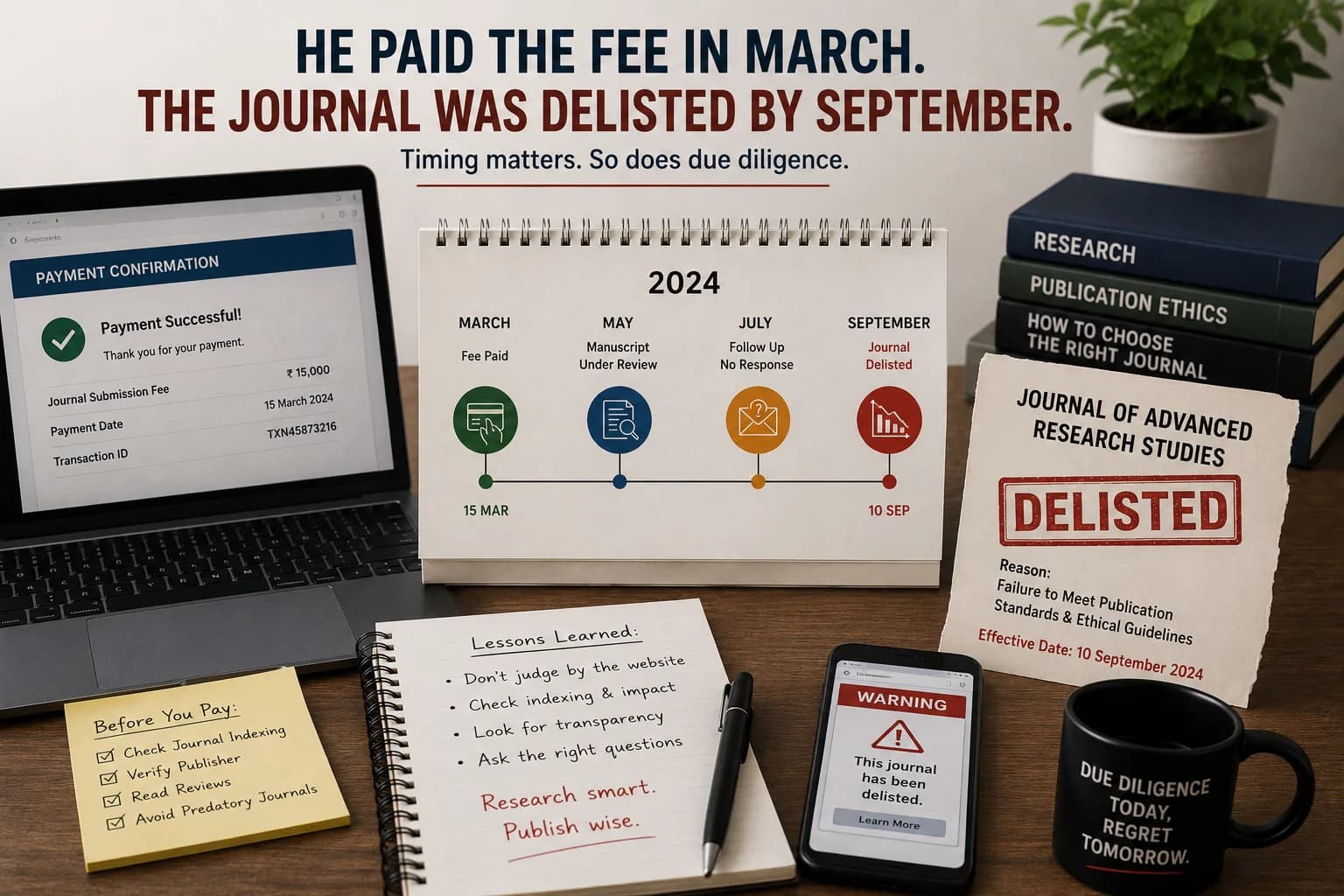
The sequence is familiar to anyone who works with early-career researchers. An email arrives, personally addressed, praising a paper the sender has clearly not read and inviting a submission to a "Scopus-indexed" journal with rapid publication. The fee is substantial but not absurd. The paper is accepted within days. The invoice is paid.
Months later the researcher discovers the title has been discontinued from the index — sometimes after their paper appeared, sometimes before. The money is gone, and the publication now sits on a CV where reviewers who know the field will read it as a judgement error rather than an achievement.
This is avoidable with about forty minutes of checking. Here is the process.
Why this is worse than not publishing
It is worth being blunt about the cost, because applicants often assume a weak publication is neutral.
- Admissions committees and supervisors in your field recognise these venues. They see the same journal names repeatedly across applications from the same regions.
- It signals that you cannot evaluate research quality, which is precisely the skill a research degree is meant to test.
- The paper is effectively unrecoverable. Most legitimate journals will not accept work already published elsewhere, so a manuscript placed in a predatory venue is generally lost.
- Some institutions and funders now explicitly discount or penalise publications in delisted venues when assessing candidates.
A paper in a questionable journal is the one case where research output is worse than no research output. No publication is neutral. A bad one is a data point about your judgement.
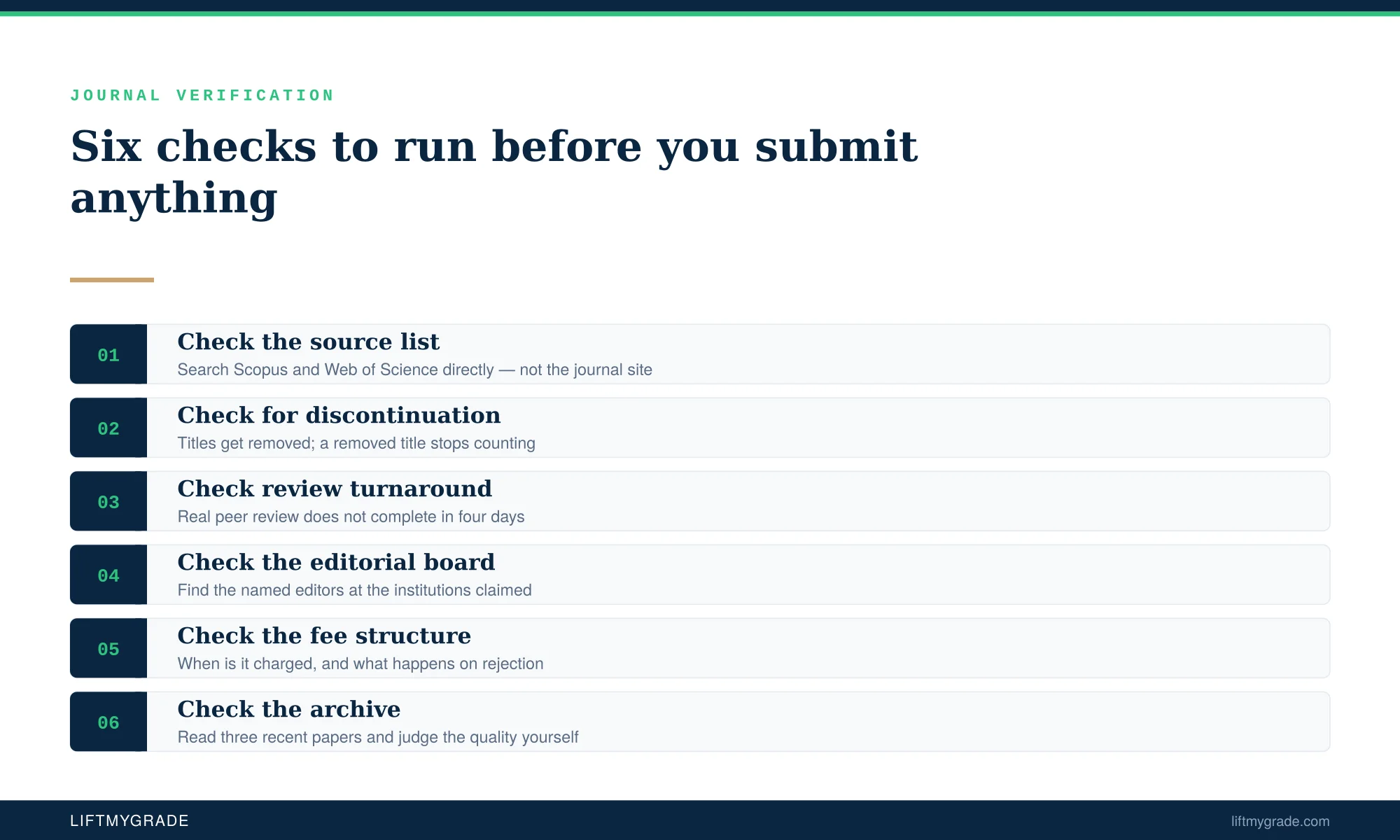
The six checks
1. Verify indexing at the source, not on the journal's website
Journal websites display index logos freely — Scopus, Web of Science, DOAJ, Crossref, and a long tail of invented "impact factor" bodies that exist only to be displayed. Logos prove nothing.
Instead, search the official source lists. Scopus publishes a searchable title list. Web of Science publishes its master journal list. Search by ISSN rather than by title, because predatory publishers sometimes register names that closely resemble legitimate journals.
If the title is not on the official list, it is not indexed, regardless of what the website says.
2. Check whether the title has been discontinued
This is the check almost nobody runs, and it is the one that caught the researcher in the opening paragraph.
Indexes remove titles. Scopus maintains a list of discontinued sources with the reason for removal — publication concerns, metrics anomalies, editorial issues. A journal can be legitimately listed when you first look and removed by the time your paper appears. Check both the current source list and the discontinued list, and check again close to submission.
Note also that removal is generally not retroactive for papers already indexed — but a paper published after the removal date does not get indexed at all. Timing matters.
3. Examine the review turnaround
Genuine peer review requires finding reviewers who are experts, available and willing. That takes weeks before any reading begins.
| Claimed turnaround | What it means |
|---|---|
| 24 to 72 hours | No peer review has taken place |
| 3 to 10 days | Effectively no external review |
| 3 to 8 weeks | Plausible for a well-run journal with an efficient editor |
| 2 to 6 months | Normal across most disciplines |
"Rapid publication" as a headline selling point is a warning sign in itself. Legitimate journals compete on quality and readership, not on speed.
4. Investigate the editorial board
Take four or five names from the board and search for them independently:
- Do they exist, at the institution claimed?
- Does their own publication record match the journal's stated scope?
- Do their institutional pages mention the editorial role?
Predatory publishers routinely list academics without their knowledge, and there have been repeated cases of researchers discovering they were named on boards of journals they had never heard of. A board of plausible names that cannot be corroborated anywhere is a strong negative signal.
5. Understand the fee structure
Article processing charges are entirely legitimate — reputable open-access publishing is funded this way. What matters is how the fee behaves:
- Legitimate: the fee is published clearly, charged after acceptance, and independent of the editorial decision.
- Concerning: a submission fee charged before review, a fee that is negotiable, a fee that appears only after acceptance, or aggressive follow-up about payment.
- Also concerning: invoices from an entity whose name differs from the publisher's, or payment requested to a personal account.
Compare the fee to comparable journals in your field. A charge far below the norm is as suspicious as one far above it.
6. Read the archive
Open three recent papers. You do not need to be a senior academic to notice:
- Uncorrected English throughout, of a kind no copy editor saw
- Figures at unusable resolution
- Reference lists that are thin, or padded with self-citation from the same journal
- A scope so broad that unrelated disciplines appear in the same issue
- Papers whose conclusions do not follow from their results
If the published work is poor, your paper joins it, and readers will assess it in that company.
Additional checks worth ten minutes
- UGC-CARE listing if you are working within the Indian academic system — useful domestically, though limited weight on its own for international admissions.
- DOAJ membership for open-access journals — an imperfect but useful signal.
- COPE membership, which indicates a stated commitment to publication ethics.
- A working DOI on recent articles. Papers without registered DOIs are effectively invisible.
- Whether the publisher exists as a real organisation with a verifiable address, rather than a webform and a Gmail address.
The invitation email
Unsolicited invitations deserve particular scepticism. Genuine journals rarely solicit submissions from researchers with no publication record. Signals in the email itself:
- Flattery about work the sender has clearly not read
- Guaranteed or "assured" publication
- A deadline attached to the invitation
- A named "special issue" with a scope unrelated to your field
- Sender address on a free email domain
- Multiple follow-ups within days
What good journal selection looks like instead
The right order is the opposite of what usually happens. Most researchers write the paper, then look for somewhere to put it, then discover the good options are slow and difficult.
Better:
- Decide the target index and quartile before writing — Scopus Q2, a specific Web of Science category, or a named conference tier.
- Shortlist five to eight journals in that band whose recent issues contain work adjacent to yours.
- Read the aims and scope properly and check recent acceptances rather than the stated remit.
- Write to the venue — length, structure, referencing style, expected depth of literature review.
- Submit to the strongest realistic option first, and treat rejection as routine rather than terminal. A desk rejection in three weeks costs less than a year in a journal that damages your record.
That sequence takes longer. It is also the difference between a line on your CV that opens conversations and one that quietly closes them.
Frequently asked questions
How do I check if a journal is really Scopus indexed?
Search the official Scopus source list by ISSN rather than by title, and separately check the discontinued sources list. Index logos on a journal's own website are not evidence — they are trivial to display and frequently displayed without entitlement.
What happens to my paper if the journal gets delisted after publication?
Removal from an index is generally not applied retroactively to papers already indexed, so an article indexed before the removal date usually remains so. A paper published after the removal date is not indexed at all. Either way, informed readers will note the venue.
Are all journals that charge a publication fee predatory?
No. Article processing charges fund legitimate open-access publishing, including at major reputable publishers. What distinguishes a predatory venue is not the existence of a fee but the absence of genuine peer review, and fee behaviour that is linked to the editorial decision.
Can I withdraw a paper from a predatory journal after publication?
It is difficult and often not possible. Some publishers will not respond to withdrawal requests at all, and others charge for withdrawal. This is why verification before submission matters so much more than remedy afterwards.
How long does legitimate peer review usually take?
Commonly two to four months to a first decision, varying widely by field and journal. A first decision in days indicates that no external review occurred.
Journal shortlisting before you write a word
We shortlist by index and quartile, verify current listing status at the source, and support the manuscript through submission and revision. Our refund guarantee is tied to the booked index and quartile rather than to any specific journal title.
Discuss publication support at liftmygrade.com