
Professor Outreach for PhD Abroad: Email Templates and Strategy That Actually Work

For a funded PhD abroad, supervisor interest before applying is often more valuable than your GPA. A professor who has signaled "yes, this is interesting, please apply" essentially has your back inside the admissions committee. Without that backing, even strong applications get filtered out.
The catch: most students do professor outreach wrong. They send generic emails to dozens of professors, get zero responses, and conclude that outreach doesn't work. It does — when done correctly.
This guide walks you through the strategy that actually generates supervisor interest, with annotated email templates and the specific mistakes that get emails deleted unread.
When Professor Outreach Is Essential (vs Optional)
Whether outreach is required depends on the country and program structure:
- Required: Germany, Netherlands, Sweden, Switzerland, most of Europe. PhD positions are often funded through specific professors' grants — without their interest, your application has nowhere to go.
- Strongly recommended: UK, Canada. Funded positions are limited; professor backing materially improves admission and funding odds.
- Recommended for funded admission: United States. PhD programs admit through committees, but supervisors who have flagged interest carry weight in those committees — especially for research assistantships and fellowships.
- Less common: Australia, parts of Asia. Where outreach culture is less established. Still useful but not always necessary.
If you're applying for a PhD anywhere — outreach matters.
The Strategy: Few, Targeted, Specific
The volume-vs-quality tradeoff in professor outreach is brutal:
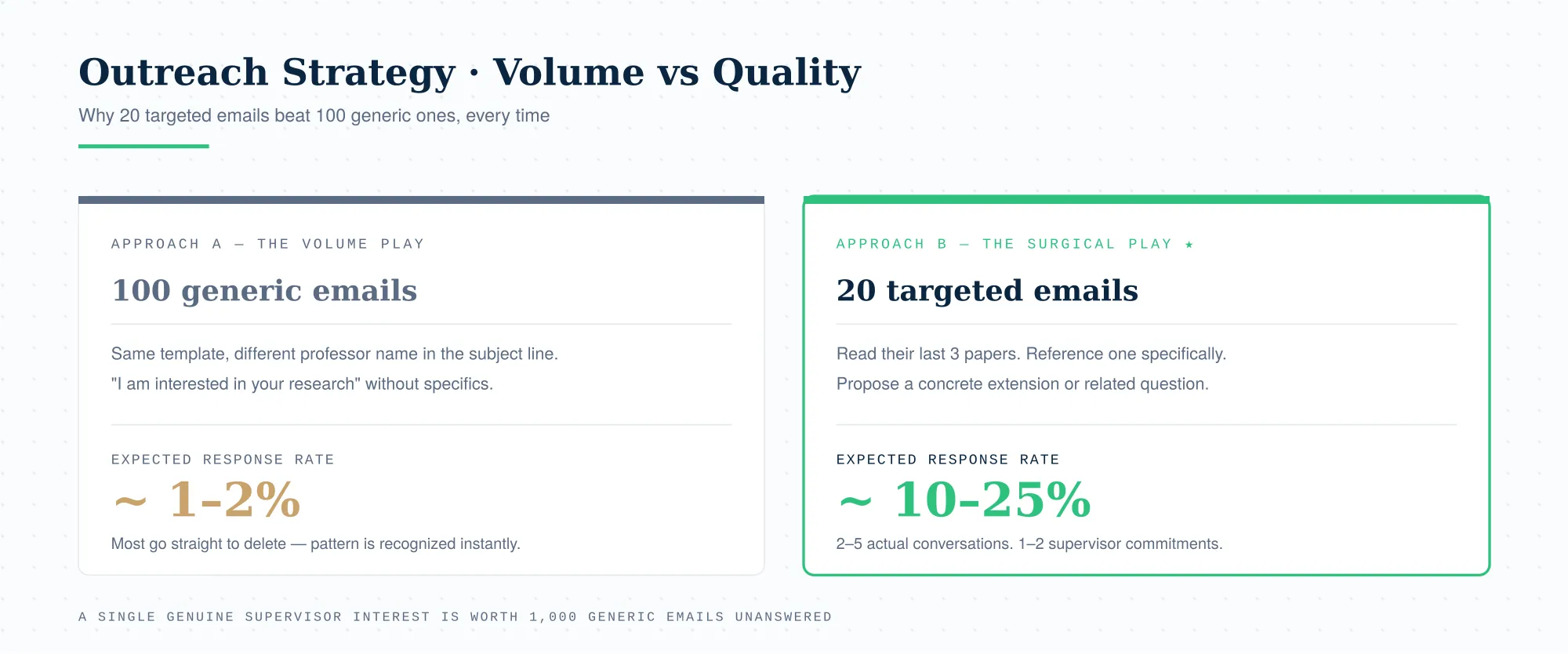
The principle: don't try to impress professors with volume. Impress them with attention.
How to Find the Right Professors
Before writing any email, build a targeted list of 15–25 professors whose recent work genuinely overlaps with your research interests.
- Use Google Scholar, not university directories. Search your topic, then filter by recent years. The professors publishing most actively on your problem are your starting point — not the most senior names.
- Read recent papers (last 3 years), not landmark old ones. A 2002 paper tells you their reputation. A 2024 paper tells you what they're working on now. Outreach should reference the latter.
- Check whether they're taking PhDs. Many professors' websites or lab pages indicate availability. Some explicitly say "not accepting students for 2026 intake." Don't waste an email on a closed lab.
- Look at their last 3 PhD students' destinations. Are they placing students well? Are they finishing? This signals supervision quality — important for both your application and the next 3–5 years of your life.
- Confirm their email is current. Use their official university page, not a profile aggregator. Bounced emails are wasted shots.
The Email Template That Actually Works
Here's a structure that consistently outperforms generic outreach. Keep it under 250 words.
- Subject line: Specific. Not "Prospective PhD student" but "PhD inquiry — extension of your 2024 work on [specific topic]"
- Paragraph 1 — Who you are, in one line. Your current degree, institution, and a one-line credibility marker (publication, research experience, or specific skill).
- Paragraph 2 — Why them, specifically. Reference a specific paper of theirs by title or finding. Show you've read it. Mention what you found compelling or what question it raised for you.
- Paragraph 3 — What you'd like to contribute. Propose a specific research direction that extends or relates to their work. Not "I want to study X with you" — but "I'm interested in whether their finding holds in Y context" or "I'd like to apply this method to the Z problem."
- Paragraph 4 — Logistics. Whether you're applying for the upcoming intake, whether you have your own funding (or are seeking it), and that you'd appreciate a brief response if they have capacity.
- Sign-off. Your name, current affiliation, and a 1-line CV link if you have one (Google Scholar, personal site, or LinkedIn — not a long PDF attachment).
Annotated Example
Notice what this email does: it's specific (cites the paper by venue and finding), it's intelligent (extends the work in a defensible direction), it's brief, and it ends with a low-cost ask ("a few minutes").
What Not to Include
- Don't attach a 4-page CV or research statement to the first email. Both make the email look like a mass send. A link to a public Scholar profile or 1-page CV is sufficient.
- Don't ask "what are you researching?" Their papers tell you. Asking signals you haven't read them.
- Don't flatter excessively. "Your groundbreaking work has inspired me deeply." Reads as filler. Specific engagement beats generic praise.
- Don't talk about your dream of studying abroad. Professors don't care about your dream. They care about your fit with their work.
- Don't ask about funding directly in the first email. Mention you're seeking funding and willing to apply for fellowships, but the funding conversation comes later.
What to Do If You Don't Hear Back
- Wait 2 weeks before following up. A single polite follow-up is acceptable. Two is too many. Three is harassment.
- Move on if no response. Some professors don't read cold emails. Others are on sabbatical. Don't take it personally and don't keep trying.
- Track your outreach. A simple spreadsheet — professor, university, date sent, response, status — keeps you organized across 20+ outreach threads.
- Update your list as you learn. If you read a new paper that changes who you want to work with, refresh the shortlist.
Common Outreach Mistakes That Sink Otherwise Strong Candidates
- Generic salutation. "Dear Sir/Madam" or "To whom it may concern." Use the professor's name. If their preferred title is unclear, "Dear Dr. [Surname]" is safest.
- Wrong professor. Sending an NLP outreach email to a computer vision professor at the same lab. Read the lab page carefully.
- Mass send, single recipient list. If your email leaks signals of being a mass send (typos in the name, irrelevant references to other work), it's done.
- Asking the professor to send you their syllabus or program details. That's not their job. Read the program page.
- Following up aggressively. Multiple follow-ups in a week make you memorable for the wrong reasons.
How LiftmyGrade Supports Professor Outreach
At LiftmyGrade, supervisor outreach is built into our PhD & Research Abroad pathway. Our mentors work with applicants on:
- Supervisor mapping — identifying 15–25 active researchers whose work overlaps with your interests
- Paper reading guidance — what to read, what to cite, what extension to propose
- Email drafting — getting from raw idea to a 250-word email that signals research thinking
- Pipeline tracking — managing 20+ outreach threads without losing track
- Conversation follow-through — what to send after a positive reply (the proposal, the meeting request)
The students who land funded PhD offers almost always have a supervisor backing them before the application is submitted. Building that backing is a skill — and a system.
Frequently Asked Questions
8–10 months before applications. Outreach takes 4–8 weeks of iteration before you have meaningful supervisor interest, and you need time to develop a proposal in dialogue with that supervisor.
Generally yes, but with care. Don't send to two professors in the same lab simultaneously — they'll discuss it. Different departments at the same university is fine.
Excellent — but it's not a guarantee. Their statement is supportive, but admissions still goes through the committee. Continue the conversation, ask about funding sources, and ask whether they'd be willing to write a quick supportive note to the committee if appropriate.
Only if asked. Most professors assume you're talking to others — that's normal. Don't volunteer it unless they raise it.
"Thank you for taking the time to respond. I appreciate your honesty about your current capacity. May I reach out again in future if my work develops further in this direction?" Keeps the door open.
Ready to Build Your Outreach Strategy?
Professor outreach is the single highest-leverage activity in a funded PhD application. Done right, it transforms your application from one of many into one with insider backing.
Explore LiftmyGrade's PhD & Research Abroad pathway to see how mentor-led outreach strategy fits into our broader admissions and funding system.
Find the right supervisor first. The PhD writes itself from there.