
How to Email a PhD Supervisor: The First Three Lines That Decide Whether You Get a Reply
Professors receive a large volume of unsolicited email from prospective students. Most of it is deleted without a reply, and the reason is not rudeness or gatekeeping. It is that the emails are indistinguishable from one another and ask the recipient to do work — to figure out who you are, what you want and whether you are worth ten minutes.
An email that gets answered removes that work. It arrives already legible.
What the recipient is actually deciding
Before writing anything, it helps to understand the decision the professor is making. In the first few seconds they are asking three questions:
- Has this person read anything I wrote? If the email could have been sent to any researcher in the field, the answer is no, and the email is done.
- Can they do something useful in my group? Not "are they brilliant" — can they run an experiment, write code, handle a dataset, do fieldwork, read a language.
- Is there money? In much of Europe, PhD positions are funded posts attached to specific projects. In North America, funding usually comes through the department, an assistantship or the supervisor's grant. Whether a position exists at all is often outside the professor's immediate control.
Every element of the email below exists to answer one of those three questions quickly.
The subject line
The subject line is doing one job: getting the email opened by someone who filters aggressively.
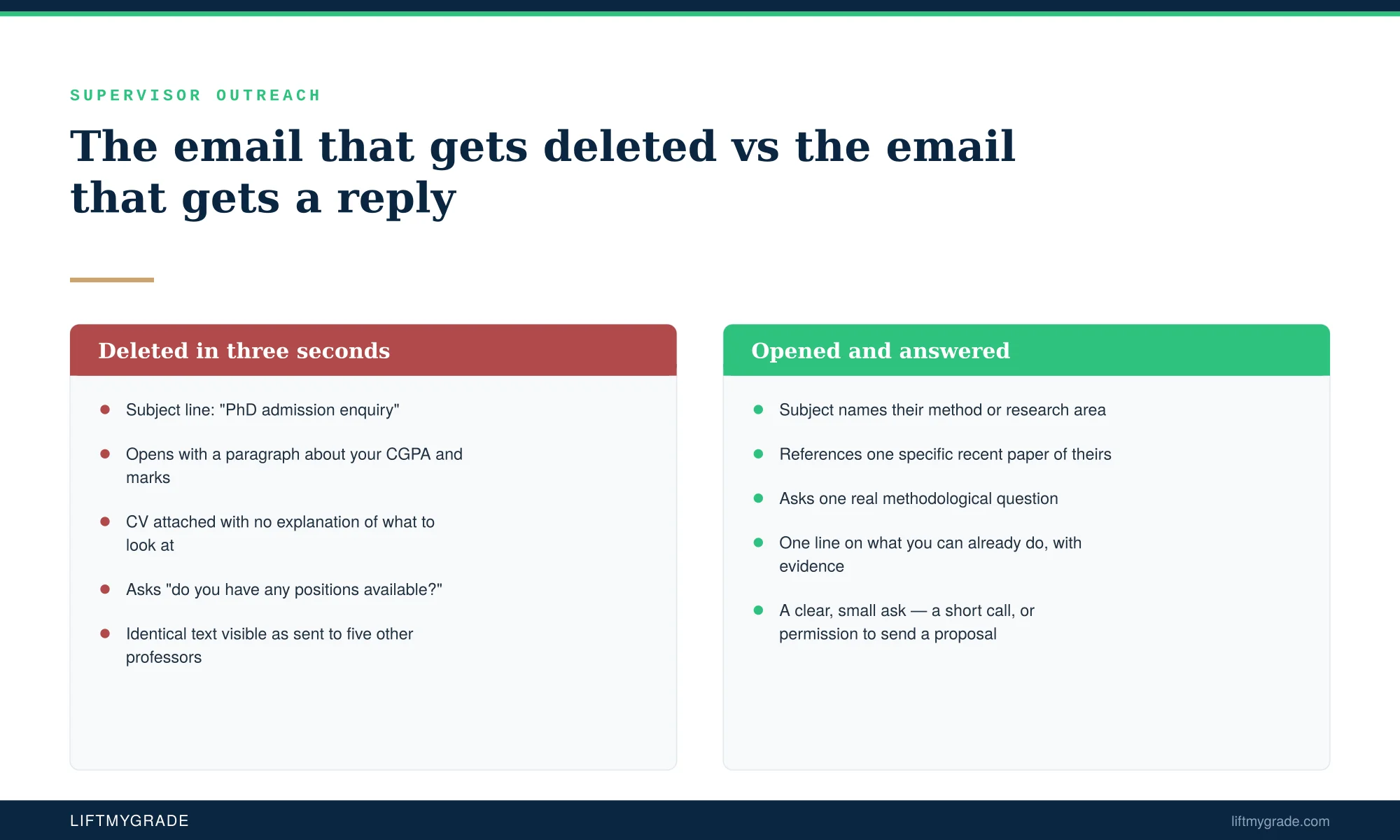
- Weak: "PhD admission enquiry", "Application for PhD", "Regarding PhD position"
- Better: "PhD enquiry — drift-robust models for clinical prediction"
- Also effective: "Question on your 2025 paper on [specific method]"
Naming the research area or the paper does two things. It signals specificity before the email is opened, and it makes the message findable later if the professor wants to return to it. Avoid marking anything urgent, avoid all-capitals, and avoid the word "Sir/Madam" in the subject line entirely.
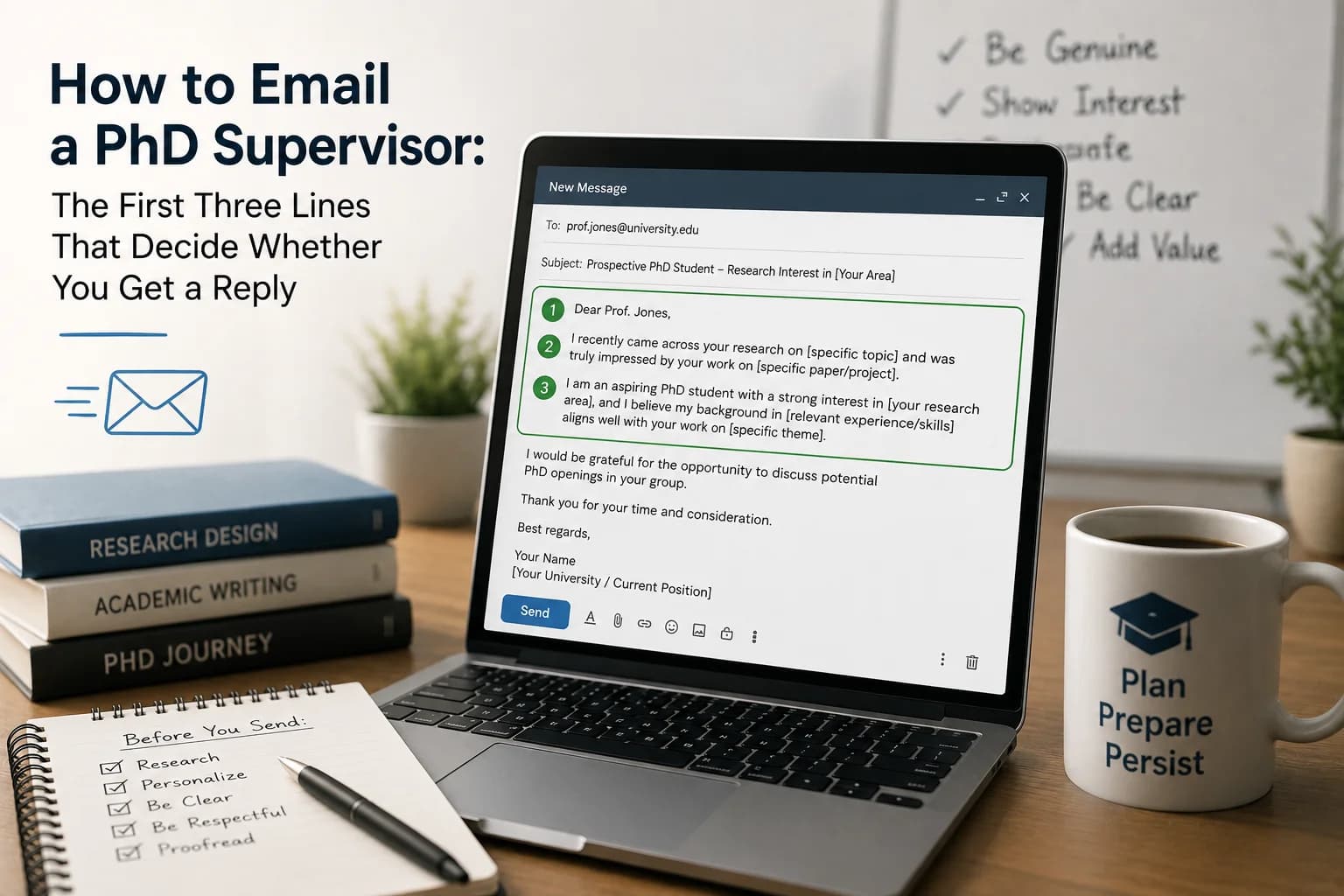
The first three lines
This is the whole email, functionally. Everything after it is supporting material.
Line one — who you are, compressed.
One clause. Degree, institution, current position. "I am completing an MSc in Environmental Engineering at Jadavpur University, where my thesis work is on membrane fouling in decentralised treatment systems."
Line two — the specific thing of theirs you have read.
Name the paper or the line of work, with the year. Then say something that proves you read it — a result that surprised you, a limitation the authors themselves noted, a method you have tried to reproduce. "Your 2024 paper on fouling-resistant coatings reported stable flux over the test period, and the discussion notes that longer-term behaviour under variable influent remains open."
Line three — the question or the connection.
One real question, or one sentence linking your work to theirs. "In my own bench work I have seen recovery drop sharply once influent variability rises, and I am interested in whether the coating chemistry you describe holds under that condition."
That is the email. If those three lines land, the professor now knows you are a real applicant with a real interest and a specific overlap with their group.
What follows
After the three lines, keep it short:
- One line of evidence. "I have run this on a bench-scale reactor for eight months and processed the data in Python." Concrete capability, not adjectives.
- The ask, made small. Not "please accept me as your PhD student." Instead: "If you are taking students for the coming cycle, I would be glad to send a two-page research outline." A small ask is easy to say yes to, and a yes opens the conversation.
- Attachments, named. Attach a CV, and tell them what to look at: "CV attached — the relevant section is the thesis work on page 1." An unexplained attachment is one more piece of work for the reader.
Total length: under 200 words. If it does not fit on a phone screen without scrolling twice, it is too long.
Common mistakes, ranked by damage
| Mistake | Why it costs you |
|---|---|
| Visible mass mailing (multiple recipients, or generic text) | Signals you are not serious about their group specifically |
| Leading with CGPA and percentages | Grading systems do not transfer, and it answers a question they did not ask |
| Flattery about their "esteemed" reputation | Reads as filler and delays the substance |
| Asking about funding in the first email | Premature; funding follows interest, not the other way round |
| Attaching a 14-page research proposal unrequested | Nobody reads an unsolicited proposal from a stranger |
| Following up after two days | Aggressive; academics travel, teach and go quiet for legitimate reasons |
Timing and follow-up
- When to send: mid-week mornings in the professor's time zone are marginally better than Friday evenings. This matters far less than content.
- How long to wait: ten to fourteen days before a single follow-up.
- The follow-up: three lines maximum, forwarding the original, adding one new piece of information — a result, a preprint, a completed module. Never a bare "just following up."
- Second follow-up: don't. One is professional; two is pressure.
- Silence is information. It usually means no funded position, not a judgement on you. Move on and keep the list wide.
How wide should the list be?
Contacting three professors is not a strategy. A workable supervisor list is 15 to 25 researchers across 8 to 12 institutions, built from recent publications in your subfield rather than from university rankings. Rankings tell you about an institution; publications tell you who is actually working on your problem and who has recent funding.
For each name, record: the paper you will reference, the specific overlap with your work, their institution's application deadline, and the date you contacted them. A simple spreadsheet is enough, and it prevents the two failure modes — contacting the same person twice, and missing a deadline while waiting for a reply that never comes.
Where a publication changes the conversation
An applicant with a peer-reviewed paper is having a different conversation from an applicant without one. Not because the paper is prestigious, but because it answers question two — can they do something useful — with evidence rather than assertion. It also gives you a legitimate reason to write: sending a relevant paper of your own alongside a question about theirs is a peer-to-peer opening, not a request.
This is the practical case for building a publication before, not during, a PhD application cycle. It takes months, which is why it has to start well ahead of deadlines.
A good outreach email does not persuade. It gives an already-busy researcher enough specific information to decide quickly, and makes saying yes cheap.
Frequently asked questions
Should I email a professor before or after applying?
For research-based PhDs in Europe, the UK and Australia, contact usually comes first — many positions are attached to a specific supervisor and project. In the US, admission is typically department-level, so a pre-application email is useful for signalling interest but is not usually a prerequisite.
What if the professor replies asking for a research proposal?
That is a strong signal. Respond within a few days with a focused two to four page outline: problem, gap, question, proposed method, feasibility and fit with their group. Do not send a literature review — supervisors are checking whether you can scope a project, not whether you can summarise a field.
Is it rude to contact several professors at the same university?
Contacting two or three researchers in genuinely different subfields is normal. Emailing an entire department is not, and academics in the same building do talk. Keep it targeted and be prepared to explain the overlap if asked.
How do I find professors working on my topic?
Start from recent papers in your subfield rather than from university websites. Search the last two or three years of relevant journals and conferences, note recurring names and check whether their group is currently active and funded. Google Scholar, ORCID and departmental pages fill in the details.
Should I mention that I need funding?
Not in the first email. If the conversation progresses, ask directly and specifically — whether the position is funded, through what mechanism, and for how many years. Funding structures differ enormously between countries, so vague questions get vague answers.
Supervisor mapping and outreach strategy
We build a supervisor list from live publications in your subfield, not from rankings — and draft outreach that references real work. This sits alongside research proposal support and publication assistance, which is rarely offered together with admissions.
Book a free consultation at liftmygrade.com