
Sometimes the Honest Answer Is: Not This Year
Every consultancy has a commercial incentive to tell you to apply now. A client who waits a year is a client who might not come back, and there is always a way to make a rushed timeline sound achievable.
We think the more useful position is the one that costs us the sale when it should. A weak application to a competitive intake does not merely fail — it can make the next attempt harder, because some institutions record previous applications and because a year is lost either way.
Here are the checks that actually decide it.
Nine readiness checks for deciding whether to apply this intake or the next
Check 1 — Do you have a usable test score?
The binding constraint is rarely your ability. It is slot availability. Popular test centres in Indian metros book out weeks ahead in peak season, and a score that arrives after a deadline is worth nothing.
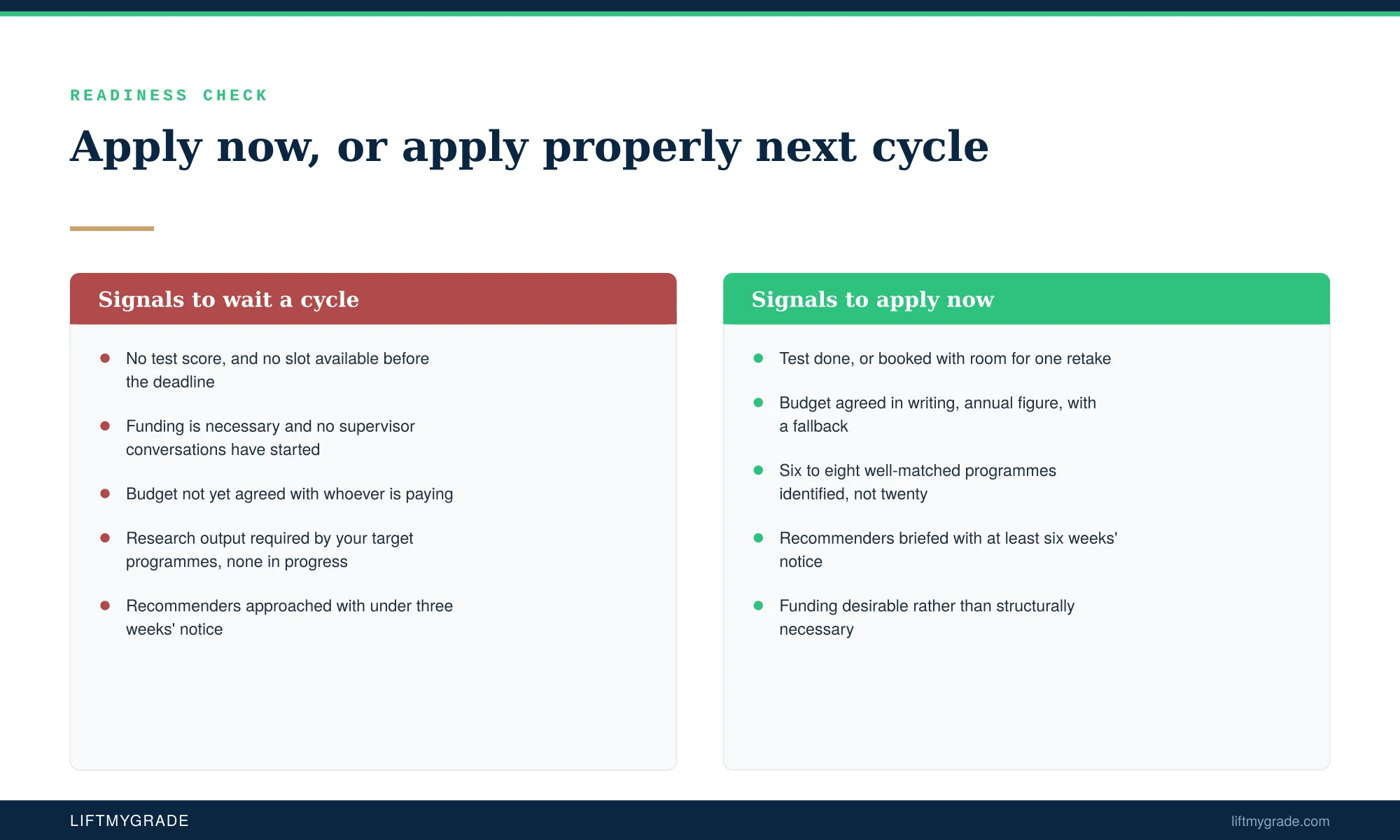
Apply now if: the score is in hand and meets requirements, or the test is booked with enough margin for one retake before the earliest deadline.
Wait if: you have no score, no booking, and the deadline is under three months away. Test first. Everything downstream depends on it.
Check 2 — Has the budget conversation actually happened?
Not "we'll manage." An annual figure, agreed with whoever is paying, covering the full duration and including the upfront financial proof that visas require.
Wait if: the number has never been said out loud. Applications built on an unexamined budget collapse in April when offers arrive, and by then a year has gone.
Check 3 — Is funding necessary or preferred?
If your plan only works with an assistantship or a scholarship, you are not applying for admission — you are applying for a funded position, which is a different and slower process. It requires supervisor outreach, a research proposal, and often research output, and those relationships take months.
Wait if: funding is structurally necessary and no supervisor conversations have begun with under four months to deadlines.
Check 4 — Do your target programmes require research output you do not have?
For PhD applications, funded thesis-based Master's programmes and research-track admissions, a publication or substantive research experience is frequently what separates candidates. And publication cannot be accelerated: writing, review and revision run six to twelve months in most fields.
Wait if: the programmes you want expect research output, you have none, and there is no time to produce it. A year spent producing a paper is not a lost year — it is the year that makes the application work.
Check 5 — Have recommenders been approached properly?
A recommender given three weeks and no brief writes a generic letter. A recommender given six to eight weeks, your CV, the programme list and a reminder of the specific work you did with them writes a specific one, and the difference is visible.
Wait if: your recommenders are unreachable, unwilling, or being asked at short notice for a deadline that is imminent.
Check 6 — Is your programme list actually researched?
Six to eight well-matched programmes, chosen after reading module handbooks and departmental pages, beats twenty chosen from a ranking table. If your list was assembled in an afternoon, it is not a list.
Wait if: you cannot say, for each university on your list, one specific reason it suits your profile that does not apply to all the others.
Check 7 — Is your field decided?
An applicant who is choosing between three unrelated fields writes documents that show it. Admissions committees read for coherence — the through-line connecting what you have done to what you propose to do.
Wait if: the field is genuinely unsettled. Six months of clarity produces a stronger application than six months of drafting around uncertainty.
Check 8 — What does your record look like across semesters?
An upward trend reads very differently from a flat or declining one. If you are mid-degree with weak early semesters, finishing strongly and applying with the full record can materially change how the file reads.
Consider waiting if: your final semesters will substantially improve the picture, or if a backlog is pending clearance.
Check 9 — Is there a hard external deadline?
Sometimes there is a genuine reason not to wait — a scholarship with an age limit, a family situation, a visa or employment constraint, a job offer contingent on the qualification. These are real and they change the calculation.
Apply now if: waiting carries a specific, identifiable cost beyond the twelve months themselves.
Note that "I want to get on with my life" is a legitimate reason, but it is a preference rather than a deadline. It should be weighed against the cost of a weak cycle, not treated as settling the question.
What a well-used waiting year contains
The argument against waiting is usually that a year is wasted. It is only wasted if it is empty. A year that changes the outcome contains most of these:
- The test, done early and properly, with a retake if the first score is marginal.
- A publication or substantive research project, started immediately, for anyone targeting research programmes.
- Relevant work experience, which strengthens both applications and later employability.
- Supervisor relationships, built over months rather than requested in a week.
- Language study, if the destination requires it for employment.
- The financial plan, made concrete — savings, loan sanction, blocked account or GIC arrangements understood in advance.
- A properly researched programme list, built from module handbooks and recent publications.
An applicant who does those seven things arrives at the next cycle as a materially different candidate. That is the honest case for waiting, and it is a strong one.
What waiting does not fix
Symmetry matters here. A year does not help if:
- The plan is unchanged and the year is spent waiting rather than working
- The underlying issue is eligibility — a hard cutoff or a missing prerequisite that a year does not address
- The budget problem is structural rather than temporary
- The delay is really avoidance of a decision about the field
How to decide
Take the nine checks above. Count how many currently sit on the "wait" side.
Zero to one check on "wait":
Apply this cycle.
Two to three checks on "wait":
Apply, but narrow the list aggressively and fix the weak areas first.
Four or more checks on "wait":
The honest recommendation is the next intake, with a written plan for the intervening months.
If you would like that assessment done properly rather than self-administered, it is what the free roadmap is for — and if the answer is "not this year," that is what the document will say.
Frequently asked questions
Does taking a gap year hurt my application?
A gap that is explained by substantive activity — work, research, publication, language study, a professional qualification — is neutral to positive in most admissions systems. An unexplained gap invites questions. What matters is what the year contained, not that it existed.
Is it too late to apply for the coming Fall intake?
It depends chiefly on your test status and your funding requirement. With a valid score in hand and no funding dependency, a compressed cycle is workable. Without a test score, or where a funded research position is essential, the timeline usually does not hold.
Will universities know I applied and was rejected before?
Many institutions retain application records, and some ask directly whether you have applied previously. This is normally not held against you provided the second application shows genuine development — a better score, new research output, a clearer direction.
Can I apply now and defer if I get in?
Some universities permit deferral and many do not, and scholarship offers are frequently non-deferrable even when admission is. Never treat deferral as a fallback without written confirmation from the specific institution.
How do I use a waiting year most effectively?
Prioritise by what your target programmes actually weigh. For research programmes, a publication and supervisor relationships come first. For taught programmes, relevant work experience and a properly researched shortlist matter more. Sit the test early regardless.
An honest read on where you stand
The free roadmap covers profile, admission, research and career, with a dated plan and the constraints stated plainly. If the assessment is that you should target the next intake, that is what it will say — and it will come with a plan for the months in between.
Start the readiness form at liftmygrade.com