
What Should Be Your Long-Term Motivation for Studying Abroad? (And Why Admissions Committees Can Tell)

Most students answer the "why study abroad" question without ever having properly asked it of themselves. They have an answer ready — better universities, global exposure, career opportunities — but it's a borrowed answer. Something they've heard in a counsellor's office, in a YouTube video, in a friend's SOP.
Admissions committees, who read tens of thousands of these statements, can tell the difference between a borrowed motivation and a genuine one within a paragraph. And so can life. Students with weak underlying motivation drift through their Master's, regret their PhD, or return home five years later wondering what it was all for.
This guide is about getting the foundation right — before you write the SOP, before you choose the country, before you commit two years of your life and ₹50 lakh of your family's savings.
Why Motivation Matters More Than Most Students Think
The decision to study abroad is one of the largest decisions of your twenties. It compounds across:
- A decade of career trajectory — your degree shapes what jobs you can take, where, and at what salary
- Where you build your life — the country you study in is often the country you settle in
- Your relationships and network — the people you meet shape your worldview, your spouse, your professional circle
- Your family's financial position — for most middle-class Indian families, this is the largest investment outside a house
A decision this large made on shallow motivation produces shallow outcomes. A clear, examined motivation produces a degree that pays off — financially, professionally, and personally — for the next 30 years.
This isn't abstract. It's why some students return from abroad transformed and others return restless and unsure what it was for.
The Five Wrong Motivations
These are the motivations that sound reasonable but consistently lead to regret. They almost always sit on the surface of student answers. They're worth naming because if any of them is your primary reason, the rest of this guide is more useful than the next college brochure.
- "My parents want me to go abroad." A real motivation for your parents, not for you. Two years in, when courses are hard and the weather is cold, parental approval doesn't get you out of bed.
- "Everyone in my batch is applying." Peer pressure dressed up as ambition. The fact that 40 of your classmates are going to Canada is not a reason for you to go to Canada.
- "I want to escape India / my city / my family." Sometimes legitimate, often not. Escape is a push motive, not a pull motive. It doesn't tell you where you should go — only what you're running from. And what you're running from usually arrives in your suitcase.
- "The brand name will help my career." Partly true, mostly overstated. A Stanford brand opens doors. A Carleton or Coventry brand mostly doesn't. If brand is your primary reason, you'll be disappointed by the actual prestige spread.
- "I want PR / settlement abroad." This is closer to a real motivation but is rarely sufficient on its own. PR-only students often struggle in coursework that doesn't matter to them, and end up in jobs that meet the immigration criteria but not their interests.
The Five Real Motivations That Hold Up Over a Decade
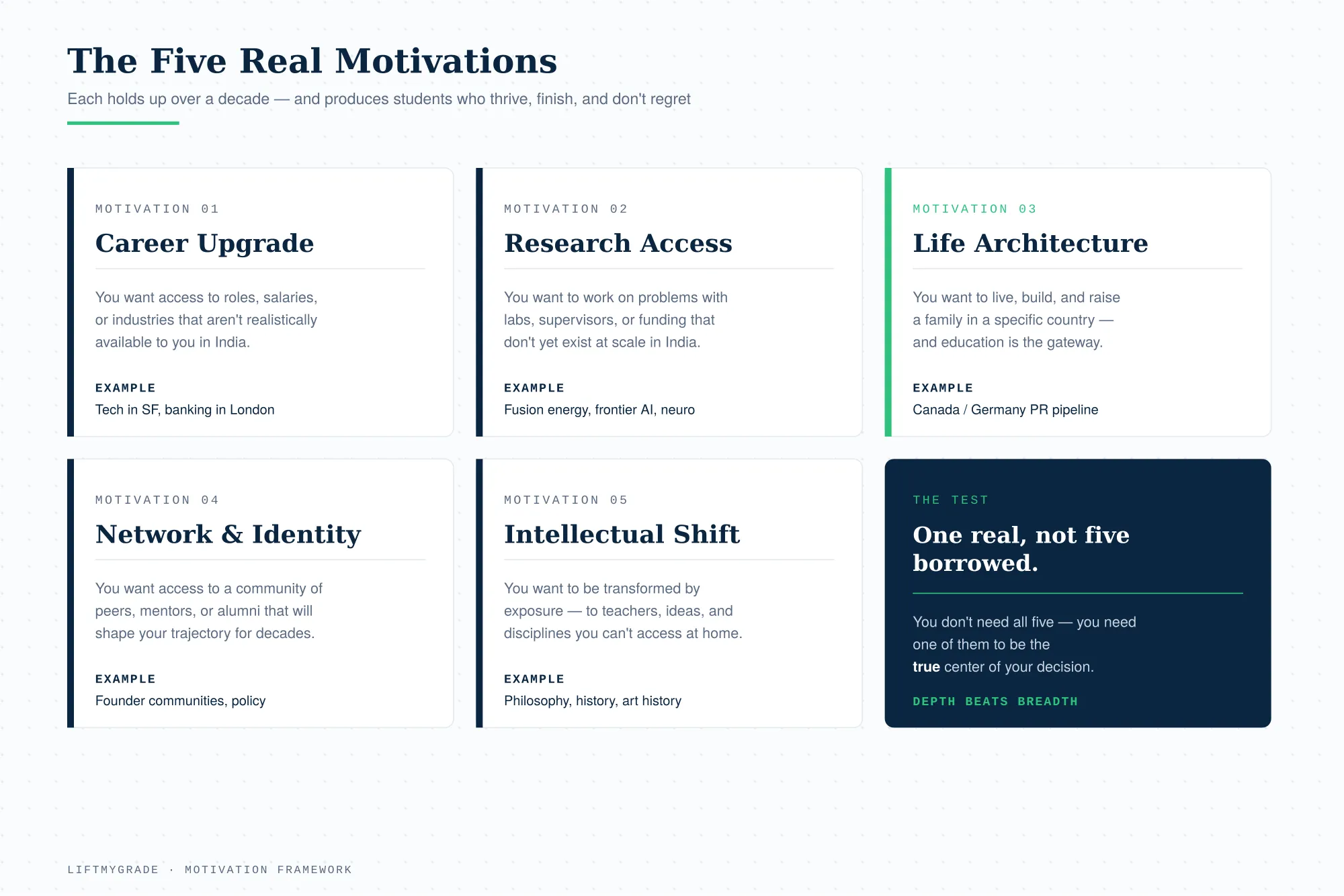
These are motivations that consistently produce students who finish, thrive, and don't regret. You don't need all five — but you need at least one of them to be the true center of your decision.
Each of these is a pull motivation — something specific that drawing you toward a future. Notice that none of them require pretending. They're all true things a 21-year-old can honestly want.
The 10-Year Question Test
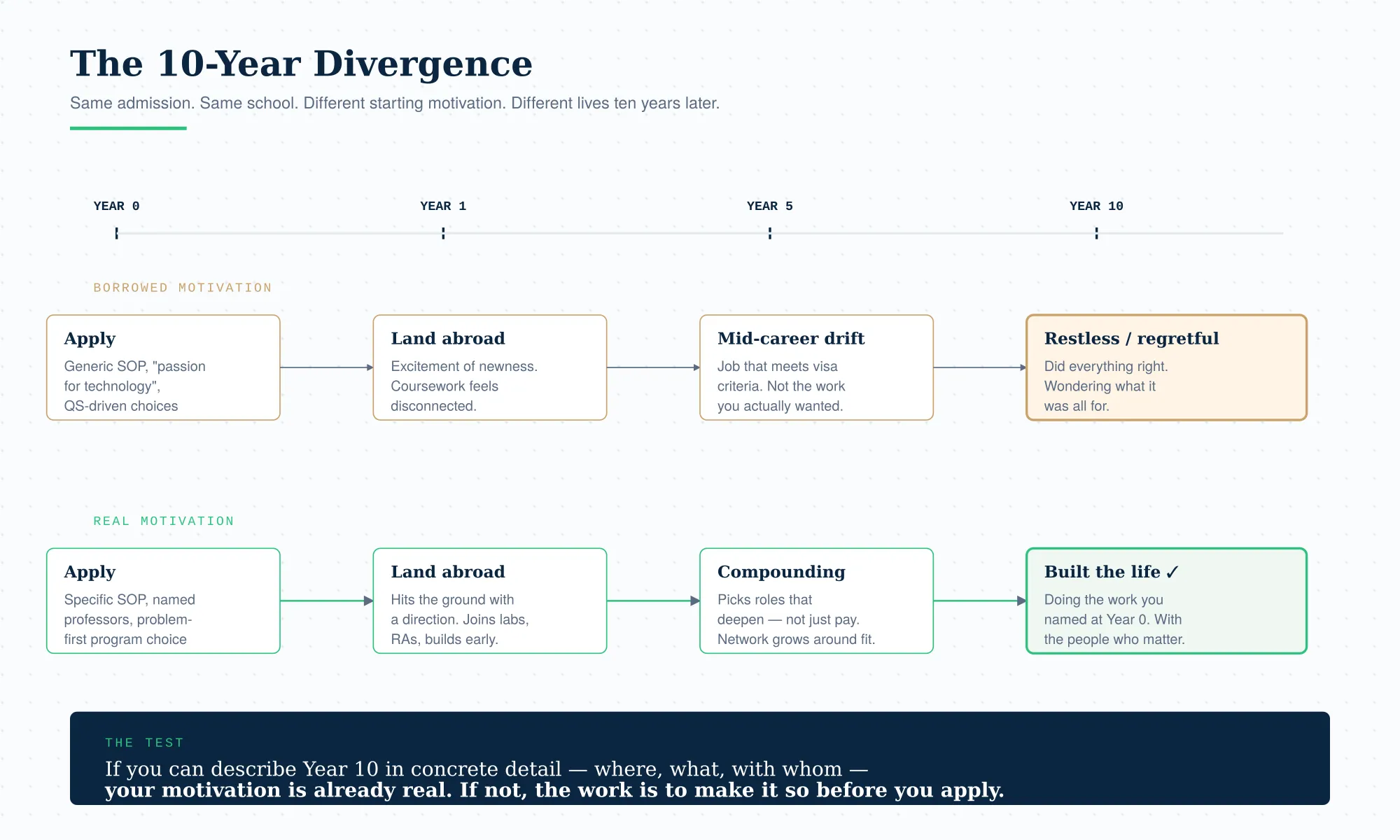
Here's a test that cuts through borrowed motivation faster than any other:
Imagine yourself ten years from today. You did everything right. The Master's worked out, the visa came through, the job happened. What does your life actually look like?
Be specific. Where do you live? What does your work look like? Who are the five people you spend the most time with? What problem are you spending your days on?
If your answer is vague — "I'll be successful, have a good job, be settled" — your motivation is borrowed. You can't visualize because you haven't actually wanted this; you've absorbed it.
If your answer is specific — "I'll be a researcher at a fusion startup in Boston, married, working on plasma confinement, with my parents visiting twice a year" — your motivation is yours. Even if some of those details turn out wrong, you have a real direction.
The 10-year test is what admissions committees are doing when they read your SOP. They're checking whether you can see your own future. Students who can are easier to admit because the school can see how they fit into the program.
How Motivation Shows Up in Your SOP — and How Committees Read It
Strong motivation doesn't appear in the SOP as a sentence that says "I am motivated." It appears in three subtler places:
- The specificity of your future goals. "I want to work in tech" reveals borrowed motivation. "I want to work on inference optimization for LLMs at companies like Cerebras or Anthropic" reveals real motivation. The specificity is the signal.
- The internal logic of your past choices. Strong motivation makes your past coherent — the internship you chose, the courses you optimized for, the projects you built all point toward the same destination. Borrowed motivation produces a CV that reads like a checklist.
- The selectivity of your program choice. Students with real motivation pick programs based on supervisor research, course curriculum, and research centers. Students with borrowed motivation pick based on QS rankings.
How to Develop Real Motivation (If You Don't Have It Yet)
This is the part nobody tells students. You don't have to already have real motivation — you can develop it. But it takes a specific kind of work.
- Read the field. If you say you want to do a Master's in AI, can you name five researchers whose work you respect and why? Five papers from the last two years that excited you? If not, you don't yet want AI — you want the idea of AI. Read more, then revisit.
- Talk to people 5 and 10 years ahead of you. Find 4–5 people who did what you're considering doing, 5–10 years ago. Ask them what their life looks like now, what they wish they'd known, what they'd do differently. Real motivation usually shows up after these conversations, not before.
- Try the work, in miniature. Want to do a Master's in policy? Volunteer at a think tank for 6 months. Want to do PhD in NLP? Reproduce two recent papers. Most "I want to do X" dissolves on contact with the actual work — which is good information.
- Sit with the alternative. What if you didn't go abroad? What would you do instead? If you can produce a meaningful answer, you're choosing abroad freely. If you can't, you're choosing it by default.
How LiftmyGrade Surfaces Real Motivation
At LiftmyGrade, we don't take "I want to study abroad" at face value. Our intake process specifically works to surface the real motivation underneath — through structured conversation, profile mentoring, and 10-year visualization. We work with students on:
- Motivation diagnostics — identifying which of the five real motivations sits at the center of your decision
- Country and program alignment — matching your motivation to the destinations that actually deliver it
- SOP narrative development — translating real motivation into specific, evidenced statements
- Long-term outcome planning — building toward the 10-year version of you, not just the next admission
- Honest profile mentoring — including telling students when "now" isn't the right time
The students who do this work upfront write better SOPs, choose better programs, and arrive abroad with a clarity that compounds for the next decade.
Frequently Asked Questions
Not wrong — but rarely sufficient on its own. Students with PR as their only motivation often struggle with coursework that feels purely instrumental. Pair the PR motivation with something specific you want to do once you're there, and it holds up much better.
Yes, and it often does. Many students start with "career upgrade" motivation and shift toward "research access" or vice versa after first-semester exposure. What matters is that your initial motivation is real enough to get you through the first year.
By being specific instead of general. Instead of "I'm passionate about technology," name the specific problem you want to work on, the researchers whose approach you admire, and the role you see yourself in 5–10 years out. Specificity is what makes motivation believable.
Have the honest conversation now, not after admission. If you go reluctantly, you'll resent it later. If parents are paying significantly, they get input — but they don't get to make the choice for you. A delayed application by 6–12 months while you figure this out is better than a wrong choice you live with for a decade.
Yes — most strong applicants do. But there's usually a primary one that organizes the others. When you write your SOP, lead with the primary motivation and let the secondary ones support it.
Ready to Find Your Real Motivation?
Studying abroad is too large a decision to make on borrowed reasons. The students who get the most from it are the ones who did this thinking before they applied.
Explore LiftmyGrade's academic pathways — Bachelor's, Master's, and PhD — to see how structured profile mentoring, SOP development, and long-term planning work together as one ecosystem.
Build a degree around your real reason. The rest follows.