
How to Write a Winning SOP for Studying Abroad: Structure, Examples & Mistakes to Avoid

Your Statement of Purpose is the only place in your application where the admissions committee hears you in your own voice. Your transcripts show what you did. Your test scores show how you performed. Your recommendation letters show what others think of you. The SOP is the one document where you make your own case.
That's why a weak SOP can sink an otherwise strong profile — and a sharp SOP can lift an average one into the admitted pile.
This guide breaks down how to write one that actually works, with structure, examples, and the mistakes that most Indian applicants keep repeating.
What an SOP Is — and What It Isn't
An SOP is NOT:
- An autobiography of your life from school days
- A list of every achievement you've ever had
- A flattering essay about how great the university is
- A creative writing piece full of metaphors and quotes from famous people
An SOP IS:
- An argument for why you, specifically, should be admitted to this program, specifically
- A story that connects your past (what you've done), present (why you're applying now), and future (what you want to do)
- Evidence — concrete, specific, and verifiable — of your readiness for the program
If your SOP could be submitted to a different university by simply changing the name, it's not a real SOP. It's a template.
The Five-Part Structure That Works
Most strong SOPs follow a recognizable five-part structure.
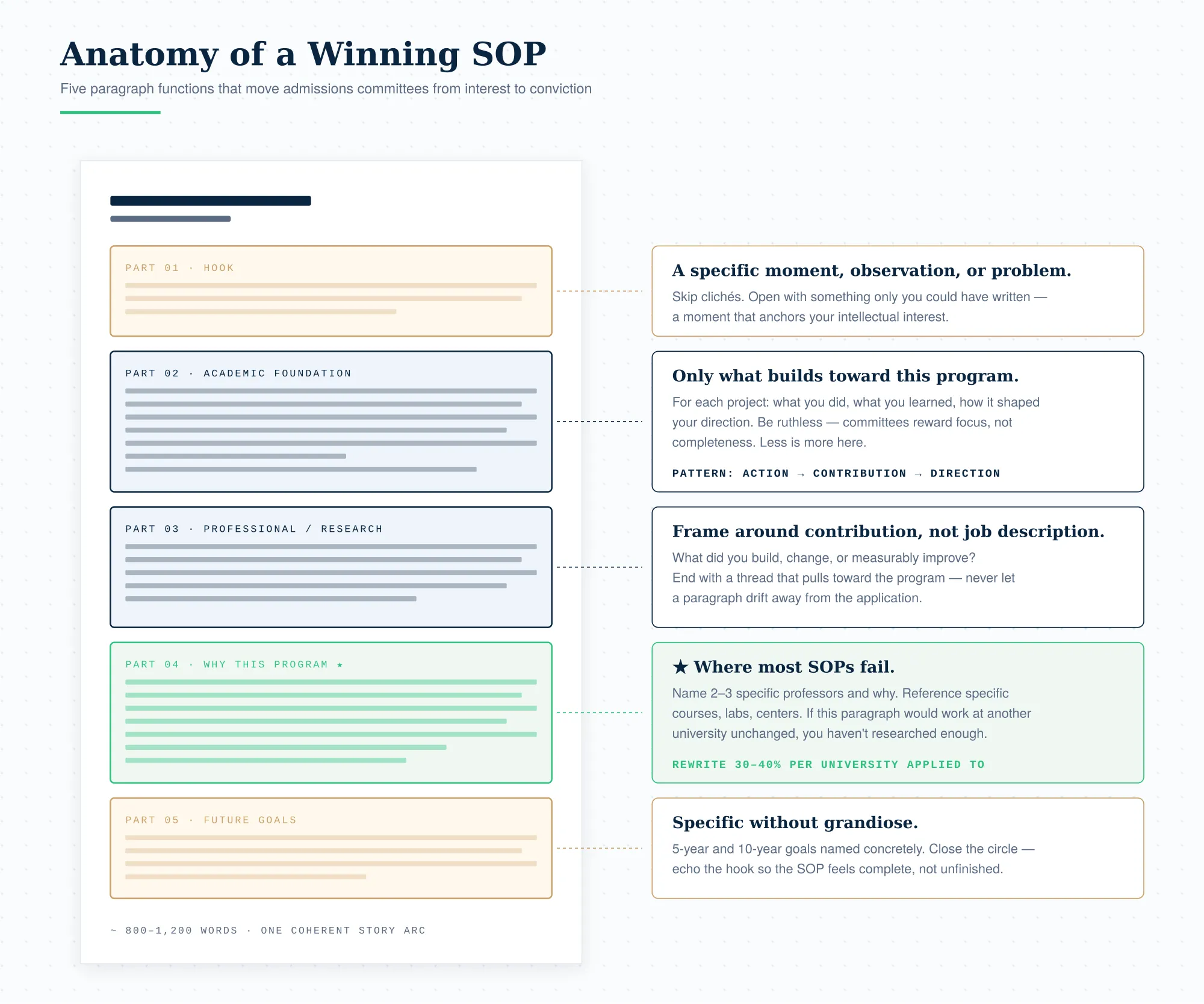
You don't need section headings — these are paragraph functions, not labels.
Part 1: The Hook (Opening Paragraph)
Start with a specific moment, observation, or problem that anchors your academic interest. Avoid clichés like "Ever since I was a child…" or "I have always been passionate about…" These openers signal to the reader that they're about to read a generic essay.
A strong hook is specific. It tells the reader something only you could have written.
Part 2: Academic Foundation (Paragraphs 2–3)
Walk through the parts of your academic journey that build directly toward this Master's or PhD. Not everything you've studied — only what matters for this application.
For each relevant project, course, or research experience, follow a simple pattern:
- What you did (briefly)
- What you learned or contributed (specifically)
- How it shaped your direction
Be ruthless with what you include. A high-impact SOP says less, not more. A reviewer reading 80 applications a day will not reward you for cramming everything in.
Part 3: Professional or Research Experience (Paragraph 4)
If you've worked, interned, or done research, this is where it goes. Frame it around contribution and learning, not job description.
Notice how the stronger version ends by connecting to the program you're applying to. Every paragraph should pull toward the application, not drift away from it.
Part 4: Why This Program, Why This University (Paragraphs 5–6)
This is the section where most students fail. Generic praise — "your university has world-class faculty and excellent research" — tells the committee nothing. They know they're a good university. They want to know why you, specifically, will thrive there.
To do this well:
- Name 2–3 specific professors whose research aligns with your interests, and explain why
- Reference specific courses in the curriculum and what you'll gain from them
- Mention research centers, labs, or initiatives that connect to your goals
If you can't write this section without it sounding interchangeable with another university's SOP, you haven't researched the program deeply enough. Go back and do that work.
Part 5: Future Goals and Conclusion (Paragraph 7)
Close with a clear articulation of what you want to do after the program — 5 years out, and 10–15 years out. Be specific without being grandiose.
Tie the conclusion back to your opening hook if possible. Strong SOPs feel like complete circles, not unfinished lists.
Country-Specific Tips That Actually Matter
United States
Strong personal voice is rewarded. Committees expect a story arc with intellectual personality. Standard length: 800–1,200 words.
United Kingdom
UK SOPs (often called "personal statements") are typically shorter (500–800 words) and more direct. Less narrative flourish, more concrete demonstration of fit. Don't pad.
Germany
Often called a "motivation letter." Should be precise, structured, and focused on academic fit. Avoid emotional storytelling. Germans value clarity over creativity here.
Canada and Australia
Closer to the US style but slightly more formal. Mid-length (700–1,000 words). Emphasize practical career outcomes and research alignment if applicable.
PhD SOPs (All Countries)
A PhD SOP is fundamentally different. It must include a research proposal — what you want to investigate, why it matters, your proposed approach, and how it fits with your prospective supervisor's work. The "personal story" should occupy no more than 25% of the document.
The Eight Most Common SOP Mistakes
- Starting with a quote. Albert Einstein, Steve Jobs, and the Bhagavad Gita have all opened too many SOPs. Skip the quote. Start with your own voice.
- Listing your achievements without reflection. Anyone can list. What admissions committees want to see is how you think about what you did.
- Writing the same SOP for every university. Detectable from the first paragraph. Reuse 60–70% of your SOP across applications; rewrite the program-specific 30–40% each time.
- Over-explaining your weaknesses. A 600-word apology for one bad semester is worse than a 50-word honest framing of it. If you need to address something, do it briefly and pivot to evidence of growth.
- Vague future goals. "I want to work in finance" tells the committee nothing. Specificity signals seriousness.
- Inflated language and over-the-top adjectives. "Phenomenal", "incredible journey", "passionate beyond measure." Cut all of them. Show, don't claim.
- Ignoring word limits. A 1,500-word SOP for a 1,000-word limit is read as inability to follow instructions. Respect the constraint.
- Skipping the proofread. Typos, grammar errors, or mismatched university names (yes, this happens) signal carelessness. Have at least two people review your SOP before submission.
How LiftmyGrade Supports SOP Development
At LiftmyGrade, SOP and academic essay support is built into every academic pathway — Bachelor's, Master's, and PhD. Our approach is fundamentally different from generic SOP-writing services:
- We don't write your SOP for you. Admissions committees have learned to recognize ghost-written SOPs, and the long-term cost of submitting one isn't worth it.
- We work with your story. Through structured mentoring, we help you surface the specific experiences, projects, and ideas that make your SOP yours.
- We tune for the program. Each version is tailored to the specific university, professor lineup, and program structure.
- We iterate. Strong SOPs come from 4–6 rounds of structured feedback, not one polished draft.
This is why SOP support sits inside our broader academic ecosystem, not as a standalone service.
Frequently Asked Questions
Typically 800–1,200 words for US Master's and PhD applications, 500–800 for UK personal statements, and 500–1,000 for most European motivation letters. Always check the specific university's word or page limit.
Tools can help you brainstorm, structure ideas, or check grammar. But submitting an AI-written SOP is increasingly risky — admissions committees use AI-detection tools, and the result often reads as generic and storyless. Your SOP must sound like you.
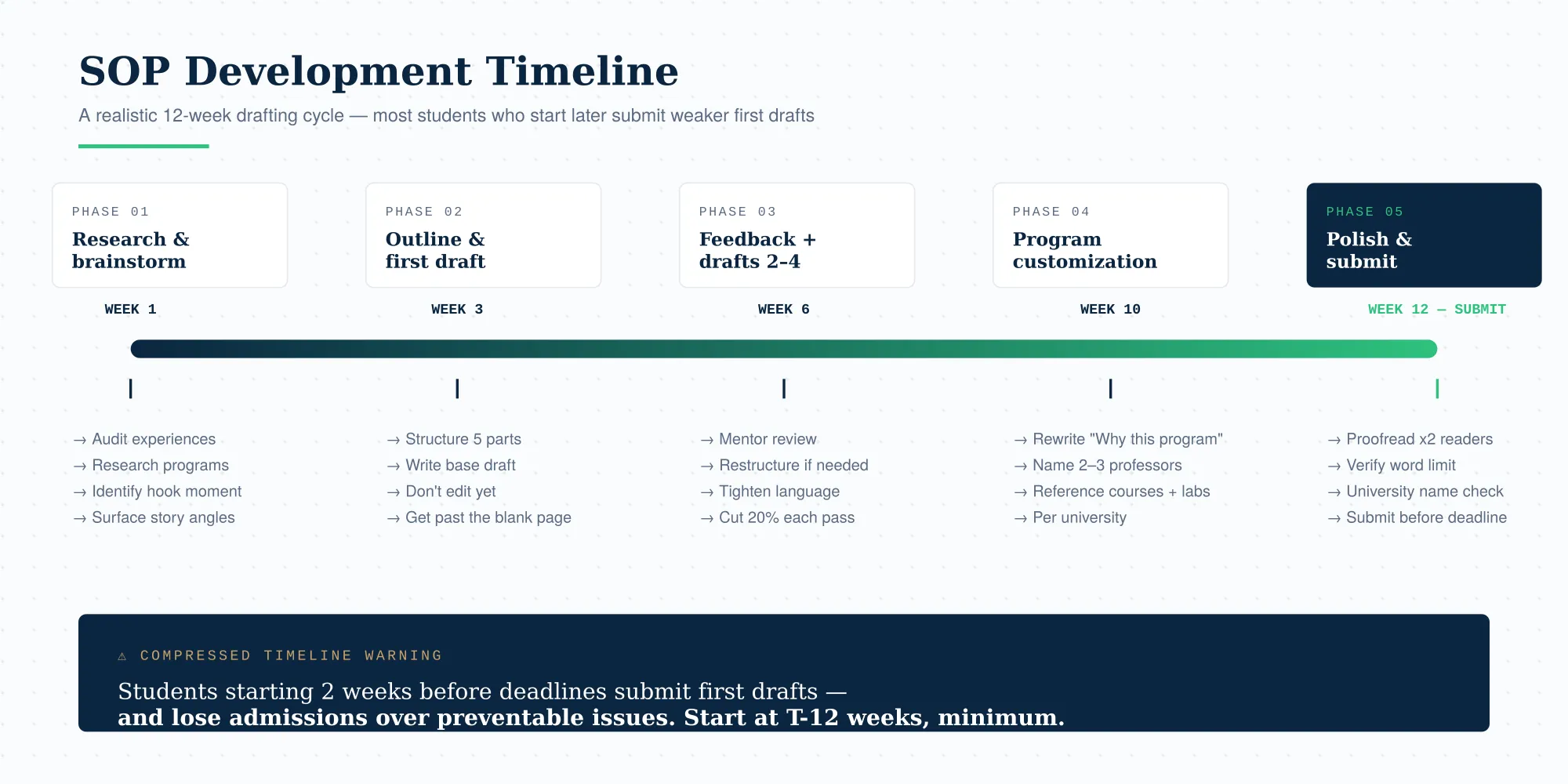
Begin 3–4 months before your earliest application deadline. A strong SOP goes through 4–6 drafts. Students who start two weeks before the deadline submit weak first drafts and lose admissions over preventable issues.
For PhD applications: yes, almost always. For Master's applications: strongly recommended for research-oriented programs, optional for coursework-only Master's. When you do mention them, mention 2–3 — not one (looks single-bet) and not eight (looks unfocused).
Roughly 60–70% of your SOP (your story, foundation, experiences, goals) stays consistent. The 30–40% on "why this program" should be substantially rewritten for each application. Reusing this section across universities is the most common reason SOPs feel generic.
Only if they're significant and unavoidable (e.g., a low GPA semester, a gap year). Address them in 2–4 sentences, then move on. The bulk of your SOP should be about strength and direction, not defense.
Ready to Write an SOP That Actually Lands?
Your Statement of Purpose is the most leveraged 1,000 words of your application. The difference between a generic SOP and a sharp one is the difference between an interview call and a polite rejection.
Explore LiftmyGrade's academic pathways — whether you're applying for a Bachelor's, Master's, or PhD — to see how structured SOP support, profile mentoring, and application strategy come together in one ecosystem.
Your story deserves to be told well. Let's make sure it is.


