
How to Get Strong Letters of Recommendation (LOR) for Studying Abroad

A great Statement of Purpose tells admissions committees what you think of yourself. A great Letter of Recommendation tells them what someone else thinks of you — and that's why LORs often carry more weight than students realize.
A weak LOR can quietly undo a strong application. A strong LOR can lift a marginal one into the admitted pile. Most Indian students get this wrong in the same way: they ask the wrong people, give them too little to work with, and hope for the best.
This guide walks you through how to actually engineer a strong LOR — from picking recommenders to giving them what they need to write something powerful.
Why LORs Matter More Than You Think
A typical Master's or PhD application asks for 2–3 LORs. These are the only documents in your file written by someone other than you. To a committee reading 200 applications a week, that third-party perspective is enormously valuable — because applicants always pitch themselves favorably, and recommenders can corroborate or contradict that pitch.
Three patterns committees specifically look for in LORs:
- Specificity. Vague praise ("She is hardworking and intelligent") signals that the recommender doesn't know you well. Specific anecdotes ("In my graduate seminar, she challenged my interpretation of Foucault and produced a 40-page term paper that I encouraged her to develop into a publication") signal genuine familiarity.
- Comparative ranking. Where do you fit among the recommender's students? "Top 5% of students I've taught in 15 years" is a different statement than "a good student." Top US PhD programs explicitly ask for ranking.
- Independent corroboration. If your SOP claims you led a research project, your LOR should confirm that. Mismatches between what you claim and what your recommender confirms can sink an application faster than a weak essay.
Who Should Write Your LOR?
The rule most students get wrong: prestige of the recommender matters less than depth of knowledge about you. A senior dean who barely remembers you writes a worse LOR than an assistant professor who has read your papers and seen you struggle.
Here's how to think about it.
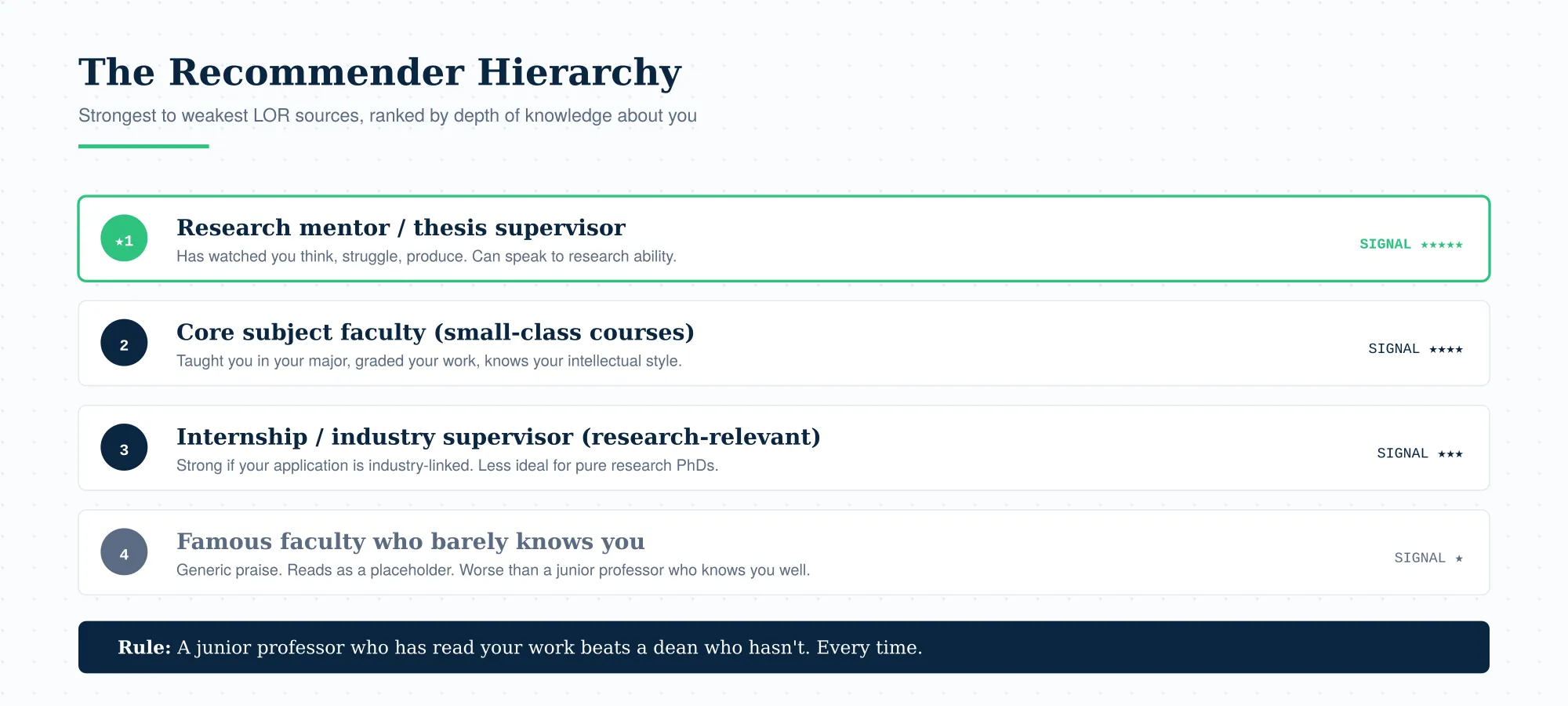
A common mistake: students chase senior or famous names, hoping the title alone will impress. It doesn't. Admissions committees read the letter, not just the signature. A specific, warm, detailed letter from an assistant professor who supervised your thesis is almost always more powerful than a vague paragraph from a department head who taught you one lecture.
How Many Recommenders Should You Line Up?
For each LOR slot in your applications, line up one primary recommender and one backup. So if your applications need 3 LORs each, identify 3 primaries and 2 backups — that's five people to brief. Some recommenders will agree but then disappear during writing season. The backup saves you.
Distribute strategically:
- One academic recommender minimum (your strongest researcher-mentor) — anchor of the letter set
- One additional academic (a different subject faculty, ideally with a different perspective on your abilities)
- One professional/internship recommender if the program is industry-adjacent, OR a third academic if it's research-pure
For PhD applications, all three should typically be academic. For Master's, a mix is acceptable. For Bachelor's, school principals or senior teachers are standard.
How to Ask — Without Burning the Bridge
The way you ask determines the quality of the letter. A casual "can you write me a recommendation?" gets you a generic letter. A structured, well-prepared ask gets you a strong one.
- Ask early. 8–12 weeks before the deadline, not 2. Recommenders have lives, schedules, and reading queues. Last-minute requests get rushed, generic letters — or rejections.
- Ask in person if possible, or with a thoughtful email. A 3-line email saying "please write a LOR by Friday" telegraphs that you've put no work into your own application. Match the effort you want them to put in.
- Ask whether they can write a "strong" letter. This is the most important question and the one students avoid. "Would you be able to write me a strong letter of recommendation?" gives the recommender an out — a graceful way to say "you'd be better served by someone else." If they hedge, take the hint.
- Bring documentation. When they say yes, send them a package: your CV, draft SOP, the universities you're applying to, deadlines, and a one-page brief on what each program is looking for. This is non-negotiable. Recommenders write better letters when they know what story to support.
What to Give Your Recommender (The LOR Brief)
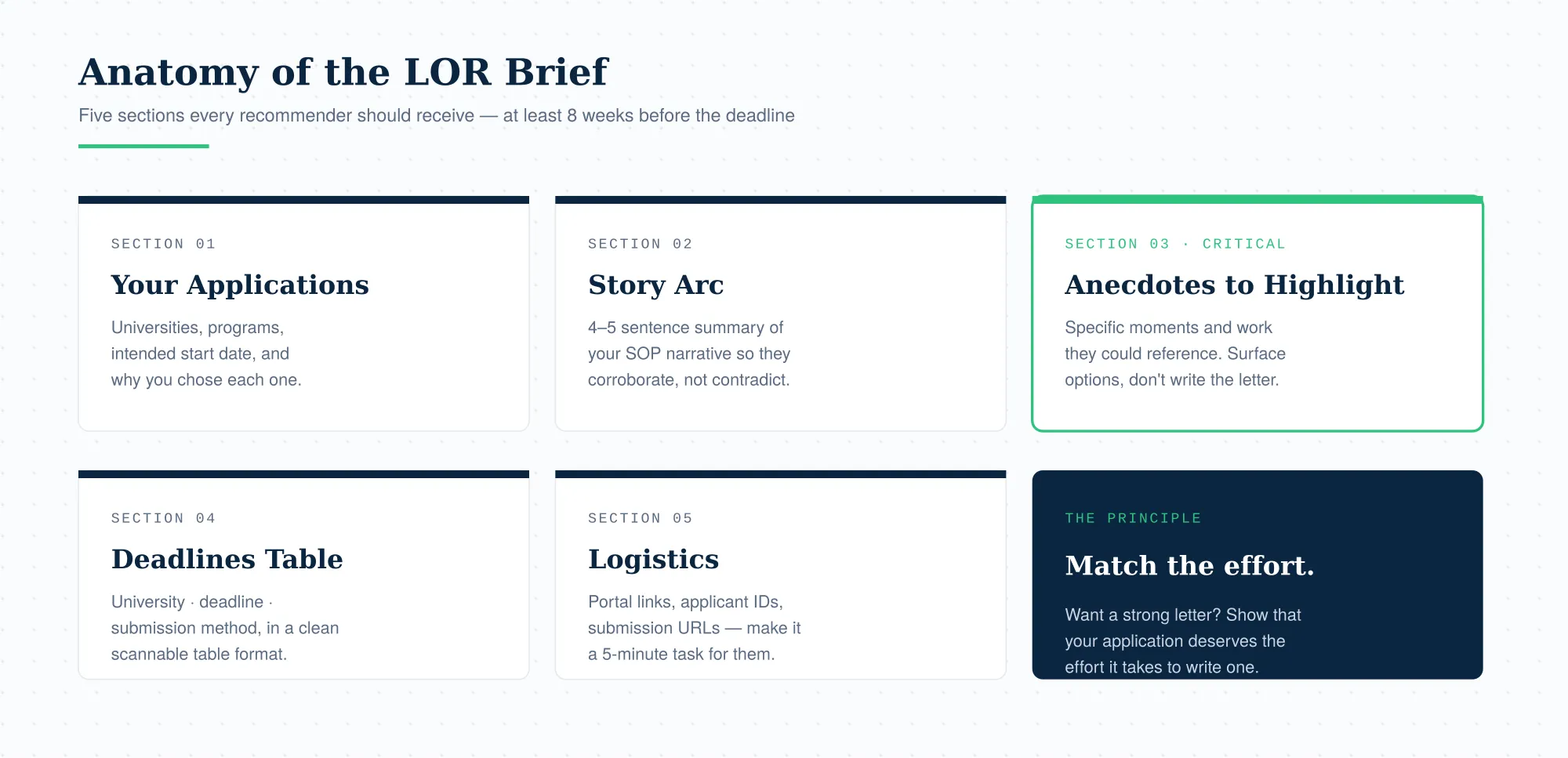
The single highest-leverage move you can make: write a one-page brief for each recommender. It should include:
- Your applications. Universities, programs, intended start date, why you chose them.
- Your story arc. A 4–5 sentence summary of the narrative your SOP is making — so the LOR can corroborate, not contradict.
- Specific moments and work you'd like them to highlight. "If helpful, you could mention the term paper on X that I expanded into a working paper, or the seminar on Y where I challenged the conventional reading." Don't write the letter for them — surface options.
- Deadlines, in a clean table. University, deadline date, submission method (online portal, email).
- Logistics. Submission link if it's a portal, your applicant ID if applicable.
This brief isn't manipulation. It's professional respect for their time. Most recommenders appreciate it — and many will explicitly say so.
Handling LOR Rejection or Delay
- If a recommender declines: thank them, move to your backup, and don't take it personally. Some professors have a policy of writing limited LORs. Others know they can't write strong ones and are being honest.
- If a recommender ghosts you mid-process: a polite reminder email at T−2 weeks is fair. At T−1 week, escalate to your backup. Never compromise your application waiting for a letter that may not come.
- If a recommender misses the deadline: most universities accept LORs 1–3 days late if submitted directly. Don't panic, do email the admissions office, and have your backup ready.
Common LOR Mistakes That Cost Admissions
- Choosing recommenders by title, not by relationship. The single biggest mistake. Depth beats prestige every time.
- Asking too late. Recommenders write better letters when they have time to think.
- Sending the same recommender brief to everyone. Different recommenders should highlight different parts of your story. A research-mentor LOR shouldn't sound like an internship-supervisor LOR.
- Not following up. Recommenders are busy. A polite reminder 1 week before the deadline is professional, not pushy.
- Asking someone who barely knows you because they have a big name. It will read exactly that way to admissions committees.
How LiftmyGrade Supports LOR Strategy
At LiftmyGrade, LOR strategy is built into our SOP and application support across all pathways. We work with students on:
- Recommender selection — who fits which application best, given their relationship with you
- The LOR brief — a structured document that gives recommenders everything they need
- Anti-overlap planning — ensuring your LORs highlight different aspects of your profile
- Timeline tracking — making sure no LOR slips through the cracks 2 weeks before a deadline
We don't write your LORs (that would be inappropriate and easily detected). We help you engineer the conditions for strong LORs to be written.
Frequently Asked Questions
This happens in India sometimes — and it's a bad idea. Admissions committees can tell when LORs are self-written (the voice matches the SOP too closely). Worse, ethical violations of this nature, if discovered, can void admissions. Write your brief, give your recommender bullet points if needed, but never write the letter itself.
Common issue. You can offer to share sample LOR structures (publicly available) without writing the content. Or suggest they write in their preferred language and use professional translation. Some universities accept LORs in other languages with certified translation.
400–800 words for Master's. 600–1,200 words for PhD. Anything under 300 words signals a recommender who doesn't have much to say.
In US applications (FERPA waiver), yes — always waive. An unwaived LOR is read as a less credible LOR by admissions committees.
Absolutely. Indian recommenders are perfectly acceptable for US/UK/EU applications, as long as they write in English and their letter is specific and detailed.
Ready to Engineer Strong LORs?
A great LOR doesn't happen by chance. It happens when you ask the right people, give them the right brief, and time the request to give them space to write well.
Explore LiftmyGrade's pathways for Bachelor's, Master's, and PhD applications — LOR strategy is built into every engagement.
Your recommenders are your advocates. Make it easy for them to advocate well.