
How to Get a PhD Abroad from India: A Complete 2026 Guide

A PhD abroad is no longer a distant dream reserved for a handful of elite students. With the right strategy — strong research positioning, well-timed professor outreach, and a publication-ready profile — students from India are securing PhDs in the US, UK, Germany, Canada, and Australia every cycle, with tuition waived and a monthly stipend that covers living costs.
But here's the truth most students discover too late: a PhD isn't won at the application stage. It's won 12 to 18 months before, in how you build your research identity, choose your supervisors, and frame your scholarly contribution. This guide breaks down exactly how to do that.
What Does " PhD" Actually Mean?
A PhD typically covers three things:
- Tuition waiver — your university fees are paid in full
- Monthly stipend — usually USD 1,800–3,500 (or local equivalent) to cover rent, food, and living expenses
- Research and travel allowances — funding for conferences, fieldwork, lab equipment, or publications
Funding can come from the university itself (graduate assistantships, teaching/research fellowships), government scholarships (DAAD in Germany, Fulbright-Nehru in the US, Commonwealth in the UK), or individual professor grants (where your supervisor pays you from their funded project). Most successful PhD applicants don't rely on a single source. They stack them — and that stacking is a strategic skill.
Top Countries for PhDs in 2026
United States
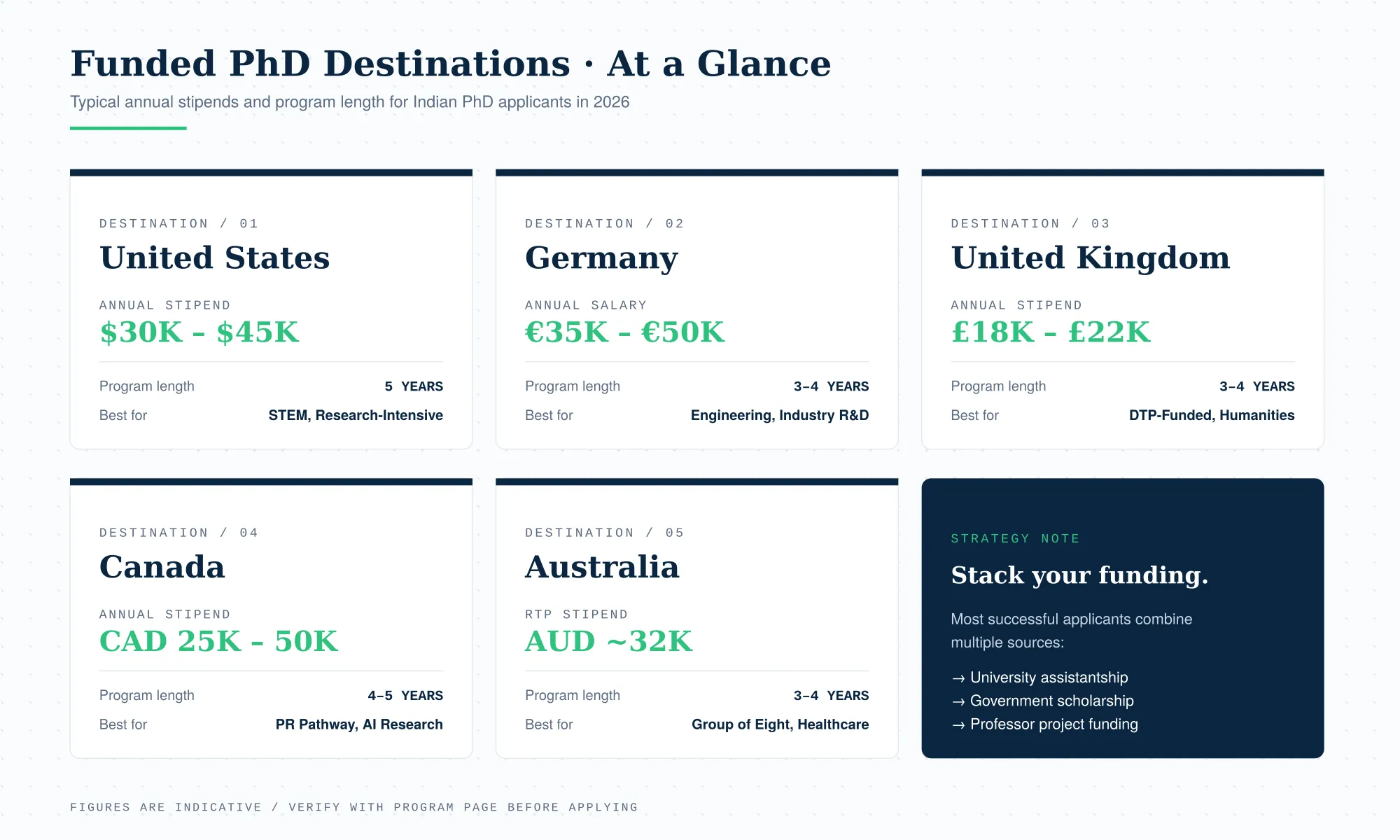
US PhDs are almost universally funded if you get admitted to a reputable program. Most R1 universities offer 5-year packages that include tuition, stipend (around USD 30,000–45,000/year), and health insurance. Competition is high, and you'll need strong GRE scores (for some programs), research experience, and at least one peer-reviewed publication or working paper.
Germany
Germany offers PhD positions as actual jobs — you're hired as a research associate (Wissenschaftlicher Mitarbeiter) with a contract, salary, and benefits. DAAD scholarships and Max Planck/Helmholtz/Leibniz Institute positions are highly competitive but accessible if your research interests align with an active project.
United Kingdom
UK PhDs are shorter (typically 3–4 years) and funding comes through UKRI Doctoral Training Partnerships, Commonwealth Scholarships, and university-specific studentships. Funded slots are limited — applying early and securing a supervisor's backing matters enormously.
Canada
Canadian PhDs come with funding packages from the university plus options like Vanier Canada Graduate Scholarships (CAD 50,000/year for three years). Canada is increasingly attractive because of post-graduation work permits and clear PR pathways.
Australia
Research Training Program (RTP) Scholarships cover tuition and provide a tax-free stipend of approximately AUD 32,000/year. Universities like ANU, Melbourne, and Sydney run highly competitive but accessible PhD pipelines.
The Five-Stage Roadmap to a PhD
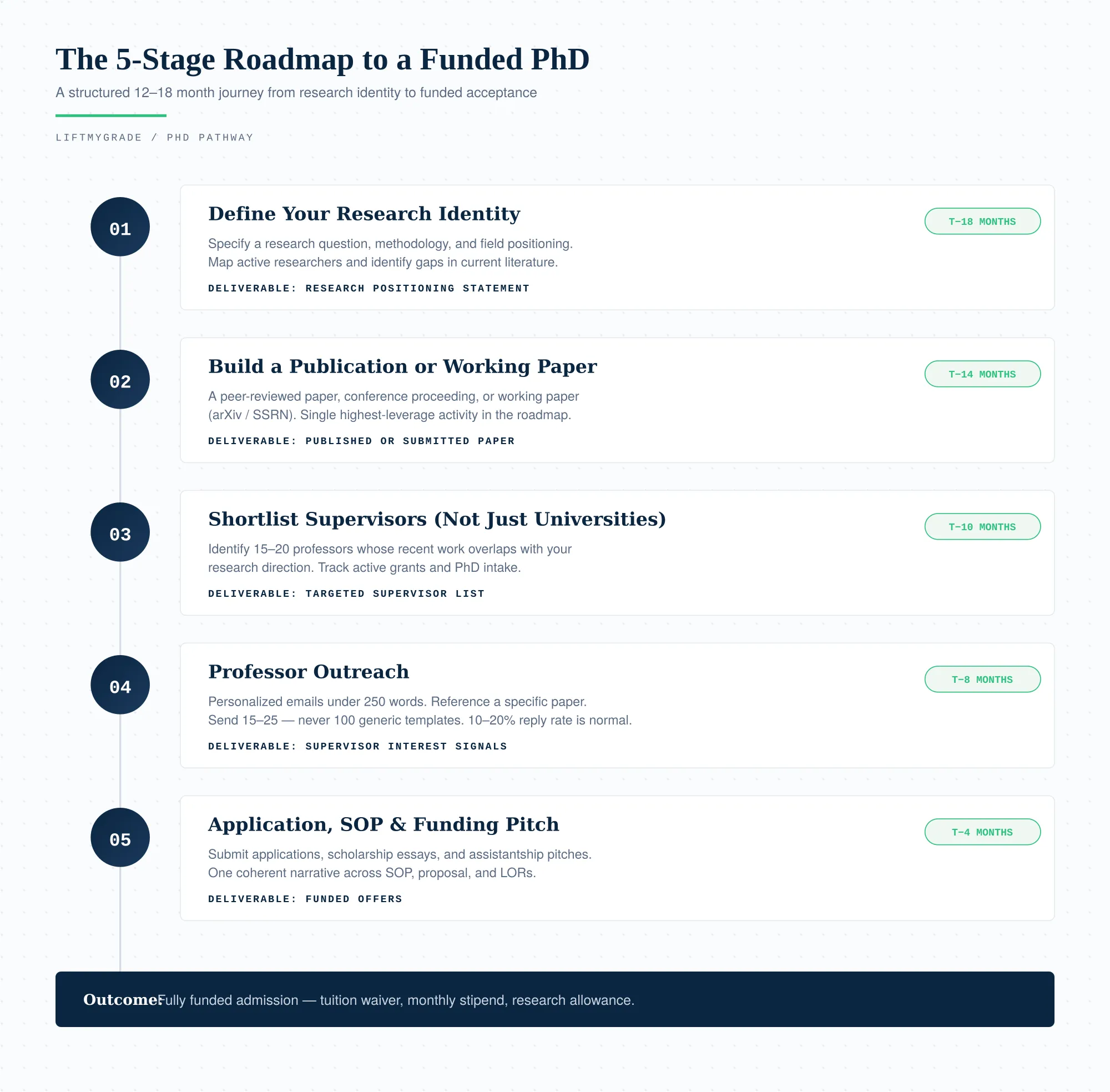
Stage 1: Define Your Research Identity (12–18 months before applying)
You can't apply broadly for a PhD. You need a specific research question, a methodological approach, and ideally a body of work that demonstrates you can contribute to that field. Start by reading recent papers in your area, mapping the active researchers, and identifying the gaps in current literature. This is where most Indian applicants underinvest. A clear research identity is what separates funded offers from rejection letters.
Stage 2: Build a Publication or Working Paper
A peer-reviewed publication — even a conference paper or a working paper on arXiv/SSRN — dramatically increases your funding chances. It signals to admissions committees and potential supervisors that you can independently produce research-grade work. If you don't have one yet, this is your single highest-leverage activity. Mentor-led publication support can compress this timeline from years to months.
Stage 3: Identify and Shortlist Supervisors
Most students pick universities. Successful PhD applicants pick supervisors. Your future PhD experience — and often your funding — depends on which professor takes you on. Shortlist 15–20 professors whose recent work overlaps with your research interests. Look at their last 3 years of publications, current projects, and whether they've taken on PhDs recently. Use Google Scholar, ResearchGate, and lab websites.
Stage 4: Professor Outreach
This is the make-or-break stage. A well-crafted email to the right professor can secure you a supervisor commitment before you even formally apply. Your outreach email should be short (under 250 words), reference a specific paper of theirs, articulate your research idea clearly, and propose a concrete way you could contribute to their work. Avoid generic templates — professors recognize them instantly and delete them. Expect a low response rate (10–20% is normal). Send 15–25 personalized emails, not 100 generic ones.
Stage 5: Application, SOP, and Funding Pitch
Once you have supervisor interest, the formal application follows. Your Statement of Purpose, research proposal, and letters of recommendation need to tell one coherent story: this is the problem I want to solve, here's why I'm the right person to solve it, and here's why this university is where I need to solve it. The funding pitch — whether through assistantship applications, fellowship essays, or scholarship statements — should mirror this narrative.
Common Mistakes That Cost Students Funding
- Applying without supervisor contact: In most countries outside the US, your application is dead on arrival if no professor has signaled interest.
- Generic research proposals: "I want to study AI in healthcare" is not a research proposal. "I want to investigate whether transformer-based models can predict sepsis onset 6 hours earlier than current clinical scores in Indian ICU populations" is.
- Treating publication as optional: It isn't. Not anymore. Top funded programs increasingly expect at least one research output before admission.
- Underestimating timeline: A serious PhD application takes 12–18 months of structured preparation. Students who start 4 months before deadlines almost always end up unfunded — or unaccepted.
- Ignoring scholarship deadlines: Government scholarships like Fulbright-Nehru, DAAD, and Commonwealth have application windows that close 6–9 months before university intake. Missing these is missing free money.
How LiftmyGrade Supports PhD Aspirants
At LiftmyGrade, our PhD & Research Abroad pathway is built around the five stages above. We work with students on:
- Professor outreach strategy — identifying the right supervisors and crafting outreach that gets responses
- Research proposal guidance — translating your research interest into a fundable proposal
- Publication support — mentor-led guidance to publish in peer-reviewed venues or working paper series
- Funding & scholarship pathways — mapping the right government, university, and project-based funding sources
- Academic profile positioning — building the long-term research identity that wins funded offers
We don't operate as a one-time application service. We work alongside students across the full 12–18 month preparation window.
Frequently Asked Questions
Yes, but it's harder. Strong research experience, clear research articulation, and a high-quality research proposal can compensate — especially in fields where undergraduate publishing is uncommon. However, having at least one working paper or conference paper meaningfully improves your odds.
It depends on the country and program. Many US programs have made GRE optional or waived it post-2020. Most European, UK, and Australian PhDs do not require GRE. Always check program-specific requirements before investing in test prep.
Application fees, document costs, English test fees (IELTS/TOEFL), and outreach costs typically total INR 60,000–1,50,000 across a full application cycle of 6–10 universities. This is a fraction of what you save through funding — but it's still a meaningful investment.
Absolutely — and you should. In Germany, the Netherlands, Sweden, and most of Europe, professor contact is essentially required. In the US and UK, it's strongly recommended for funded programs.
For students who follow a structured 12–18 month preparation roadmap — research identity, publication, targeted outreach, strong SOP — funded admission rates typically range from 30–60% across applied programs. For unprepared applicants, the rate is in low single digits.
Ready to Build Your Funded PhD Roadmap?
A PhD abroad isn't about luck. It's about starting early, positioning your research identity sharply, and executing a structured outreach and application strategy. If you're 12–18 months out from applications, this is the right time to start. Explore LiftmyGrade's PhD & Research Abroad pathway to see how mentor-led guidance, publication support, and funding strategy come together into one structured journey.
Your research career deserves more than a generic consultancy. It deserves a system built around it.