
When to Apply to Universities Abroad: The Complete Timing Guide for Indian Students (2026 & Beyond)

Timing is the single most underestimated factor in study-abroad applications. Students obsess over GPA, test scores, and SOP wording — and then submit an excellent application six weeks too late, into a closed scholarship window, or for an intake that doesn't match their year of graduation.
The result: rejection from programs that would have accepted them, or admission without the scholarships they needed to actually attend. This guide breaks down exactly when to start, what to do at each stage, and how application timing differs across the top destination countries.
The Two Calendars That Matter
Most Indian students think about timing in terms of deadlines — the date by which the application must be submitted. That's the wrong frame. What actually matters are two different calendars running in parallel:
- The university calendar — when programs open applications, when they close, and when the academic intake begins.
- The scholarship calendar — when external funding (Fulbright-Nehru, Chevening, DAAD, Commonwealth, etc.) opens and closes, which is often 6–9 months before university deadlines.
Plan only around university deadlines and you'll miss most scholarships. Plan only around scholarships and you'll over-prepare for the wrong year. The students who get admitted with funding work both calendars at once.
The Major Intake Seasons Explained
Fall Intake (August–September)
This is the dominant intake globally. Most US, UK, Canadian, European, and Australian universities open their main academic year in late August or September. For Indian students, Fall intake is when:
- The largest number of programs are available
- Scholarships are concentrated
- Most assistantships and on-campus jobs open up
- Class sizes are at full strength (so networking is best)
If you have a choice, apply for Fall. Approximately 80% of Indian students applying abroad target Fall intake.
Spring Intake (January–February)
Spring is a smaller second intake. Programs available are fewer, scholarships are limited, and some flagship programs don't offer it at all. However, Spring is valuable if:
- You're a December graduate and don't want to wait 9 months
- You missed Fall deadlines but have a strong profile
- You want a smaller cohort and faster feedback cycles
Summer Intake (April–July)
Mostly limited to Australia (which runs on a Feb/July calendar), some European programs, and short specialized degrees. Niche, but worth knowing about if Australia is on your shortlist.
The Country-by-Country Timing Snapshot
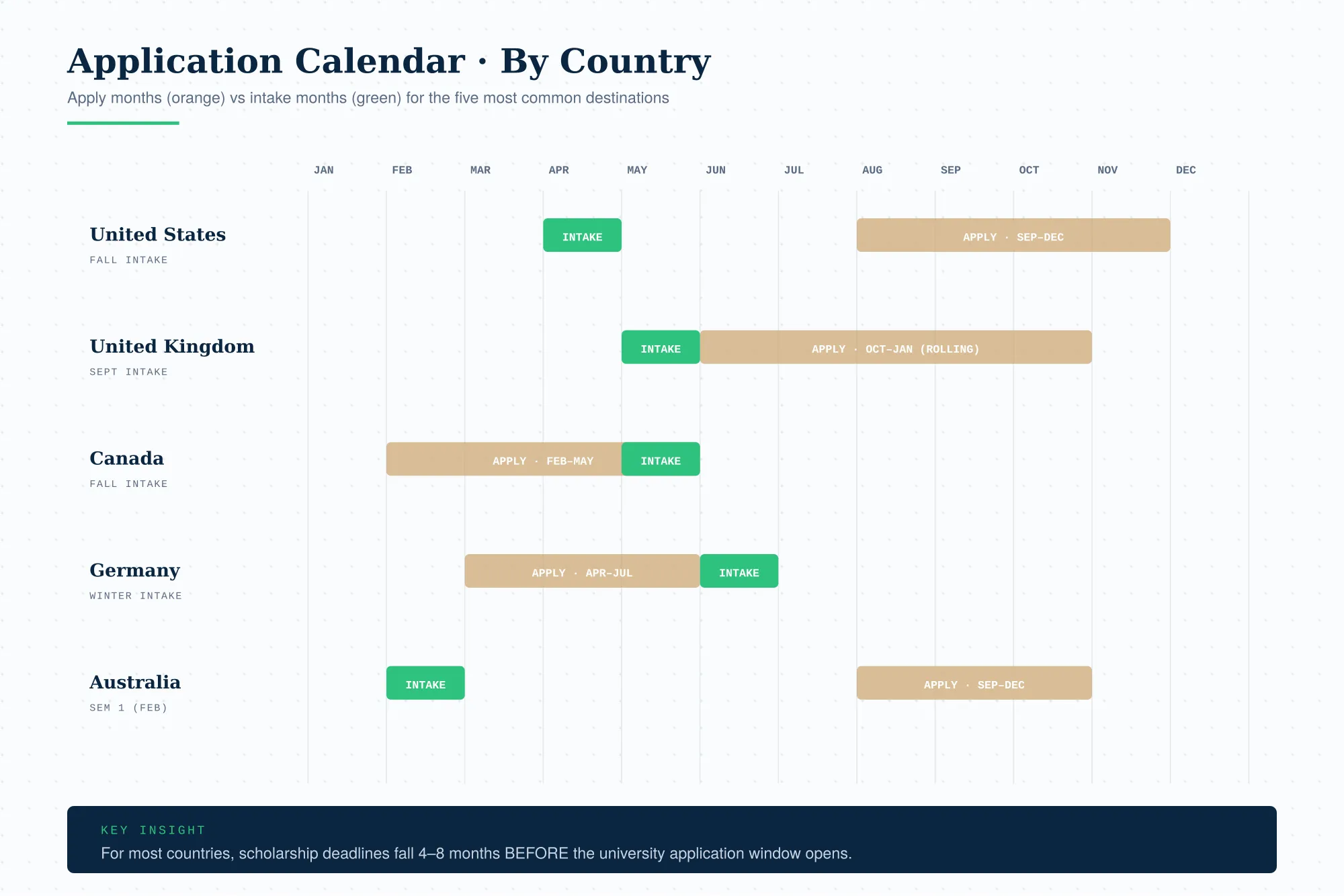
A few country-specific notes worth internalizing:
- United States — Top programs (Stanford, MIT, Ivy League) often have December 1 or December 15 deadlines for Fall intake the following year. Less competitive programs roll through January–March.
- United Kingdom — UCAS-style central applications for undergraduate; for postgrad, applications are rolling but most funding decisions are tied to early January deadlines.
- Canada — Fewer rounds, but programs often close earlier than students expect. February–April is the realistic window.
- Germany — The Uni-Assist platform handles many international applications; processing times can stretch 6–8 weeks, so submit early.
- Australia — Two intakes (February and July) give flexibility, but scholarship deadlines for the February intake fall in the previous August–October window.
The 12-Month Backwards Plan
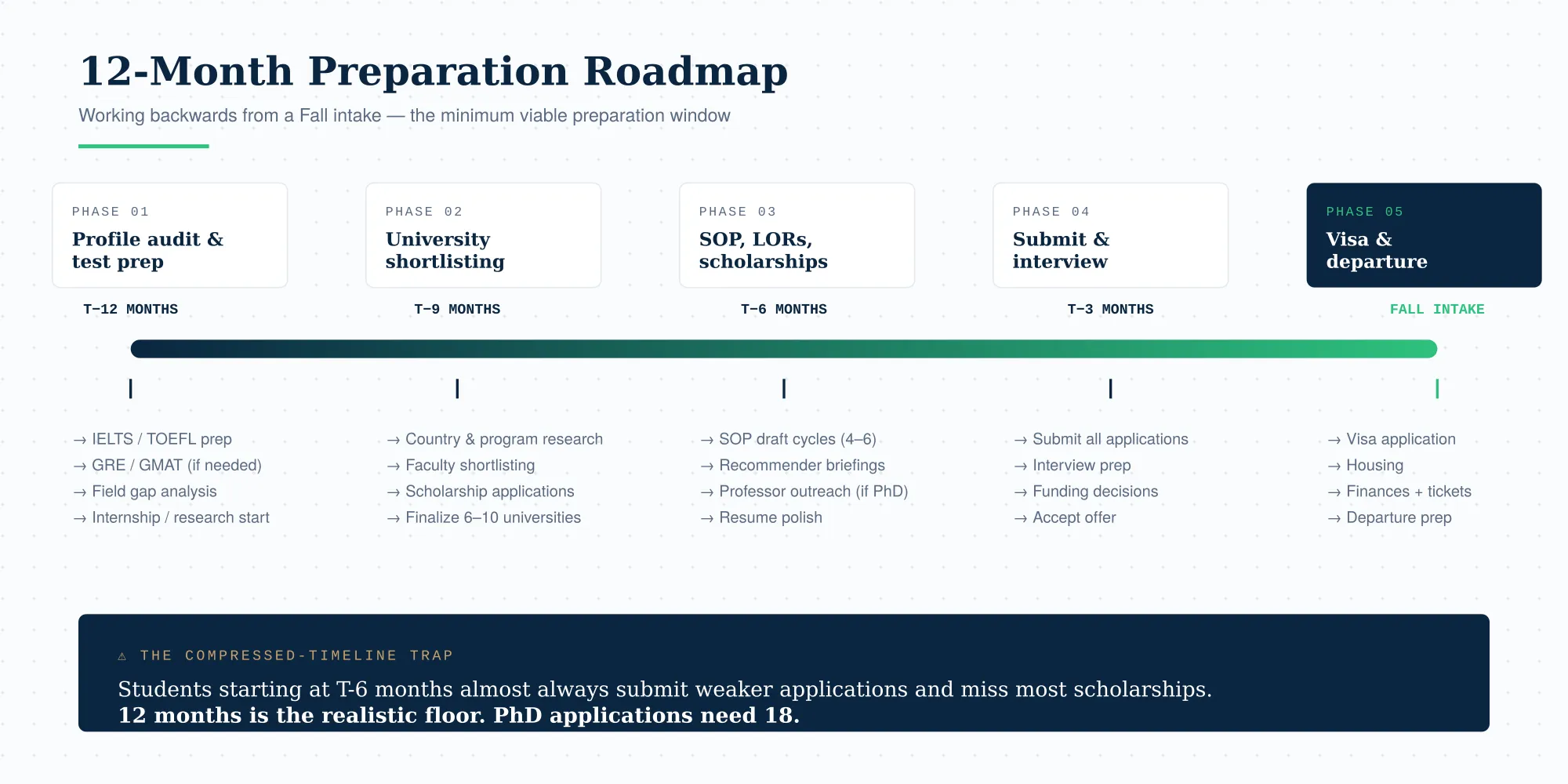
Working backwards from a Fall 2027 intake (the most common Indian target), here's what a structured timeline looks like:
When to Start What — A Practical Breakdown
PhD aspirants should be defining research direction, identifying supervisors, and starting on publications. For Master's, this is when you should be building research or internship experience that will anchor your SOP.
Begin IELTS/TOEFL prep. If you need GRE or GMAT, start now. Audit your profile honestly — what's strong, what's a gap, what can still be improved in the next 6 months?
Finalize the country shortlist. Identify 8–12 universities to seriously target. Begin researching scholarship applications, especially Fulbright-Nehru, Chevening, DAAD, Inlaks — these have early deadlines.
SOP drafting begins. Recommendation letter conversations start. Resume gets refined. If applying for PhD, professor outreach is in active mode.
Submit applications in batches. Don't wait for one program to decide before submitting to the next. Interview prep begins for programs that conduct them.
Acceptances arrive. Scholarship decisions get finalized. You accept your best offer and decline others promptly (out of courtesy to waitlisted candidates).
Visa, housing, finances, departure.
The Five Most Common Timing Mistakes
- Starting at T-4 or T-5 months: This is the most common mistake. There's no time for proper SOP iteration, scholarship applications close before you reach them, and your applications go in late in the cycle when seats are filling.
- Treating tests as the first step: IELTS or GRE prep often becomes a 6-month obsession that crowds out everything else. Tests matter, but not at the cost of your profile, SOP, or applications.
- Missing scholarship calendars: Government scholarships have deadlines 4–9 months before university deadlines. Plan around scholarships first; university deadlines naturally follow.
- Applying everywhere at once: Submitting six applications in the final week guarantees errors. Stagger your submissions across 6–8 weeks so each gets full attention.
- Ignoring the timezone of decisions: Most US programs release decisions in waves between February and April. Don't accept the first offer until you've heard from at least 4–5 programs unless deadlines force your hand.
How LiftmyGrade Structures Application Timing
At LiftmyGrade, every academic pathway is built around a structured 12–18 month timeline rather than an end-of-cycle scramble. We work with students on:
- Profile audits at T-12 — honest assessment of where you stand and what to build in the months ahead
- Country and program shortlisting with timing-fit factored in
- Scholarship calendar mapping so external funding deadlines don't get missed
- Phased SOP development across multiple drafts and reviews
- Application execution support across 6–10 university applications without quality drop
- Decision-phase strategy when multiple offers arrive
This is why our students rarely face the compressed-timeline trap. The work happens before deadlines arrive, not against them.
Frequently Asked Questions
12 months before your intended intake is the realistic minimum for Master's applications. For PhD, plan 18 months out. For Bachelor's, ideally start at the beginning of Class 11 (about 24 months before applications close).
Fall intake is better for the vast majority of applicants. Larger program availability, more scholarships, fuller cohorts, and standard September intake aligns with the Indian academic calendar (graduation in May–June, application year for Fall the following year).
Major scholarships have early deadlines: Fulbright-Nehru (May–June), Chevening (Aug–Nov), DAAD (varies by program, typically Oct–Jan), Commonwealth Scholarships (Oct–Dec). These close before most university deadlines.
Yes. Most universities accept applications with predicted results and conditional offers. You submit final transcripts after results are released. Don't wait — apply with current results.
US programs: 8–16 weeks after the deadline. UK programs: 4–8 weeks (rolling). Canadian programs: 6–12 weeks. German programs: 8–12 weeks. Plan accordingly when scheduling visa applications.
Ready to Build Your Application Timeline?
Timing isn't a bureaucratic detail — it's a strategic choice that compounds every other decision in your application.
Explore LiftmyGrade's academic pathways — Bachelor's, Master's, and PhD — to see how structured timing, profile development, and application support work together as one ecosystem.
Start at T-12. Apply at T-3. Land where you wanted to.