
Best Countries for Master's Abroad for Indian Students in 2026: A Strategic Guide

Choosing where to do your Master's abroad is one of the highest-stakes decisions you'll make in your twenties. The country you pick shapes more than your degree — it shapes your career ceiling, your earning potential, your settlement options, and the network you build for the next 20 years.
This guide cuts through the marketing noise. We'll compare the top six destinations for Indian Master's students in 2026 across the four dimensions that actually matter: cost, career outcomes, PR pathways, and academic reputation.
How to Actually Choose a Country (Not Just Pick a Brand)
Before we get into country breakdowns, here's the framework most students skip:
- Career-first or degree-first? Are you choosing this Master's because you want a specific career outcome (e.g., tech in the US, engineering in Germany) or because you want the academic credential first and will figure out the career later? Both are valid — but they lead to different countries.
- PR/settlement matters or not? If you want a clear immigration pathway after graduation, Canada and Australia have far cleaner systems than the US. If you don't, your options widen.
- What's your total budget — including living costs? A "cheap" Master's in a high cost-of-living city often ends up more expensive than a "premium" Master's in a low-CoL one.
- Are you research-track or industry-track? Research-track students should weight publication culture and lab funding heavily. Industry-track students should weight internships, alumni networks, and recruiter access.
Country Breakdowns
United States
Best for: Tech, finance, research-heavy disciplines, top-tier brand recognition
The US still leads on salary outcomes, particularly in STEM. A Master's from a strong US program in computer science, data science, or engineering routinely leads to starting salaries of USD 100,000–140,000 in tech hubs. The 3-year STEM OPT extension gives you meaningful runway to find sponsorship.
- Realistic cost (2-year program): USD 60,000–120,000 total, depending on program prestige and city.
- Career outcomes: Excellent for STEM; competitive for non-STEM where work authorization gets harder.
- PR pathway: Long and uncertain. Green card backlogs for Indian nationals stretch decades for employment-based categories. If long-term settlement in the US is your goal, factor this in seriously.
- Scholarships: University-specific merit aid, Fulbright-Nehru, Inlaks Shivdasani, J.N. Tata Endowment.
United Kingdom
Best for: One-year Master's, finance and consulting, students who want a global brand
The UK's biggest advantage is the compressed one-year Master's. You save a full year of tuition and living costs, and the post-study Graduate Route gives you 2 years to find work (3 for PhDs).
- Realistic cost (1-year program): GBP 25,000–55,000 total, with London adding 30–40% to non-London estimates.
- Career outcomes: Strong for finance, consulting, and law in London. More mixed outside London, especially in tech where US salaries dwarf UK ones.
- PR pathway: 5 years on the Skilled Worker visa can lead to Indefinite Leave to Remain. Cleaner than the US, but employer sponsorship requirements are tightening.
- Scholarships: Chevening, Commonwealth, GREAT Scholarships, university-specific bursaries.
Germany
Best for: Engineering, automotive, manufacturing, research, students with budget constraints
Germany is the underrated giant of European Master's destinations. Public universities charge little to no tuition, and engineering programs at TU Munich, RWTH Aachen, KIT, and others are world-class.
- Realistic cost (2-year program): EUR 20,000–35,000 total — almost entirely living costs.
- Career outcomes: Excellent for engineering, automotive R&D, industrial research. The German job market actively recruits Master's graduates with relevant technical skills.
- PR pathway: 21 months to a permanent settlement permit (Niederlassungserlaubnis) with German B1, faster than almost any other country.
- Scholarships: DAAD, Deutschlandstipendium, Heinrich Böll Foundation, Konrad-Adenauer-Stiftung.
- The catch: Learning at least basic German (A2/B1) dramatically increases your job outcomes — and is increasingly expected by employers.
Canada
Best for: Students prioritizing PR, balanced cost-to-outcome ratio, healthcare and tech
Canada has built one of the cleanest student-to-PR pipelines in the world. A 2-year Master's gives you a 3-year Post-Graduation Work Permit, and Express Entry rewards Canadian education and work experience generously.
- Realistic cost (2-year program): CAD 50,000–90,000 total.
- Career outcomes: Strong in tech (Toronto, Vancouver, Montreal), healthcare, and increasingly in AI research. Salaries are lower than US equivalents but cost of living is also lower in non-Toronto cities.
- PR pathway: Among the most predictable globally. Many Indian students transition from Master's → PGWP → PR within 4–6 years.
- Scholarships: Vanier Canada Graduate Scholarships, university entrance scholarships, Ontario Graduate Scholarship.
Australia
Best for: Healthcare, engineering, students wanting quality of life with PR options
Australia offers a strong balance — high-quality universities (Group of Eight), post-study work visas of 2–6 years depending on location and degree, and a regional PR system that rewards study and work in non-metropolitan areas.
- Realistic cost (2-year program): AUD 65,000–110,000 total.
- Career outcomes: Strong in healthcare, engineering, mining-adjacent fields, and increasingly in tech in Sydney and Melbourne.
- PR pathway: Through skilled migration, with bonus points for regional study. Less automatic than Canada but well-defined.
- Scholarships: Australia Awards, RTP for research Master's, university-specific international scholarships.
Ireland
Best for: Tech sector access to European HQs, one-year Master's, students wanting a less crowded destination
Ireland has quietly become a strong Master's destination, particularly for students targeting roles at Google, Meta, LinkedIn, Stripe, and the broader Dublin tech ecosystem. The Stay Back option (2 years post-Master's) provides meaningful runway.
- Realistic cost (1-year program): EUR 25,000–40,000 total.
- Career outcomes: Excellent for tech and pharma due to European HQ concentration in Dublin. More limited in other industries.
- PR pathway: Critical Skills Employment Permit can lead to long-term residency in 2 years — among the fastest pathways in Europe for skilled workers.
- Scholarships: Government of Ireland International Education Scholarships, university merit awards.
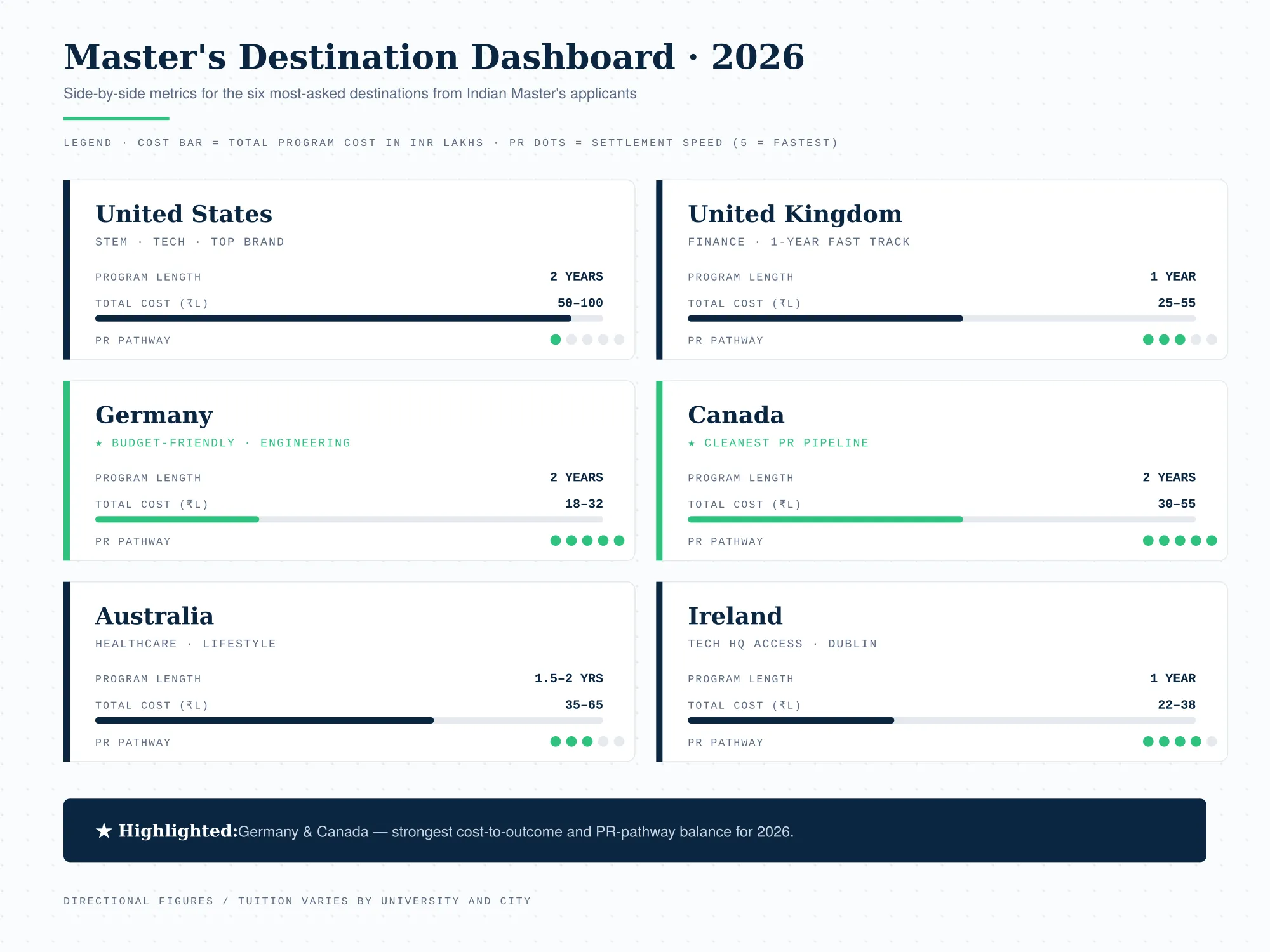
A Quick Comparison Snapshot
| Country | Program Length | Total Cost (INR equivalent) | PR Pathway | Best For |
|---|---|---|---|---|
| USA | 2 years | ₹50–100 lakh | Slow | STEM, top brand |
| UK | 1 year | ₹25–55 lakh | Moderate | Finance, fast track |
| Germany | 2 years | ₹18–32 lakh | Fast (21 mo) | Engineering, budget |
| Canada | 2 years | ₹30–55 lakh | Clean | PR-focused students |
| Australia | 1.5–2 years | ₹35–65 lakh | Moderate | Healthcare, lifestyle |
| Ireland | 1 year | ₹22–38 lakh | Fast for tech | Tech sector access |
Costs are approximate and vary significantly by city, university, and program. Use as directional, not precise.
How to Match the Right Country to Your Profile
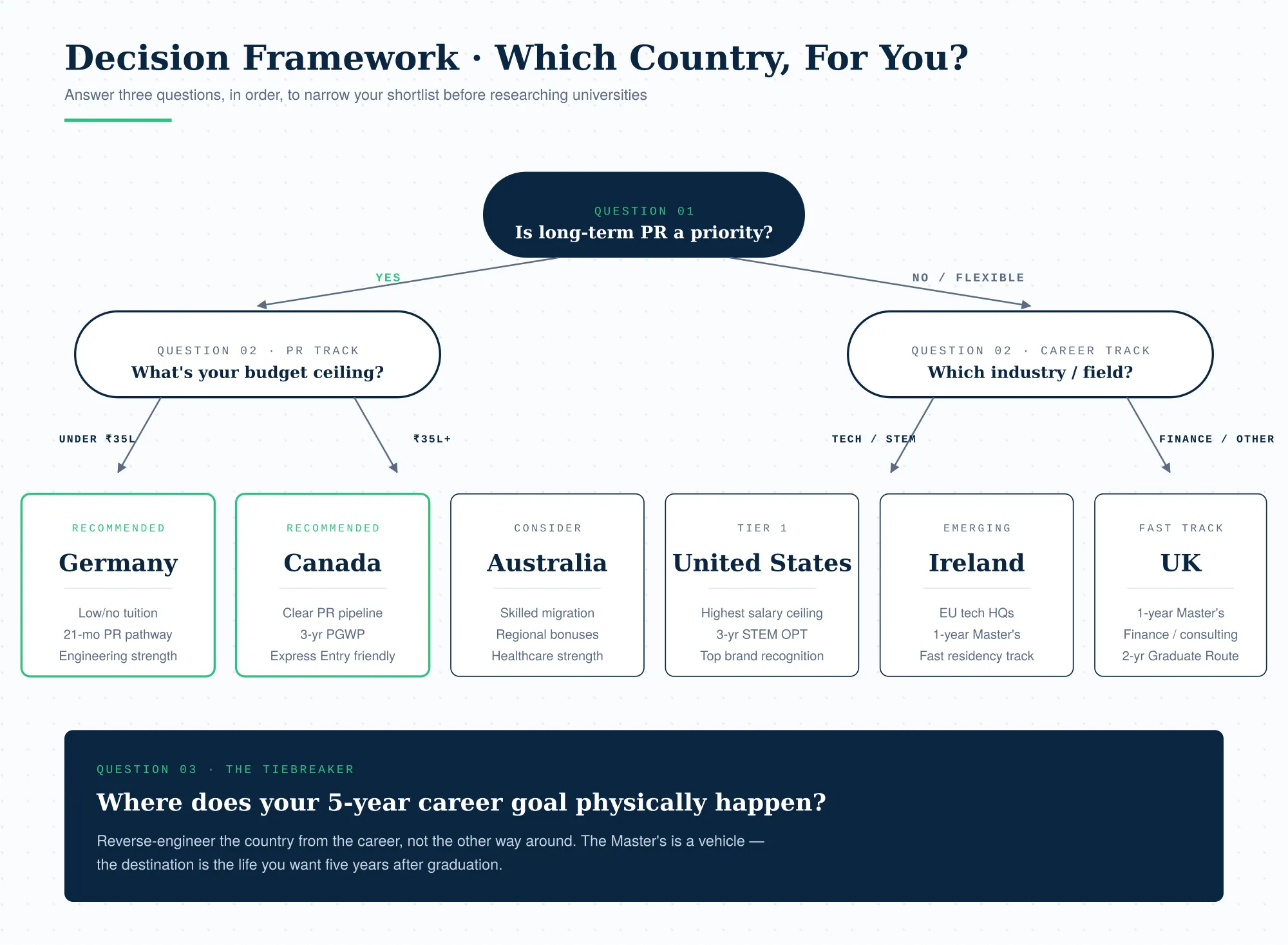
- Your undergraduate field and grades: Some programs in the US and UK are competitive for the wrong reasons — they accept students they shouldn't, and those students struggle. Honest profile assessment matters.
- Your test scores and language readiness: GRE/GMAT, IELTS/TOEFL, and language proficiency (especially German for Germany) all shape your realistic options.
- Your career goal 5 years out: Where do you want to be? In which industry? With what kind of life? Reverse-engineer the country from there.
- Your financial bandwidth: Have a Plan B if scholarships don't come through. Don't bet everything on a scholarship you haven't won yet.
How LiftmyGrade Helps Master's Aspirants
At LiftmyGrade, our Master's Abroad pathway is built specifically around this country-fit decision and everything that flows from it:
- Career-oriented country strategy — matching you to countries based on long-term goals, not popularity
- Scholarship guidance — mapping you to fundable scholarships across your shortlisted countries
- SOP and academic essay support — translating your story into application material that ranks
- Research profile development — for students considering research-track Master's
- PR and settlement planning — factoring long-term immigration into country choice
- University application support — end-to-end execution across multiple applications
We treat Master's planning as a 12-month strategic process, not a 3-month rush.
Frequently Asked Questions
Germany leads on tuition (often free at public universities), with total 2-year costs typically in the INR 18–32 lakh range — almost entirely living expenses. Ireland and parts of Canada (in smaller cities) follow.
For STEM students in tech, data, and engineering — yes, the salary premium typically justifies the investment even with H-1B uncertainty. For non-STEM Master's where work authorization is harder, the case is weaker and you should consider UK, Canada, or Ireland.
For most Indian middle-class families, scholarships make the difference between feasible and not. Government scholarships (Fulbright-Nehru, Chevening, Commonwealth, DAAD) are competitive but transformative if secured. University merit aid is more accessible but smaller.
Yes, in all six countries above, though limits vary. Typically 20 hours/week during semester, full-time during breaks. Part-time work helps with living costs but rarely covers tuition.
12–18 months before your intended intake. This gives you time for test prep, university shortlisting, scholarship applications, SOP development, and application strategy. Students who start 3–4 months out almost always end up with weaker offers.
Ready to Build Your Master's Roadmap?
The right country for your Master's isn't the one with the loudest marketing. It's the one that aligns with your career goals, financial reality, and long-term plans.
Explore LiftmyGrade's Master's Abroad pathway to see how we help students make this decision strategically — and then execute every step that follows, from SOPs to scholarships to settlement planning.
Pick your country once. Pick it right.