
Why Study Abroad Applications Get Rejected (And How to Fix It Before You Submit)

Most rejected applications aren't rejected for the reasons students think. The applicant assumes it was their GPA, their GRE, or "they only take students from IITs." The actual reason, visible only to the admissions committee, is usually a profile that didn't make a clear, distinctive argument for itself.
This guide breaks down the real rejection patterns we see across Bachelor's, Master's, and PhD applications from India, and what to fix before you submit, not after the email arrives.
Below, each pattern is explained from the committee's side, followed by a practical fix. If you are asking why study abroad applications get rejected, start by finding which of these five describes your own application.
The Five Rejection Categories
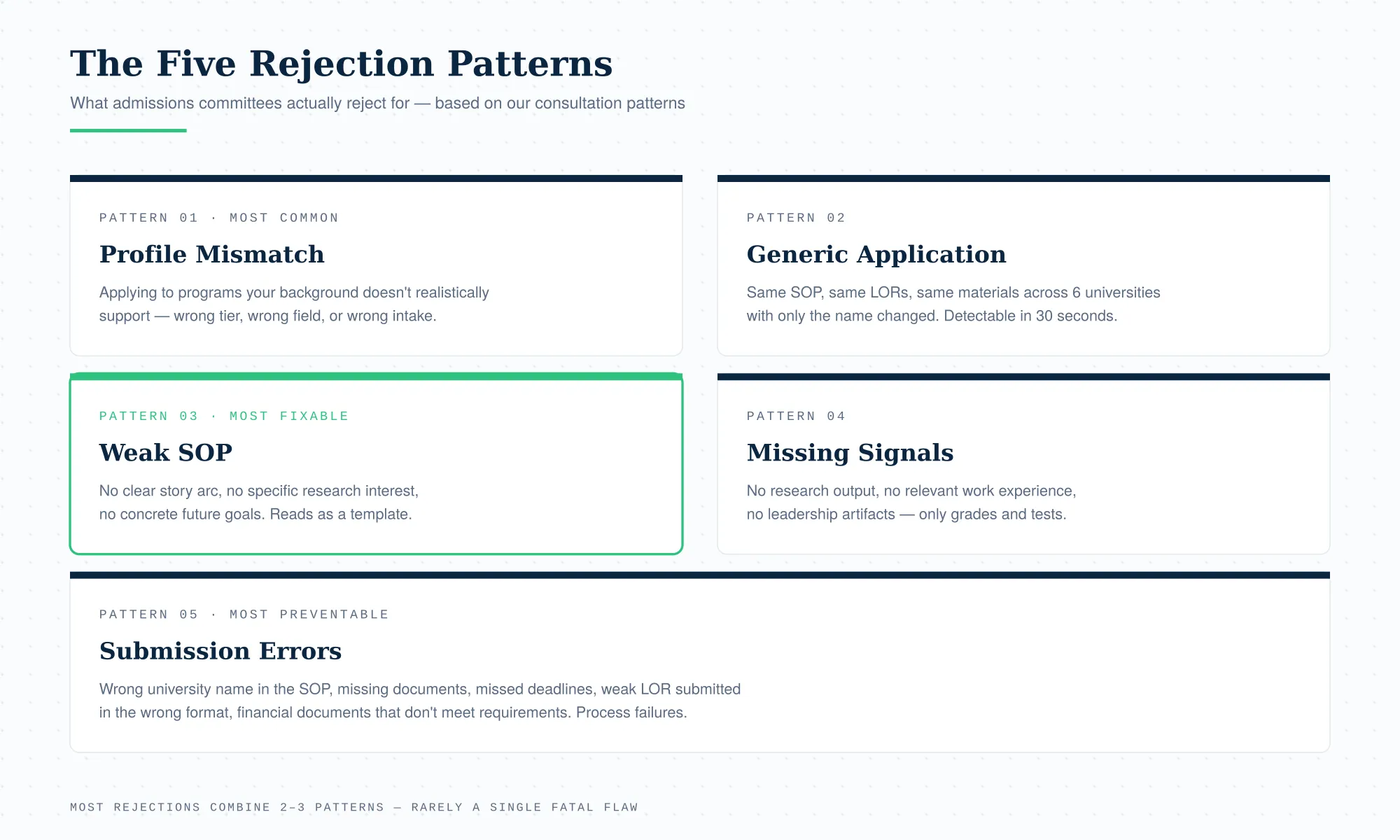
Rejections cluster into five recognizable patterns. Most failed applications fall into one (sometimes two) of these, rarely "the candidate just wasn't good enough."
- Profile mismatch
- A generic or unfocused SOP
- Weak or generic recommendation letters
- No evidence of research or academic fit
- Execution and readiness problems
Pattern 1: Profile Mismatch
You can have a strong profile that's still mismatched to the program. A 9.2 CGPA in Mechanical Engineering doesn't help a Computer Science PhD application without demonstrating necessary coursework or research experience. Committees don't admit smart people; they admit smart people who fit their specific cohort needs. A related version is sending one generic profile to programmes with very different focus areas, so no single application looks designed for the place it is going to.
How to fix it: Read the programme's curriculum, entry requirements and faculty research areas before you shortlist it. Apply where your coursework, projects and goals line up with what the programme teaches. If there is a gap, close it with relevant coursework or a documented project, or choose a different programme. If the gap is too large for this cycle, a readiness check before applying is better than a rejection.
Pattern 2: A Generic or Unfocused SOP
A statement of purpose that opens with a childhood dream, repeats the CV line by line, or could be sent to any university unchanged gives the committee nothing to remember. It explains who you are but never argues why this programme is the right next step for you. Committees read many of these, and the ones that stand out are specific about the programme, the faculty and the applicant's own direction.
How to fix it: Build the SOP around one clear argument: what you want to do, what you have already done toward it, and why this programme and these faculty are the way to get there. Cut anything that does not support that argument. Our guides on writing a winning SOP for studying abroad and on the SOP opening paragraph mistake show the structure and the most common errors. It also helps to be clear on your long-term motivation for studying abroad, because committees can tell when it is missing.
Pattern 3: Weak or Generic Recommendation Letters
A letter from someone who barely supervised you, or one that praises you in general terms without a single concrete example, adds little. A letter that contradicts your CV or SOP can do real damage, because committees notice when the three documents describe different people.
How to fix it: Choose referees who have actually taught, supervised or managed your work. Give them your CV, your SOP draft, the programme details and the points you hope they can speak to, and give them enough time. Our guide on how to get strong letters of recommendation explains how.
Pattern 4: No Evidence of Research or Academic Fit
For Master's and especially PhD applications, committees look for signs that you can do academic work: projects, research experience, a clear research direction, and for PhDs, alignment with a specific supervisor. A Master's applicant whose only evidence is coursework, or a PhD applicant whose interests match no faculty member's current work, gives the committee little reason to believe the research will go well. A vague proposal or an unanswered supervisor email often means the application never gets serious attention.
How to fix it:
- Build an academic CV for study abroad that puts research and projects first.
- Write a focused proposal. See how to write a research proposal for a PhD abroad and the structure supervisors actually scan.
- Contact supervisors properly, using our guides to professor outreach for a PhD abroad and how to email a PhD supervisor.
- If you have a paper, make sure it is genuine. Learn how to verify a journal before submitting, and see why publishing a paper can help postgraduate applicants and what it changes in a funded application.
Pattern 5: Execution and Readiness Problems
Some applications are rejected because of avoidable mistakes: details that differ between documents, missed requirements, typos, claims that cannot be verified, or an application sent before the profile was ready. In these cases the candidate may be capable, but the application does not show it. Another common version is an inconsistent story, such as an SOP that describes one goal while the CV and letters point somewhere else.
How to fix it: Cross-check every document against the others before you submit, follow each university's instructions exactly, and verify every publication and reference you list. Be honest about readiness too. Sometimes the right answer is to strengthen your profile first and apply next cycle. If you are speaking to a consultant, know what a free study abroad consultation should look like.
Why the Reason Is Rarely Just Your GPA
Admissions committees usually compare many capable candidates for a limited number of places, so the decision is rarely about a single number. They read your SOP, CV and letters together and ask whether they tell one consistent story: what you want to do, why this programme, and what evidence supports it. They also cannot call you to clarify, so your documents have to answer their questions on their own.
An application with a slightly lower GPA but a sharp argument and strong evidence often reads better than a high-scoring one with none.
A Pre-Submission Checklist
- The programme matches your coursework, projects and goals.
- Your SOP makes one clear argument and is written for this programme.
- Your recommenders know your work and have the details they need.
- Your CV leads with research and projects, with every claim verifiable.
- For a PhD, your proposal and supervisor outreach are focused and specific.
- Names, dates, grades and details match across all documents.
- Every university requirement and deadline has been checked.
- Someone other than you has proofread the full application.
What to Do If You Have Already Been Rejected
A rejection is information, not a verdict on your ability. Take it in four steps:
- Diagnose: Compare your application against the five patterns above and identify the weakest part, instead of assuming it was your GPA.
- Ask for feedback: Where a university offers it, request it, although many do not.
- Fix the weakest area first: Improving one real weakness is better than rewriting everything.
- Decide your next move: Choose honestly between reapplying, changing your target programmes, or waiting for the next intake. Check each university's reapplication policy, because rules differ.
Frequently Asked Questions
A high GPA shows academic performance, but committees also look for fit, a clear argument, strong references and evidence of research or relevant experience. Most rejections come from gaps in those areas.
Often yes, but policies differ by university and programme. Check the rules, and reapply only when the application is meaningfully stronger.
There is no fixed number. A shortlist you can genuinely tailor, with a clear reason for each programme, usually works better than a long list of generic applications.
A genuine, well-placed paper can strengthen a research-focused application, but it does not guarantee admission. It also needs to be real and verifiable.
Get Your Application Reviewed Before You Submit
It is far easier to fix an application before you send it than after a rejection. LiftMyGrade's admissions team works on SOPs, LORs and academic CVs as part of a full application plan built around your target programmes.
Start with the free readiness assessment to see where your profile stands, or read how we work and browse all our services.
We do not promise admission outcomes, only a clearer, stronger and honest application that gives the committee every reason to take a closer look.