
Top Scholarships for Indian Students to Study Abroad in 2026: A Complete Guide

Studying abroad without a scholarship is possible. Studying abroad well without one — at a top university, in the program you actually want, without crushing family debt — usually isn't. For most Indian middle-class families, scholarships aren't an optional bonus. They're the difference between a feasible plan and an aspirational fantasy.
The good news: more than two dozen serious scholarships are available to Indian students across the Bachelor's, Master's, and PhD levels. The harder news: most of them open and close 6–9 months before university application deadlines, and Indian students consistently miss them by treating scholarships as something to "look into" after applying.
This guide breaks down the scholarships that matter, what they cover, who they're realistic for, and how to actually win one.
The Three Tiers of Scholarships You Should Know
Not all scholarships are the same. They differ in funding amount, prestige, eligibility filters, and competition level. Understanding which tier you're realistically competing in saves months of misdirected applications.
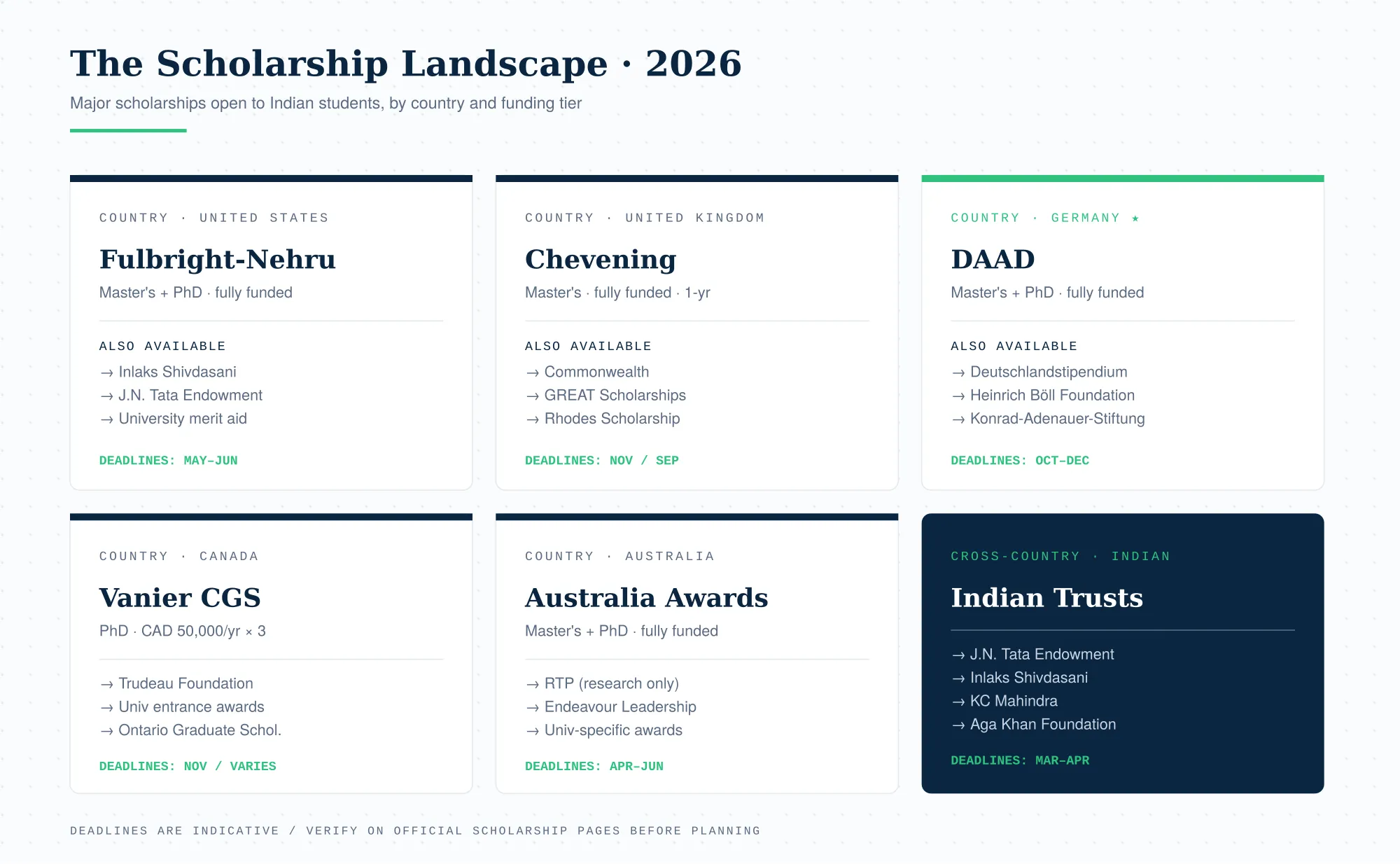
- Tier 1 — Government & Sovereign Scholarships., prestigious, internationally branded. Fulbright (US), Chevening (UK), DAAD (Germany), Commonwealth (UK), Vanier (Canada). These cover tuition + stipend + flights + insurance, but admission rates are typically 2–5%.
- Tier 2 — University Merit & Need-Based Aid. Direct from the institution. Cover partial-to-full tuition, sometimes with a stipend. More accessible than Tier 1, but each university has different rules — research them program-by-program.
- Tier 3 — Private Foundations & Indian Trusts. Tata, Inlaks Shivdasani, J.N. Tata Endowment, KC Mahindra. Cover specific portions (tuition, travel, books) and are particularly accessible for high-merit Indian students.
The strongest applicants stack across tiers — they don't bet on one Tier 1 win.
The Major Scholarships Deep Dive
Fulbright-Nehru (United States)
One of the world's most prestigious scholarships, for Master's and PhD in the US. Covers tuition, stipend, travel, and health insurance. Highly competitive (around 80–100 awards per year for India), with separate streams for Master's (Fulbright-Nehru Master's) and doctoral research. Application opens around February, closes mid-May. Strong emphasis on leadership, demonstrated impact, and clear return-to-India intent.
Chevening (United Kingdom)
one-year Master's at any UK university. Approximately 65–80 Chevening scholarships are awarded to Indian applicants annually. Applications open in August, close in early November. Selection emphasizes leadership potential, networking ability, and clear post-Master's career plans.
DAAD (Germany)
Germany's official academic exchange service. Multiple streams: Master's (EPOS-funded development-relevant), Doctoral (full and joint funding), and short research grants. Generous monthly stipend (~EUR 934 for Master's, ~EUR 1,300 for PhD) plus tuition and travel. Deadlines vary by program — most fall between September and December.
Commonwealth Scholarships (UK)
Funded by the UK government for citizens of Commonwealth countries. Master's, PhD, and split-site PhD options. Applications close in early December. Focus on developmental impact in your home country.
Vanier Canada Graduate Scholarships
PhD-only, CAD 50,000/year for three years. Awarded by Canadian universities (you must be nominated by the university). Internal university deadlines fall in October–November.
Rhodes Scholarship (Oxford)
postgraduate study at Oxford. Five Rhodes Scholarships are awarded to Indian citizens each year. Extremely competitive, selection emphasizes intellectual excellence, character, and commitment to public service. Application closes around end of July.
Inlaks Shivdasani Foundation
Indian-funded, covers part of tuition + living costs at top universities globally. Excellent for Master's-level applicants. Applications typically close in March.
J.N. Tata Endowment
Loan-scholarship from the Tata Trusts for Indian postgraduate students studying abroad. Covers up to INR 10 lakh, repayable on favorable terms. Applications close in late March.
How to Actually Win a Scholarship
The students who win Tier 1 scholarships share a pattern. Their applications aren't generic essays about "wanting to study abroad." They're tightly argued cases that demonstrate three things: a specific contribution they'll make, a clear connection to the scholarship's stated mission, and credible evidence that they've already started doing the work.
- Map your scholarship calendar 12 months out. Most students discover scholarships when they discover universities — far too late. Build your calendar in reverse: when do scholarships close, what do they need, when do I start drafting?
- Tailor each application — don't recycle. A Chevening essay isn't a Fulbright essay isn't a DAAD motivation letter. Each scholarship has stated values (leadership, research impact, developmental contribution, regional knowledge). Your essay needs to mirror those values with evidence specific to you.
- Apply for more than you think you can win. Tier 1 acceptance rates are low. Apply to 4–6 scholarships across tiers, not 1–2. A common pattern that wins: one Tier 1 (Fulbright/Chevening), two Tier 2 (university aid), one Indian trust (Inlaks/Tata).
- Get LORs from people who can speak to scholarship-specific qualities. A research-focused scholarship needs a recommender who can describe your research process. A leadership scholarship needs a recommender who has watched you lead something concrete.
Common Scholarship Application Mistakes
- Treating the SOP and scholarship essay as interchangeable. They serve different audiences with different priorities. Scholarship essays should explicitly engage with the scholarship's mission.
- Vague "return to India" claims. For Fulbright and Chevening, the return narrative matters. Don't just state intent — describe what you'll do, where, and why your foreign education makes that work possible.
- Missing the scholarship's named requirements. Some scholarships require specific work experience, specific leadership roles, or specific research output. Read the eligibility criteria literally, not aspirationally.
- Waiting for a university admission to apply for a scholarship. Most scholarships are independent of admission. You apply for them in parallel — not after.
How LiftmyGrade Supports Scholarship Applications
Scholarship strategy is built into every LiftmyGrade pathway. Our mentors map your eligible scholarships at the start of the engagement, build a calendar that runs ahead of university deadlines, and work with you on scholarship-specific essay drafts (which are structurally different from SOPs).
For PhD applicants, we focus on funding pathways — research fellowships, university assistantships, project-based funding, and government scholarships. For Master's applicants, we map all five tiers. For Bachelor's applicants, we focus on university-specific aid and Indian trust applications.
The goal isn't to apply to every scholarship. It's to apply to the right four to six — with applications that actually reflect the scholarship's stated mission.
Frequently Asked Questions
Yes — and you should. Most scholarships allow concurrent applications. Some (like Chevening and Commonwealth) have specific rules about combining funding, but applying to several in parallel is standard practice.
Generally no — scholarships are evaluated independently of university admissions. Some scholarships (like Vanier) require university nomination, so the university must support your application internally. Most don't.
Application opens in February. Deadline in May. Interview shortlist announced in August. Final decisions in February of the following year. Yes — over a year of process.
Yes — most major scholarships are not purely GPA-driven. Fulbright weights leadership and impact equally with academics. DAAD weights research fit and project quality. Chevening weights leadership potential and post-study plans. A clear narrative often beats a slightly higher GPA.
Yes. The Schlumberger Foundation Faculty for the Future grant, AAUW International Fellowships, and various country-specific awards. Plus university-specific awards at MIT, Stanford, ETH, and others.
Ready to Build Your Scholarship Strategy?
A scholarship application written six weeks before the deadline almost never wins. One built over six months — with the right essay strategy, the right recommenders, and the right tier coverage — often does.
Explore LiftmyGrade's pathways for Bachelor's, Master's, and PhD applications to see how scholarship strategy fits into our end-to-end approach.
The best scholarship for you is the one you actually win. Let's find it.