
Test-Optional and GRE-Waived Programs Abroad in 2026: The Complete Guide for Indian Students

Since 2020, a quiet revolution has swept graduate admissions abroad. Programs at MIT, Berkeley, Michigan, Columbia, Cornell, Johns Hopkins, and hundreds of others have made the GRE optional — or dropped it entirely. What began as pandemic-era flexibility has hardened into a durable shift in how admissions committees evaluate applicants.
For Indian students, this changes the strategic calculus. A GRE score used to be table stakes. Now, the question is: should you take one at all?
This guide breaks down the state of test-optional graduate admissions in 2026 — what's genuinely optional, what's "optional but expected", which countries have moved fastest, and how to decide whether to invest 4 months in a GRE prep cycle you may not need.
Three Different Kinds of "Test-Optional"
Not all "test-optional" policies mean the same thing. Understanding the distinction saves months of misdirected planning.
- Category 1: Test-Optional (Genuinely Neutral). The program has no preference. Applicants who submit and applicants who don't are evaluated identically. Most public US universities and many UK/European Master's fall here.
- Category 2: Test-Optional (But Preferred). The program says "not required" but admissions committees favor applicants who submit strong scores. If your target GPA is borderline for the program's admitted student profile, a strong test score becomes an implicit boost. Some Ivy League and top-15 US programs behave this way.
- Category 3: Test-Waived Entirely. The program does not accept scores even if you submit them. GRE isn't part of evaluation. This is increasingly common at UK, Australian, German, and Canadian universities.
The best question to ask any target program: "If I don't submit a GRE score, will my application be evaluated differently than if I do?" The honest answer tells you whether the test-optional policy is category 1, 2, or 3.
Country-by-Country Landscape
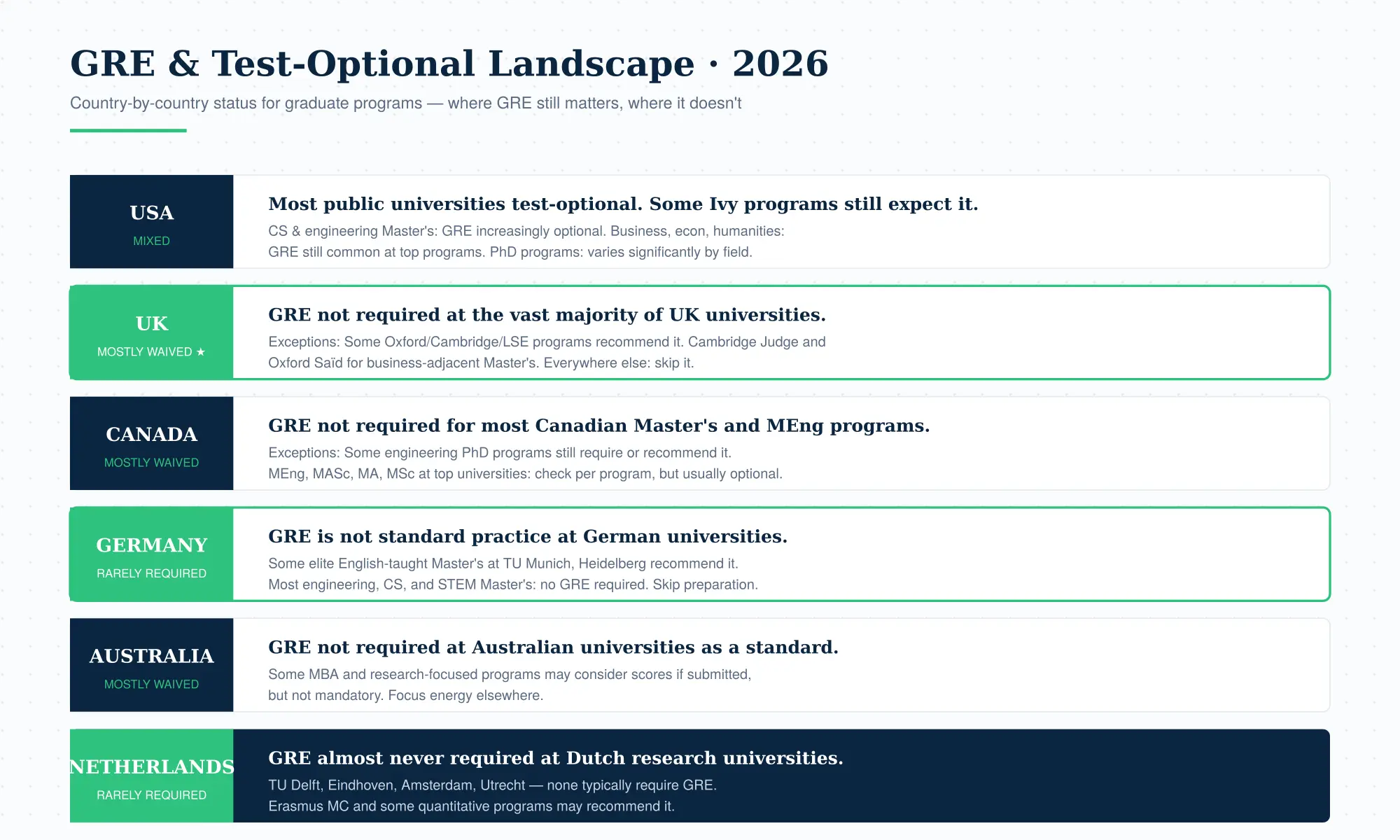
Where GRE Still Matters
Despite the broad shift, GRE remains genuinely important in a few specific contexts. Recognize them and plan accordingly.
- Top US PhD programs in STEM. Stanford, MIT, Caltech, Princeton, Harvard PhDs in CS, engineering, mathematics, physics — GRE (and Subject GRE for physics/math/CS) still carries weight. Not mandatory everywhere, but strong scores are common in admitted applicants.
- Business-adjacent Master's programs. MBA (GMAT more than GRE, but both accepted), Master's in Finance, Business Analytics at top schools — quantitative section scores often expected. LBS, INSEAD, Wharton, Sloan.
- Some economics and public policy Master's. Harris (UChicago), SIPA (Columbia), Kennedy (Harvard), LSE Master's in Public Policy — GRE quantitative scores still weighed.
- Scholarship consideration. Some scholarships (Fulbright, various university-specific awards) still request GRE scores as part of evaluation, even if the target program doesn't require them.
- Applicants from unfamiliar undergraduate institutions. If your Bachelor's is from a university that admissions committees don't recognize easily, strong GRE scores can substitute as a signal of academic rigor. Applicants from lesser-known Indian universities sometimes benefit from submitting GRE even where "optional."
When to Skip GRE Entirely
Skip GRE preparation if:
- Your target programs are all UK, Australian, German, Canadian, or Netherlands Master's. Very unlikely you'll need it.
- Your target programs explicitly say "GRE not accepted" or "not required." Category 3 above. Save the time.
- You have strong quantitative markers already — Bachelor's from a recognized institution (IIT, NIT, BITS, ISI, top NITs), high CGPA in quantitative subjects, publications, work experience in quantitative roles. The GRE adds less marginal signal.
- Your target field genuinely doesn't emphasize GRE. Humanities, design, architecture, education — GRE is often either not required or heavily discounted.
When to Take GRE Even If Optional
Consider taking GRE if:
- You're applying to top US PhD programs, especially STEM. Even "optional" programs at Stanford, MIT, Berkeley, Michigan often evaluate submitted scores favorably.
- Your Bachelor's institution isn't well-known internationally. GRE adds a comparable metric across applicants.
- Your GPA is borderline for target programs. A strong quantitative GRE (167+) can offset a mid-tier GPA.
- You're applying for scholarships that explicitly consider GRE (Fulbright and others).
- You're pivoting fields. Applying to CS from a mechanical background, or economics from an engineering background — GRE quantitative can demonstrate readiness for the new field.
The Master's Programs Where GRE Is Truly Optional Now
Some notable examples where GRE was formerly expected but is now genuinely optional (verify current policy per program before applying):
- Computer Science / Engineering Master's: UC Berkeley's Master of Engineering, University of Michigan MSCS, Cornell MEng, Columbia MS in CS, University of Washington MSCS, Georgia Tech MSCS (via OMSCS or on-campus), UIUC MCS.
- Data Science / Analytics: Northwestern MSiA, UChicago MS in Applied Data Science, USC DS Master's, several UC campus DS Master's.
- Public Health / Sciences: Harvard T.H. Chan MPH, Johns Hopkins MPH, University of Michigan MPH, most epidemiology programs.
- Environmental / Sustainability: Yale F&ES, Duke Nicholas School Master's, several sustainability-focused programs.
Always verify the current policy on the specific program page. Policies have shifted repeatedly since 2020.
Strategic Implications for Your Timeline
If you determine that GRE isn't necessary for your target programs, you free up 3–4 months of focused prep time. Reinvest strategically:
- Deeper research on target programs — read faculty papers, understand curriculum specifics
- Stronger SOPs — multiple rounds of revision produce meaningfully better essays
- Better research output — a publication, a working paper, an open-source contribution can outweigh a GRE score at many programs
- Portfolio development — for design, architecture, or applied fields
- Language investment — B1 German, French, or Spanish can open program options and career pathways
The GRE-optional trend has been a genuine gift to Indian applicants who use the freed time well.
Common Test-Optional Mistakes
- Assuming "test-optional" means "test doesn't matter" everywhere. At category-2 programs, it still counts. Verify by looking at admitted-student profiles where published.
- Taking GRE "just in case." Costs you INR 20,000+ and 3–4 months of prep. Better to make a definitive decision.
- Submitting weak GRE scores. If your GRE is 300 total and the program is optional, don't submit. Submitting weak scores can hurt more than not submitting at all.
- Not verifying at the program level. University policies aren't the same as department policies. A university may broadly be "test-optional" while a specific department expects scores.
- Confusing GRE requirements with English test requirements. IELTS/TOEFL is separate — that's almost universally required (with some exceptions for applicants who studied in English-medium institutions).
How LiftmyGrade Advises on Test Strategy
At LiftmyGrade, test strategy is part of our pathway kickoff for Master's and PhD applicants. Our mentors work with students on:
- Program-specific test policy verification — the honest picture at each target program
- Cost-benefit analysis — whether GRE preparation is likely to move outcomes for your specific profile
- Timeline optimization — reallocating GRE prep time to higher-leverage application work
- Score-target setting for cases where GRE is genuinely valuable
- Application positioning without GRE — how to build strong signals when you skip the test
The best test strategy is the honest one. Sometimes GRE moves the needle. Sometimes it wastes months. Knowing which applies to your specific case saves both time and money.
Frequently Asked Questions
Can I apply to top US PhD programs without GRE in 2026?
At many programs, yes. Stanford, MIT, Berkeley, and others have made GRE optional in various departments. However, top applicants often still submit strong scores where possible — especially in STEM. Check per department, not per university.
If I have a low undergraduate GPA, will GRE help me?
Possibly. A strong GRE (particularly quantitative for STEM programs) can partially offset GPA concerns. But the offset is limited — a great GRE won't save a GPA below 3.0 (7.5/10) at competitive programs.
How much does GRE preparation cost?
Realistic prep costs: INR 5,000–15,000 for self-study materials. INR 25,000–60,000 for coached prep. Plus the test fee (~USD 220 = INR 18,000+) and potential retake fees.
What score do I need if I take GRE?
For competitive US Master's/PhD applications: Quantitative 165+, Verbal 155+. For scholarship consideration: Quantitative 167+, Verbal 160+. For non-STEM programs: Verbal weighted higher, Quantitative expectations lower.
Is GMAT better than GRE for MBA applications?
Both are accepted at most business schools, but GMAT is historically more common for MBA. GRE is more common for MS in Finance, MS in Business Analytics, and MA in Economics. Take whichever matches your test-taking strengths — quantitative test-takers often prefer GMAT format.
Ready to Make a Smart Test Decision?
The best test is the one that actually helps your application. Sometimes that's GRE. Often, in 2026, it's not. Making the honest determination for your specific case is one of the highest-leverage decisions in your entire application cycle.
Explore LiftmyGrade's pathways for Master's and PhD — test strategy is built into your engagement from day one.
Every hour you save on unnecessary GRE prep is an hour that goes into a better application. Choose wisely.