
Studying in the Netherlands: The Complete Guide for Indian Students in 2026
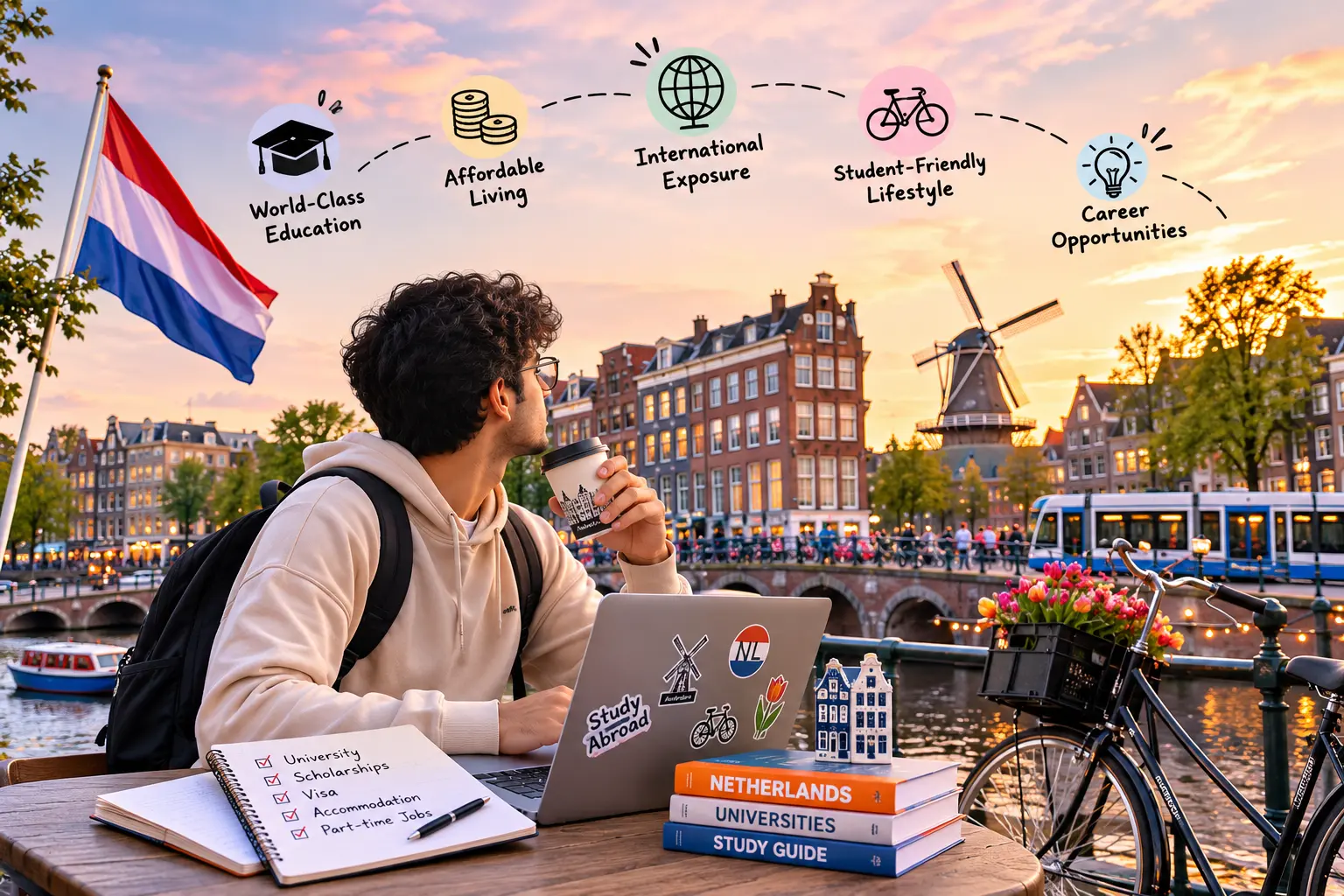
The Netherlands is quietly one of the strongest study-abroad destinations for Indian students — and one of the most underappreciated. It sits in the sweet spot that many other countries can't match: world-class universities, all-English instruction, tuition significantly below the US and UK, a clean post-graduation work visa, and access to the broader European job market.
While Germany dominates the "affordable Europe" conversation, the Netherlands quietly outperforms it on one dimension that matters enormously: English is not just tolerated, it's the default language of academic and professional life for international graduates in most cities.
This guide covers everything Indian students need to know about the Netherlands in 2026 — universities, costs, application processes, and life on the ground.
Why the Netherlands Deserves a Serious Look
Three genuine advantages set the Netherlands apart:
- English is the working language of academic and knowledge-economy life. Roughly 90% of Dutch adults speak English fluently. Universities offer 2,000+ programs in English. You can complete a Master's, land a knowledge-worker job in Amsterdam or Utrecht, and never need to become fluent in Dutch.
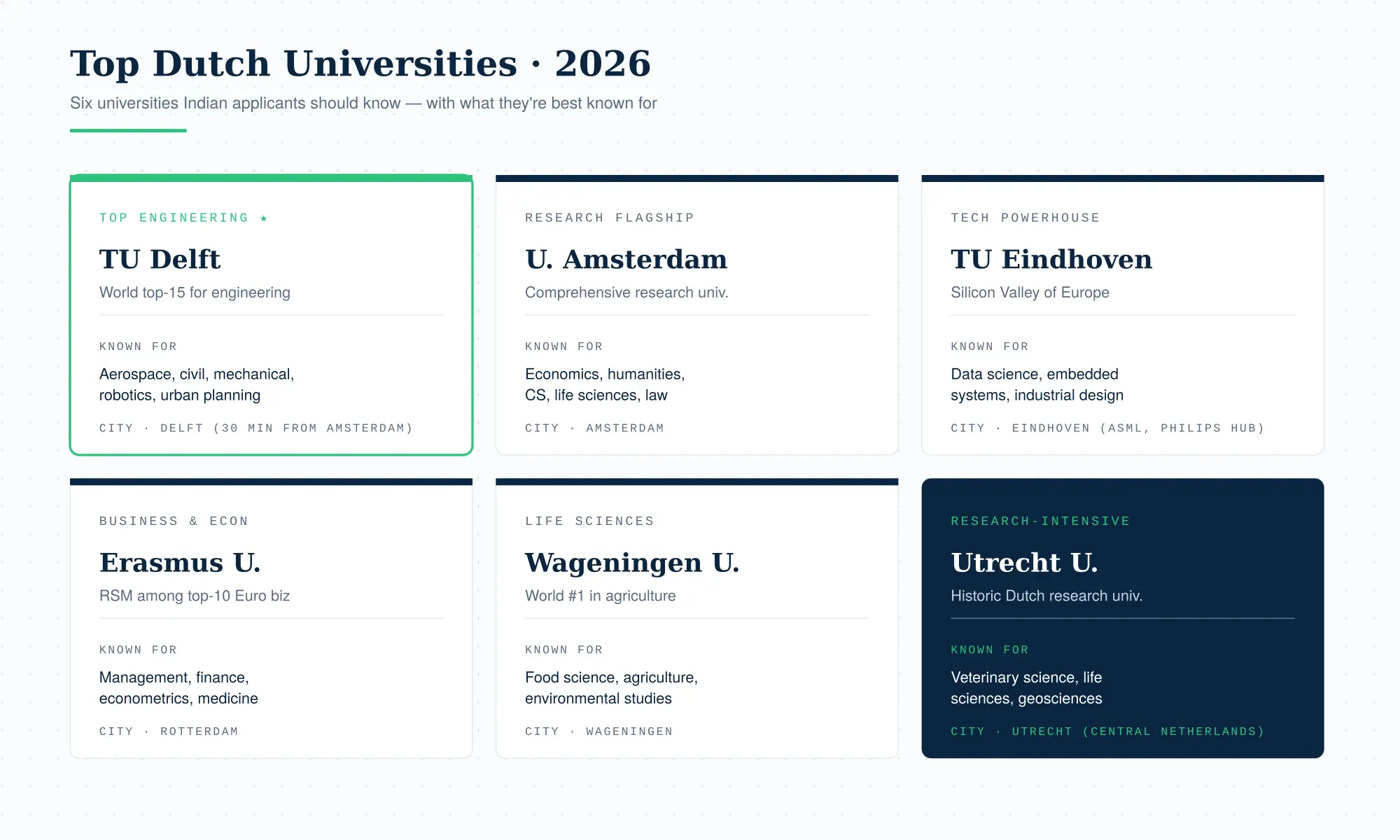
- Highly ranked universities at reasonable cost. Delft University of Technology (TU Delft), University of Amsterdam, Utrecht University, Erasmus University Rotterdam, Wageningen University are all among the world's top 100-150 in most rankings. Tuition for non-EU students is EUR 8,000–20,000/year — dramatically less than comparable UK or US programs.
- The Orientation Year visa. After graduation, non-EU graduates can apply for a Zoekjaar (Orientation Year) visa: a 1-year permit to search for a "highly-skilled migrant" job in the Netherlands, with permission to work in any capacity while searching. This is one of the more generous post-graduation work provisions in Europe.
Top Universities and What They're Known For
The Cost Reality
Tuition and living costs in the Netherlands sit in the middle of the European affordability spectrum — more than Germany, less than the UK, considerably less than most US programs.
Tuition for non-EU international students (2026 figures — verify current):
- Bachelor's: Typically EUR 8,000–15,000/year at research universities. Some university colleges charge higher — EUR 12,000–20,000.
- Master's: Typically EUR 15,000–20,000/year for one- or two-year programs. Business Master's at Erasmus and Amsterdam can reach EUR 25,000+.
- PhD: In the Netherlands, PhDs are structured as employment — you're a salaried employee, not a fee-paying student. No tuition, and you earn a monthly salary (EUR 2,700–3,500 gross depending on year).
Living costs (per month, moderate lifestyle):
- Amsterdam: EUR 1,100–1,500 (housing is the largest and most volatile cost)
- Rotterdam / Utrecht: EUR 900–1,200
- Groningen / Enschede / Nijmegen / Wageningen: EUR 750–1,000
Total 2-year Master's cost from India: typically INR 30–50 lakh, depending on city and program.
Total 1-year Master's cost: typically INR 20–30 lakh — comparable to a UK 1-year Master's at a lower price point.
Application Timeline for September 2026 Intake
The Netherlands runs on a September academic year, with limited February intakes for some programs.
- T-12 months (September 2025): Research programs, shortlist, start language tests (IELTS 6.5+, TOEFL 90+).
- T-9 months (December 2025): Apply through Studielink (the central Dutch university application portal). Some universities require their own portals in addition.
- T-6 months (March 2026): Application deadlines for most Master's programs. Some fall earlier — January 15 for scholarships, February 1 for competitive programs. Business Master's at Erasmus and Amsterdam often close by January.
- T-4 months (May 2026): Admission decisions arrive. Formal acceptance triggers next steps.
- T-3 months (June 2026): Apply for MVV visa (entry visa) through your university. The university acts as a "recognized sponsor" and handles most of the paperwork. Processing time: 2–4 weeks typically.
- T-2 months (July 2026): Confirm accommodation. Housing in Dutch cities is competitive — start early.
- T-1 month (August 2026): Arrive in Netherlands, register with the municipality (Basisregistratie Personen), open a bank account.
The Application Process
The Netherlands has centralized parts of its application process, which is unusual in international higher education.
Studielink is the central portal. You register there and can apply to up to 4 programs simultaneously — but only 2 at the same university.
Some universities layer their own portals on top of Studielink — you complete Studielink registration and then upload documents to the university's system for evaluation.
Documents required typically include:
- Bachelor's degree (final or provisional) and transcripts
- Motivation Letter (Dutch universities often prefer this term over SOP — subtly more concise and direct than American SOPs)
- CV
- IELTS/TOEFL/PTE scores
- 2 Letters of Recommendation
- Sometimes: GRE (for select quantitative programs), portfolio (design/architecture), research proposal (research Master's or PhD)
Application fees: Typically EUR 100–150 per program. Lower than US application fees, comparable to UK.
Post-Graduation Work: The Orientation Year
The Netherlands offers a genuinely useful post-graduation pathway.
Zoekjaar (Orientation Year) visa: After graduation, non-EU international graduates can apply for a 1-year permit to search for a "highly-skilled migrant" job in the Netherlands. Key advantages:
- Full work permission during the year (any type of job)
- Not tied to a specific employer
- Once you find a qualifying "highly-skilled migrant" job, you convert to that permit
- Family (spouse and children) can accompany you
Highly-skilled migrant salary threshold for those under 30 is approximately EUR 3,700/month gross (verify current — thresholds update annually). Above 30, higher threshold.
Pathway to PR: After 5 years of continuous legal residence, you can apply for permanent residency. After Dutch language competency (typically A2/B1) and integration, citizenship becomes an option.
The Job Market for Indian Graduates
Netherlands is home to major HQs and offices of Google, Netflix, Uber, Stripe, Booking.com, Elastic, Adyen, ASML, Philips, Shell, ING, and hundreds of tech, financial, and industrial employers.
Strongest sectors for Indian graduates:
- Software engineering and data science — Amsterdam, Utrecht, Rotterdam, Eindhoven
- Semiconductor and hardware — Eindhoven (ASML, NXP, Philips)
- Financial services and fintech — Amsterdam (Adyen, ING, Bunq)
- Life sciences and pharma — Leiden, Utrecht, Wageningen
- Consulting and management — Amsterdam (McKinsey, BCG, Bain all have offices)
English proficiency in the workplace: Very high in these sectors. Dutch language becomes valuable for career progression beyond 5 years, but is rarely required at entry.
Common Mistakes When Applying to Netherlands
- Underestimating housing difficulty. Rental markets in Amsterdam, Utrecht, and Rotterdam are extremely tight. Start housing searches immediately after admission. University-provided housing (where available) is often the safest path.
- Missing the Nuffic Certificate step. Some universities require your Bachelor's degree to be evaluated by Nuffic before evaluation. This adds 2–4 weeks — factor it in.
- Assuming everywhere in Netherlands is Amsterdam. Different cities have different vibes, costs, and job market densities. Delft, Eindhoven, Utrecht, Rotterdam are distinct choices.
- Not applying for the Orientation Year immediately. You must apply within 3 years of graduation. Most students apply during their final semester to have it ready at graduation.
- Overlooking scholarships. Holland Scholarship (EUR 5,000 one-time), Orange Tulip Scholarship, university-specific merit awards, and Erasmus+ scholarships all exist for Indian applicants. Apply early.
How LiftmyGrade Supports Netherlands Applications
At LiftmyGrade, our Master's Abroad pathway includes structured support for Netherlands-specific applications. Our mentors work with students on:
- University-fit matching — Delft for engineering, Erasmus for business, Wageningen for life sciences, Amsterdam for research-heavy Master's
- Motivation letter drafting — subtly different from American SOPs, more direct and concise
- Studielink and university portal navigation
- Scholarship layering — Holland Scholarship + university-specific aid combinations
- Orientation Year and post-study planning — starting during your Master's, not after
The Netherlands offers one of the most balanced study-abroad experiences for Indian students — quality, cost, English access, and post-study pathway all working together.
Frequently Asked Questions
Can I study in the Netherlands without knowing Dutch?
Yes. Programs are English-taught. Academic life, most social settings in Randstad cities, and knowledge-economy jobs all operate in English. Learning basic Dutch helps but isn't required.
Is a Netherlands Master's cheaper than a UK Master's?
Generally yes. Tuition for a Netherlands Master's typically runs EUR 15,000–20,000/year. UK Master's tuition typically runs GBP 20,000–35,000/year. Living costs are broadly comparable. Netherlands is meaningfully more affordable at the tuition level.
Do I need work experience to apply for a Netherlands Master's?
Generally no for research and technical Master's. Business Master's at Erasmus and Amsterdam often prefer 1–2 years of work experience.
What's the post-graduation job market like?
Strong for tech, engineering, data science, finance, and consulting. Netherlands has a "skilled migrant" employer database — many multinational employers actively recruit international graduates. Language is rarely a barrier in these sectors.
Are Netherlands degrees recognized in India?
Yes. Dutch research university degrees carry strong recognition globally, including in India. Many companies with Indian operations (Philips, ING, Shell, ASML) also have India offices — creating natural return-to-India pathways when relevant.
Ready to Explore the Netherlands as Your Study Destination?
The Netherlands rarely gets the first mention when Indian students discuss study-abroad options. That's changing — because the math genuinely works: strong universities, English-taught programs, reasonable cost, clean post-graduation work rights, and a job market that welcomes international graduates.
Explore LiftmyGrade's Master's Abroad pathway — Netherlands-specific application support is built into every engagement.
Sometimes the best destination isn't the most-talked-about one. Sometimes it's the one that fits your goals with the least friction.