
August 2026 to September 2027: The Month-by-Month Timeline for Fall 2027 Applicants
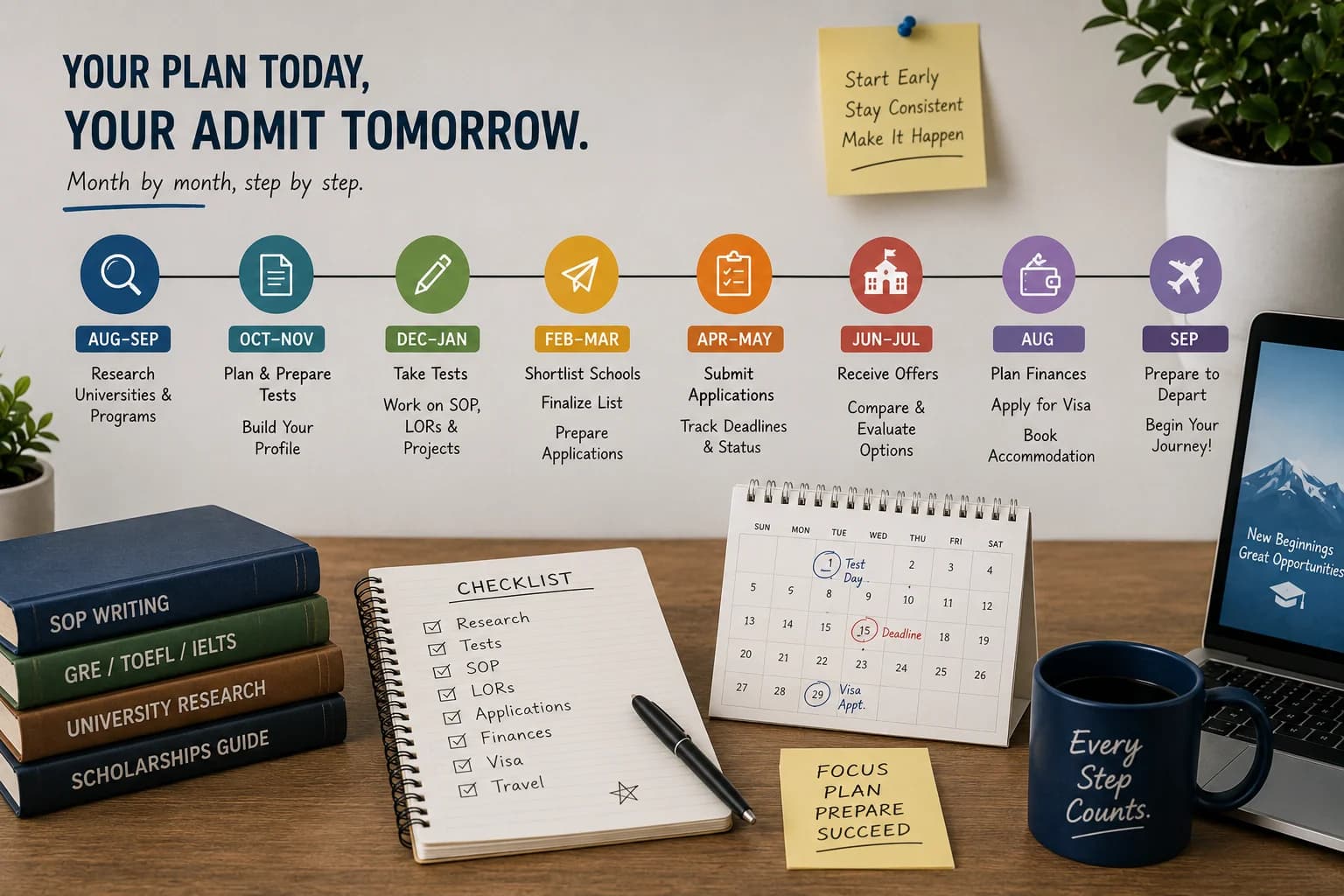
Most people who miss a Fall intake do not miss a deadline. They miss the thing that had to happen four months before the deadline — a test date that was fully booked, a recommender who needed six weeks, a document that had to be attested, a publication that takes half a year regardless of how motivated you are.
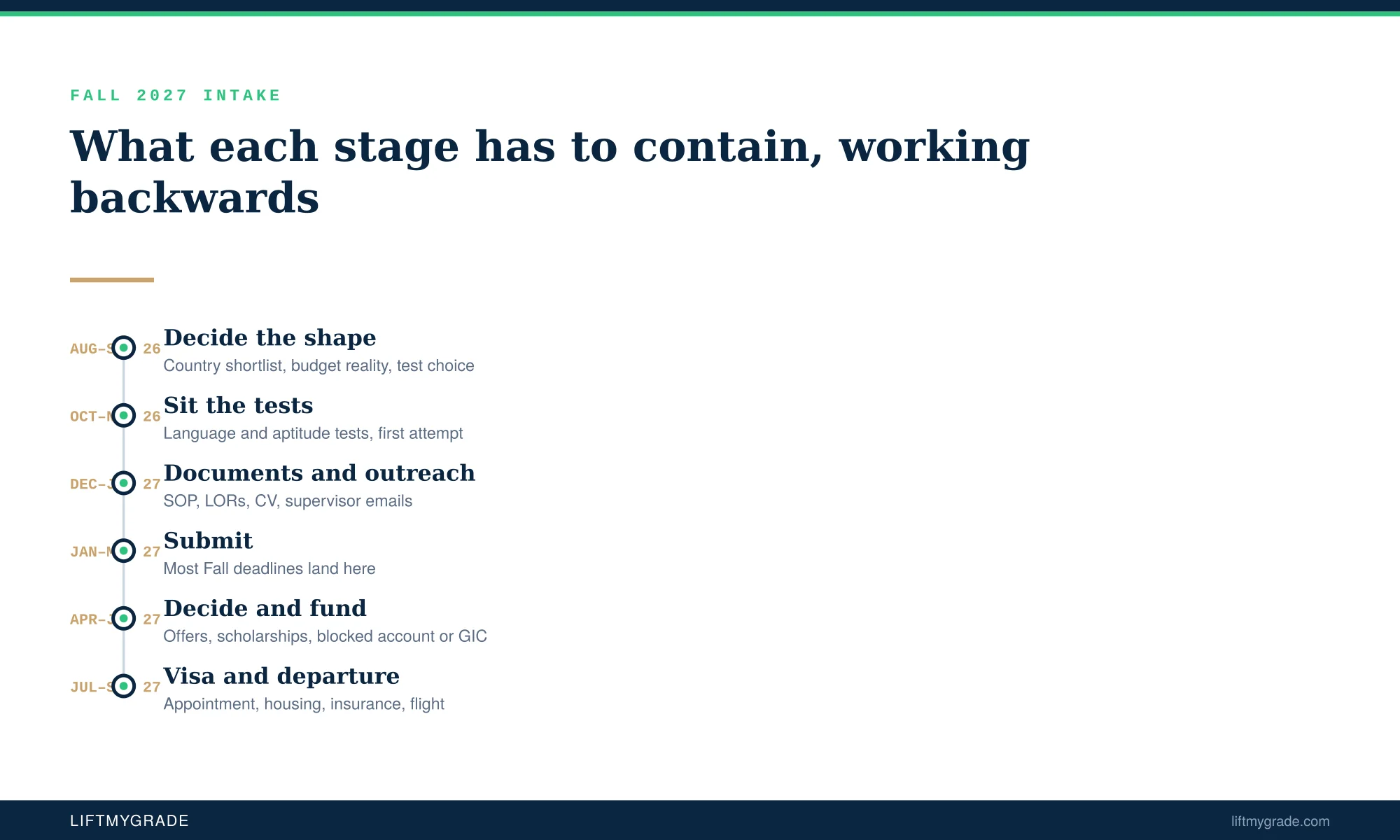
This is the timeline read backwards from a September 2027 departure. Treat the months as capacity, not as suggestions.
August to September 2026 — decide the shape
This is the only genuinely calm stretch in the whole cycle, and the decisions made here constrain everything after.
- Country shortlist, honestly costed. Not a wish list. Tuition, living costs, mandatory financial proof, part-time work rights and post-study work rights differ so sharply between Germany, the US, Canada, the Netherlands and Ireland that the same student is a strong candidate in one and financially unviable in another.
- The budget conversation with whoever is paying. Do it now, in full, with an annual figure rather than a total. Applications built on an unexamined budget assumption collapse in April when offers arrive.
- Which test, and when. Language test for almost everyone; GRE or GMAT only where programs actually require it, which is fewer than it was five years ago. Book the slot now — popular centres in Indian metros fill weeks ahead.
- Publication or research work, if it applies. For PhD and research-track Master's applicants, this is the hard deadline hiding in plain sight. Journal review cycles run for months. Starting a paper in January for a January application does not work.
Everything that takes months rather than weeks — publication, supervisor relationships, test retakes, funding applications — has to begin in this window or it does not happen in this cycle at all.
October to November 2026 — sit the tests
Attempt one goes here, deliberately early, so that a disappointing score has room for a retake before documents are due.
- IELTS, TOEFL, PTE or Duolingo, depending on what your shortlist accepts. Check each university individually; acceptance of Duolingo in particular varies by institution and sometimes by department.
- GRE or GMAT if required. Note that a meaningful share of programs have made these optional, so verify rather than assume.
- For Germany specifically: begin the APS certificate process for Indian applicants. This is an academic verification step that sits ahead of the visa and takes time of its own.
- Start assembling transcripts, degree certificates and mark sheets. Universities are slow. Requesting official copies in October rather than January is free and saves a month.
December 2026 to January 2027 — documents and outreach
The heaviest writing period, running concurrently with early deadlines.
- SOP drafting. Budget two to three weeks per country group rather than per university, because the core evidence sections are reusable and the fit paragraphs are not.
- Letters of recommendation. Approach recommenders now, with a brief: your CV, the programs, the deadlines and a reminder of the specific work you did with them. Six weeks is a reasonable ask; two weeks is not.
- Academic CV, in the format your target countries expect.
- Supervisor outreach for research-track and PhD applicants. Expect a low response rate and plan a list of 15 to 25 names accordingly.
- Scholarship research. Many major scholarship deadlines sit close to or ahead of university deadlines, not after them.
January to March 2027 — submit
The bulk of Fall deadlines land in this window, though the spread is wide:
| Destination | Typical Fall 2027 application window | Notes |
|---|---|---|
| Germany (public universities) | Dec 2026 – Mar 2027 (varies) | Uni-assist processing adds weeks; APS required for Indian applicants |
| United States | Dec 2026 – Feb 2027 | Earlier for funded programs and assistantships |
| Canada | Dec 2026 – Feb 2027 | Thesis-based programs may close earlier and depend on supervisor acceptance |
| Netherlands | Jan – May 2027 | Numerus fixus programs have hard early deadlines |
Practical notes for this window: submit at least a week before each deadline, keep a single tracker with portal logins and submission dates, and expect at least one university to request a document you have never heard of.
April to June 2027 — decide and fund
- Offers arrive across several weeks, rarely together. Resist deciding on the first one.
- Compare properly: total cost over the full program, funding attached, thesis or coursework structure, post-study work rights, and — for research programs — whether a supervisor has actually committed.
- Scholarship and assistantship outcomes land here. Note that research and teaching assistantships are usually contingent on a supervisor or department accepting you, not guaranteed by admission.
- Financial proof mechanics begin. Germany's blocked account, Canada's GIC and equivalent requirements elsewhere each take time to set up and must be funded before the visa application, not after.
July to September 2027 — visa and departure
- Visa appointment. Book the moment you have your admission letter and financial proof. Appointment availability, not processing time, is usually the binding constraint in peak season.
- Health insurance, which is mandatory in most destinations and sometimes required before enrolment.
- Accommodation. In German university towns and Dutch cities this is genuinely difficult and should not be left to August.
- Enrolment, flight, and the arrival paperwork — city registration, residence permit appointment, bank account. Know the sequence before you land.
The three things that go wrong most often
1. The test retake with nowhere to go.
A score arrives in January, it is below the requirement, and there is no slot before the deadline. Solved entirely by testing in October.
2. The recommender who goes quiet.
Approached in December for a January deadline, then travelling. Solved by asking early and by having a third recommender identified as backup.
3. The budget discovered late.
An offer arrives in April and the annual cost turns out to be beyond what the family can commit. Solved only by having the honest number in August.
If you are starting late
If you are reading this well into the cycle, the sequence compresses but the order does not change. Test first, because everything downstream depends on the score. Narrow the country list aggressively — a focused set of six well-matched programs beats twelve rushed ones. And be willing to consider the answer nobody in this industry likes to say out loud: sometimes the honest recommendation is to target the next intake and apply properly rather than to apply now and badly.
Frequently asked questions
Is thirteen months really necessary to apply abroad?
For a coursework Master's with no test retakes and no research component, a compressed eight-month cycle is workable. Thirteen months matters when any of the following apply: you need a publication, you are targeting funded or thesis-based programs, you are applying for major scholarships, or you may need to retake a language test.
When should I start preparing for IELTS or TOEFL?
Aim to sit the test 10 to 12 months before departure, which for a September 2027 start means around October or November 2026. That leaves room for one retake without disturbing the document timeline.
What is the APS certificate and when do I need it?
The APS is an academic verification step required for Indian applicants to German universities. It sits ahead of the visa process and takes time of its own, so it should be initiated in the autumn rather than after you receive an admission letter. Check the current requirements and processing details directly with the APS office.
Do I need to contact professors for a coursework Master's?
Usually not. Supervisor outreach matters for PhD applications and for thesis-based Master's programs where a research group has to accept you. For taught programs, effort is better spent on the application documents.
Can I apply for the Fall intake and defer to the next one?
Some universities allow deferral, many do not, and scholarship offers are frequently non-deferrable even when admission is. Never treat deferral as a fallback plan without written confirmation from the specific institution.
Get this timeline built around your profile
Our free roadmap starts with a readiness form, moves through consultation and country shortlisting, and ends with a written plan dated to your intake. No payment is required for any of those four stages.
Fill the readiness form at liftmygrade.com