
Master's Abroad for Working Professionals: The Career Break Strategy Guide

You've been working for three, five, seven years. The Master's abroad plan has been on your mind for a while, but it always felt like something for younger applicants — for people who'd just graduated. Now you're wondering if the window is closing. Are you too old to take a career break? Will admissions committees see the gap as a red flag? How do you make the financial math work when you're giving up a salary?
Here's the honest answer: working professionals with genuine reasons for pursuing a Master's abroad are among the most sought-after applicant profiles at top international universities. Committees value the maturity, clarity, and applied experience that new graduates simply don't have.
But how you approach it — full-time career break, executive program, or online Master's — matters enormously. This guide walks through the strategy specifically for working professionals.
Three Paths, Three Different Trade-Offs
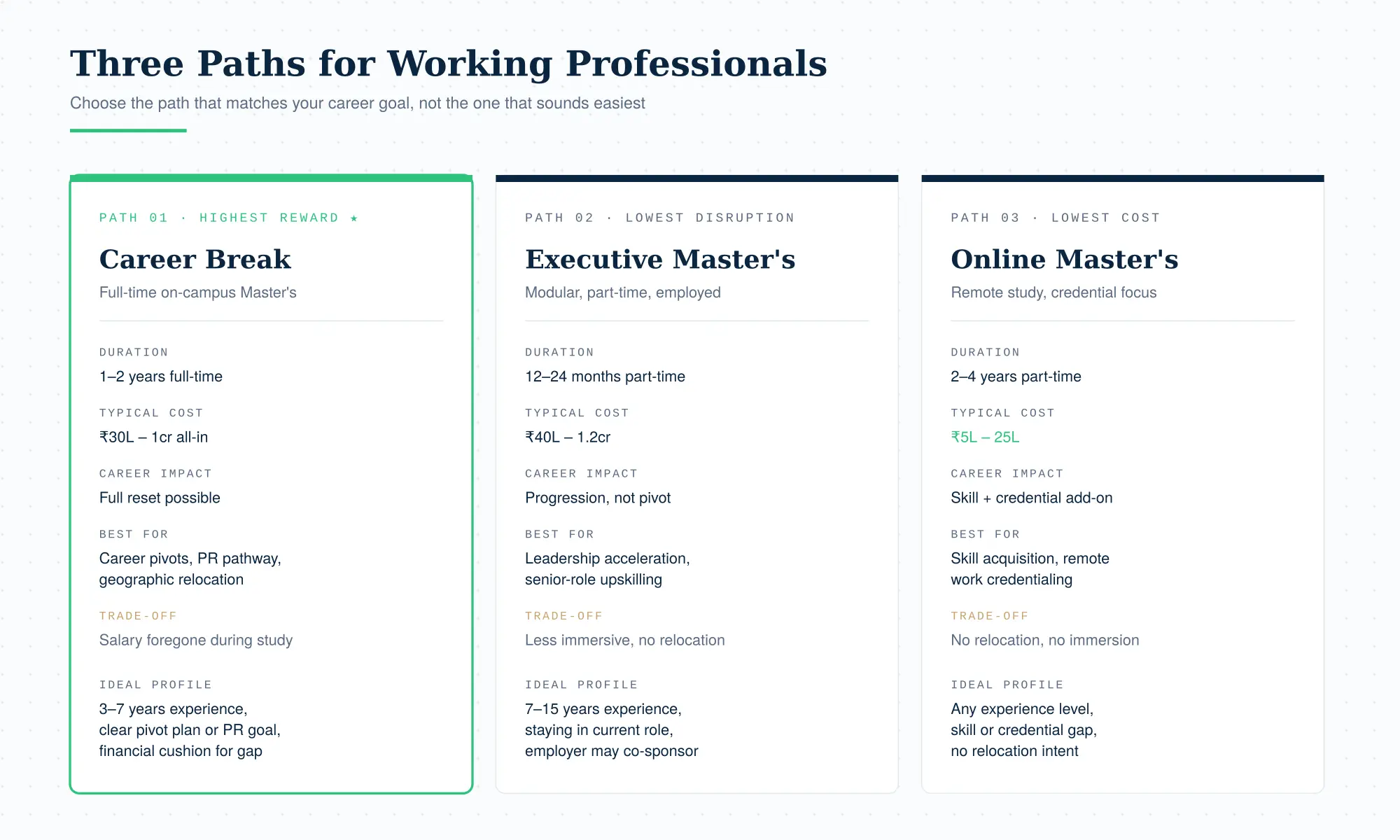
Working professionals have three main structural options for a Master's abroad. Each solves a different problem.
- Path 1: Full-Time Career Break. You leave your current job, move abroad, complete a full-time Master's (1–2 years), and re-enter the workforce internationally or back in India. Maximum immersion, maximum career reset opportunity, maximum cost.
- Path 2: Executive Master's. Programs specifically designed for professionals with 5–10+ years of experience. Typically 12–18 months. Formats vary: intensive weekend modules, one-week-per-month blocks, or blended online-in-person. You stay employed while enrolled. Common in business, public policy, engineering leadership, and healthcare administration.
- Path 3: Online / Hybrid Master's. Fully or largely online Master's from international universities. Lower cost, no career break, and increasingly credible (Georgia Tech OMSCS, Illinois iMBA, Imperial's various online Master's, etc.). Best for skill-building without geographic move.
Choose based on your career goal, not on which sounds most convenient.
Which Path Is Right for You?
The ROI Math for a Career Break Master's
The question every working professional asks — and few answer honestly — is whether the numbers actually work.
Your total cost includes:
- Tuition and fees for 1–2 years
- Living expenses abroad for 1–2 years
- Foregone salary during the study period (this is huge and often ignored)
- Opportunity cost of career progression you would have made staying
Your total benefit includes:
- Post-graduation salary uplift (target country vs staying in India)
- Post-study work permit and PR pathway value (if relevant)
- Career pivot value (moving into a higher-earning role or industry)
- Network and long-term optionality
A realistic worked example:
- Current INR salary: 25 LPA, working in India
- Master's in the UK (1-year): ~INR 45L total cost + INR 25L foregone salary = INR 70L total investment
- Post-graduation UK job (typical STEM Master's grad): GBP 40K–55K, roughly INR 42–58L/year
- Post-Master's return-to-India salary: often 40–70% uplift on your current, i.e., INR 35–42 LPA
The math works when:
- Post-Master's salary uplift is substantial — typically 40%+ on India-based roles, more for those staying abroad
- Career pivot is genuinely enabled — not just a "checkbox" Master's, but one that opens doors otherwise closed
- You value non-financial outcomes — international experience, PR pathway, family relocation, personal growth
The math doesn't work when:
- You're taking a career break at 35+ for a Master's that won't meaningfully change your trajectory
- You're paying full-freight tuition at a program with mediocre placement outcomes
- Your current role already offers strong progression that a Master's won't accelerate
Timing: When Is the Right Career Stage?
3–5 years of experience is often the sweet spot for a full-time career break Master's:
- Enough experience to have clarity on what you want
- Recent enough to still be strong test-taker and student
- Career pivot still credible (harder after 10+ years in one field)
- Salary foregone is meaningful but not catastrophic
5–10 years of experience works well for:
- Business school (MBA) — this is often the peak MBA age
- Public policy or specialized policy Master's
- Executive Master's programs
- Master's specifically designed to accelerate leadership progression
10+ years of experience typically better served by:
- Executive Master's programs (part-time, employer-sponsored where possible)
- Online Master's for specific skill/credential gaps
- Non-degree executive education (INSEAD, Harvard, Wharton short programs)
Under 3 years — the traditional Master's-right-after-Bachelor's path is often better than delayed application. If you have less than 3 years of work experience and you know you want a Master's, the delay usually doesn't add much.
How to Address Career Gaps and Work Experience in Applications
Working professionals actually have easier SOP challenges than fresh graduates in one key way: you have concrete career trajectory to work with. But you have to structure it well.
- Show trajectory, not just tenure. "5 years as a Business Analyst at Deloitte" is less compelling than "Progressed from junior analyst to senior consultant, led a team of 6, delivered 12 client engagements in banking data transformation." Weight what you learned and led.
- Explain what your Master's completes. Don't frame the Master's as "next step because I want a Master's." Frame it as "specific gap that my current trajectory can't fill." What research, curriculum, network, or capability does this Master's provide that your current work cannot?
- Address the career break honestly. Don't hide that you're leaving a job. Committees admire clarity. "I plan to leave my current role in April 2026 to begin the Master's in September" is a fine sentence. "I have been contemplating my career trajectory..." is not.
- Show the return path. Whether you're staying abroad post-Master's or returning to India, articulate the specific plan. Vague "further career growth" plans hurt applications from experienced applicants more than from fresh graduates.
- Get LORs that speak to workplace impact. Your work supervisor's LOR is often stronger than an old professor who barely remembers you. Ask your manager, or a senior colleague who has watched you deliver.
The Best Programs for Working Professionals
- MBA programs: INSEAD (1-year format), London Business School, IESE, HEC Paris, Cambridge Judge, Oxford Saïd, Wharton, Stanford GSB, MIT Sloan. Expect 5+ years experience minimum.
- Executive Master's in specific fields: MIT Sloan Executive MBA, LBS Executive MBA, London School of Economics MPA, Harvard Kennedy MPA, Oxford Executive MBA.
- Career-pivot friendly Master's: Master of Science in Data Analytics at various UK/US universities, Master of Public Policy programs, Master of Engineering Management, Master of Information Systems Management.
- Online Master's with strong recognition: Georgia Tech Online MSCS (OMSCS), Illinois iMBA, Imperial College's various online Master's, MIT's MicroMasters programs, University of London's various online degrees.
The Financing Reality
Working professionals often have better financing options than fresh graduates.
- Employer sponsorship — Some employers sponsor part or all of Executive Master's tuition, especially if the degree relates to your current role. Ask early.
- Career break sabbatical policies — Some Indian and multinational employers allow 1-year unpaid leave with rejoin rights, providing safety net.
- Higher loan eligibility — Working professionals typically qualify for larger education loans (HDFC Credila, Avanse, ICICI Bank) than fresh graduates, thanks to stable income history.
- Savings runway — If you've been working 3–5+ years, you likely have some savings buffer, reducing loan dependency.
- Post-Master's earnings capacity — Working professionals typically have higher post-Master's earnings ceilings, making the loan math more manageable.
Common Working Professional Application Mistakes
- Framing the Master's as an escape from current job. Committees read this as weak signaling. Frame it as advancement toward specific goals.
- Underemphasizing work impact. Your SOP shouldn't read like a fresh graduate's — it should showcase what you've done, learned, and led.
- Overusing corporate jargon. "Synergized cross-functional deliverables to drive impact" reads as filler. Specific outcomes always win.
- Ignoring your quantitative reset needs. If you haven't done math or programming in 5 years, GRE prep or coursework refresh may be needed before applications.
- Underestimating the family conversation. Career break Master's often affect spouse, children, aging parents. Have those conversations early, not after admission.
How LiftmyGrade Supports Working Professionals
At LiftmyGrade, our Master's Abroad pathway is designed to serve working professionals with structured support that recognizes their unique context. Our mentors work with applicants on:
- Path selection — career break vs executive vs online, based on your specific career goals
- ROI modeling — real financial math for your specific scenario
- Career-narrative SOPs — leveraging your work experience as an asset, not a liability
- Recommender strategy — balancing professor LORs with strong workplace LORs
- Family and financial planning — because a career break isn't just an application decision
Working professionals often make the strongest Master's candidates. But only if the application reflects the professional you've become, not the student you once were.
Frequently Asked Questions
Am I too old for a Master's abroad at 30? 35? 40?
Not too old. Committees at top programs regularly admit applicants in their 30s and even 40s. What matters is the coherence of your story: why now, why this program, why this field. Age becomes a factor only when the story doesn't add up.
Should I quit before applying or after admission?
After admission, absolutely. Never quit before you have a firm offer. Employers can serve as strong references during the application process, and financial stability matters when applying.
Will admissions committees see my career break as a red flag?
Not if you frame it correctly. A career break for a specific Master's with a clear post-Master's plan is celebrated, not penalized. A career break without a clear reason is what raises concerns.
Should I take the GRE/GMAT after so many years out of school?
Test requirements have loosened significantly (see our test-optional programs guide). If required, plan for 3–4 months of prep — including quantitative reset if you've been away from math for years.
Can my spouse and children move with me during a Master's?
Depends on country. Canada and Netherlands offer generous family accompaniment. UK allows spouse via dependent visa (subject to salary thresholds for the dependent to work). US F-2 dependent visa for spouse allows accompaniment but not employment. Germany allows family reunification with restrictions.
Ready to Plan Your Career-Break Master's?
A Master's abroad as a working professional isn't a step backward. Done right, it's the single biggest career acceleration move you can make in your 30s. The question isn't whether to consider it — it's how to structure it so the math and career outcomes actually work.
Explore LiftmyGrade's Master's Abroad pathway — working professional support is built into our engagement from the first conversation.
You've earned the runway to make this decision on your terms. Now make it well.