
IELTS vs TOEFL vs Duolingo vs PTE: Which English Test Should You Take for Study Abroad?

Every year, thousands of Indian students spend months preparing for the wrong English test. They take IELTS when their target universities prefer TOEFL. They take Duolingo without checking that their scholarship even accepts it. They spend INR 20,000 on multiple attempts, then realize their program required a specific test they never studied for.
This guide breaks down the four major English proficiency tests — what each is best for, where each is accepted, and which one you should actually take based on your target countries and universities.
The Four Tests, in Ninety Seconds
- IELTS (International English Language Testing System) — The most widely accepted English test globally. Two versions: Academic (for university admission) and General Training (for immigration). Runs in paper and computer formats. Scored on a 9-band scale.
- TOEFL (Test of English as a Foreign Language) — The traditional test for US universities. Fully computer-based. Scored out of 120. Emphasizes academic English and reading-heavy content.
- Duolingo English Test (DET) — The newer, disruptive option. Fully online, taken from home, scored out of 160. Cheaper and faster than the others, but accepted by fewer institutions.
- PTE (Pearson Test of English) Academic — Fully computer-based. AI-scored. Faster results than IELTS. Popular among Australian and UK applicants. Scored out of 90.
Which one you take should depend on three factors: acceptance by your target universities and scholarships, your test-taking strengths, and your budget for retakes if the first attempt doesn't hit the target.
The Big Comparison
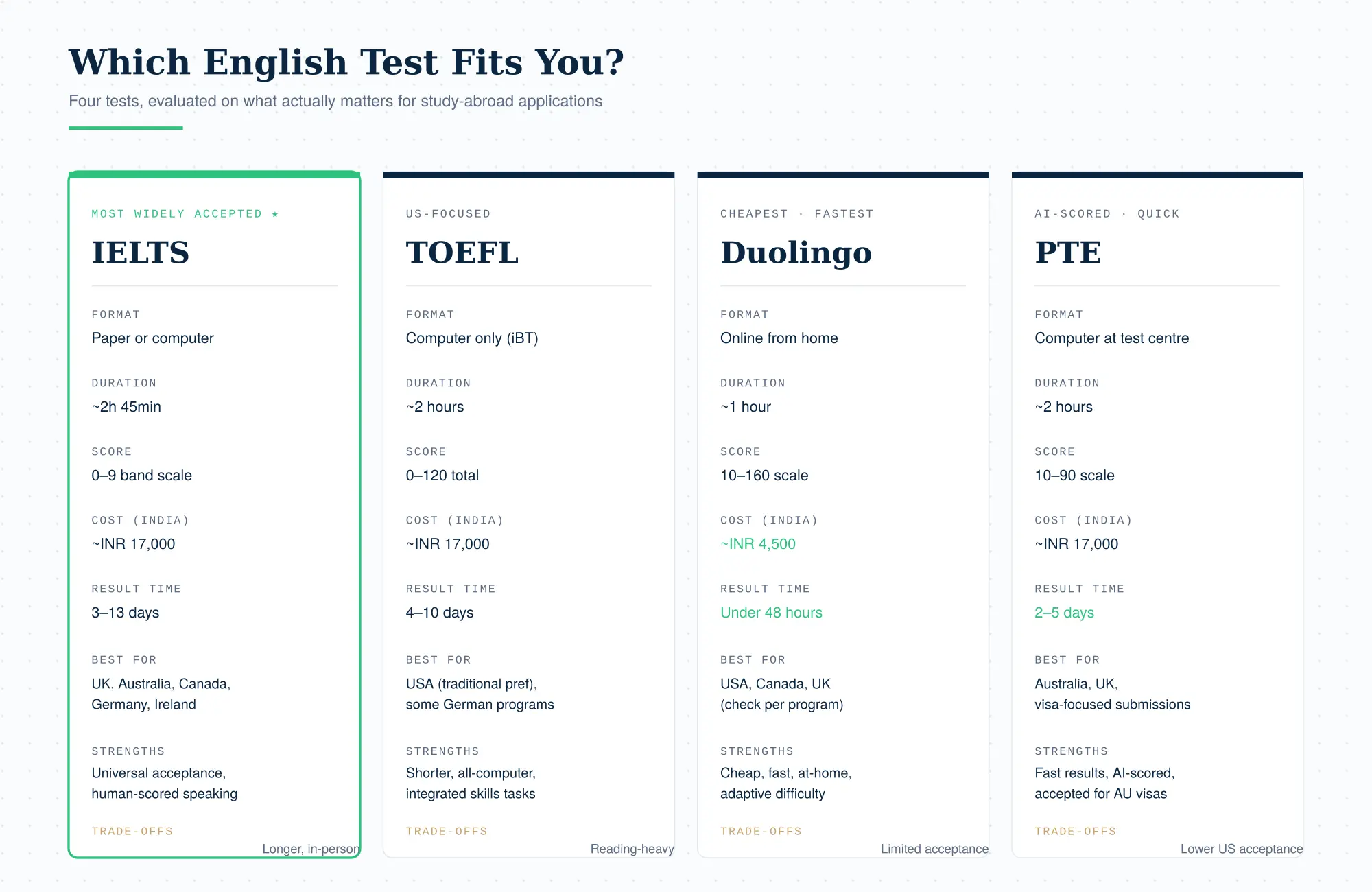
Which Test Fits Your Target Country?
United States
TOEFL has been the traditional preference and remains the safest choice for older programs. IELTS is widely accepted at most US universities. Duolingo has grown rapidly — many US universities accept it, but always verify per program. PTE is accepted less broadly for US universities.
United Kingdom
IELTS is the safest and most universally accepted. For visa purposes, IELTS Academic (UKVI) or PTE Academic (UKVI) is required. Duolingo is accepted by many universities for admission but not for visa purposes.
Canada
IELTS is the safest for both admission and immigration. TOEFL is widely accepted. Duolingo acceptance is growing at universities but not accepted for Express Entry immigration scoring.
Germany
For English-taught programs, IELTS and TOEFL are equally accepted at most universities. PTE and Duolingo are accepted at some, but not all. Check per program.
Australia
IELTS is universally accepted. PTE is very popular and specifically accepted for Australian student visas. TOEFL is accepted by most universities. Duolingo has limited acceptance.
Ireland
IELTS and TOEFL widely accepted. PTE accepted at most universities. Duolingo growing.
Netherlands
IELTS and TOEFL are standard. PTE increasingly accepted. Duolingo limited.
Score Requirements by Country and Program Tier
Rough guidelines. Always verify per program.
- Undergraduate programs abroad: Typically IELTS 6.0–6.5 overall, TOEFL 79–90.
- Master's at strong universities: IELTS 7.0 overall (some sections 6.5 minimum), TOEFL 100+, Duolingo 115+.
- Master's at top universities (Oxbridge, Ivy League, Stanford, LSE): IELTS 7.5 overall, TOEFL 105+, Duolingo 125+.
- PhD programs: Same as top Master's typically. Some programs have specific speaking-section thresholds (7.0+) for TA-eligibility.
- Scholarship-eligible thresholds: Chevening requires IELTS 6.5 minimum overall. Fulbright typically requires TOEFL 90+ or IELTS 7.0+. DAAD varies by program.
Which Test Should You Actually Take?
Here's how to make the decision.
- If you're applying primarily to the US, Canada, or UK, and can afford one test attempt: Take IELTS. Universal acceptance, safe choice.
- If you're applying to the US only, prefer computer-based tests, and are comfortable with academic reading passages: Consider TOEFL. Shorter format, all-computer.
- If you're on a tight budget or need a score quickly, and your target universities and scholarships accept it: Consider Duolingo. But verify acceptance per program — no exceptions.
- If you're applying primarily to Australia or need a fast, AI-scored test: Consider PTE. Especially valuable if visa considerations matter (Australia's SkillSelect and student visas explicitly accept PTE).
- If uncertain about your target list: Take IELTS. It's the most universally accepted, and the score is transferable across countries.
The Test Preparation Timeline
Most students underestimate prep time. Realistic ranges for someone starting from an intermediate English base:
- IELTS 6.5–7.0: 6–10 weeks of structured prep.
- IELTS 7.5+: 3–4 months of dedicated preparation.
- TOEFL 100+: 6–10 weeks, with attention to integrated speaking/writing tasks.
- Duolingo 120+: 2–4 weeks (fewer question types to master, faster prep).
- PTE 65+: 4–6 weeks, with heavy focus on speaking accuracy for AI scoring.
Practice tests are essential. Book the actual test only when your practice test scores consistently exceed your target.
Common English Test Mistakes
- Preparing for the wrong test. Confirm test acceptance for every program before scheduling.
- Not verifying visa vs admission requirements. UK Student visa requires IELTS Academic (UKVI) specifically — some universities accept regular IELTS for admission but not visas.
- Taking too many tests. Some students take three or four different tests hoping one lands. Time and money wasted. Pick one, prepare properly, take it twice if needed.
- Ignoring section minimums. Many programs specify not just overall score, but minimum scores per section. "IELTS 7.0 with no band less than 6.5" is a different bar than "IELTS 7.0 overall."
- Retaking too aggressively. Repeated fails hurt your record and drain your budget. Better to prep for 2 extra weeks and pass than take the test 3 times.
How LiftmyGrade Handles Test Strategy
At LiftmyGrade, test selection is part of our pathway kickoff for Bachelor's, Master's, and PhD applicants. Our mentors work with students on:
- Test-to-target matching — mapping your target universities to their preferred tests
- Timeline coordination — booking tests to align with application and scholarship deadlines
- Score-goal setting — realistic band targets based on your baseline
- Test format recommendations — matching test format to your test-taking strengths
The best test is the one your target universities accept, that you can score well on, that fits your timeline. Not the one your neighbor took.
Frequently Asked Questions
Which English test is easiest?
None is meaningfully easier than the others — but each rewards different strengths. IELTS: balanced skills, human-graded speaking. TOEFL: computer comfort, reading endurance. Duolingo: adaptive difficulty, tighter time pressure. PTE: fast pace, precise speaking articulation.
Can I take multiple English tests?
Yes. Some students take IELTS first, then switch to another if scores don't hit target. Wastes money and time — better to prep properly for one test first.
How long are English test scores valid?
Most are valid for 2 years from the test date. Some universities specify a shorter window (18 months). Verify per program.
Is Duolingo accepted at top universities?
Increasingly yes. Harvard, Yale, MIT, Stanford, Cambridge, Oxford, and many others accept Duolingo for admission. But acceptance for scholarships and immigration is more restrictive — verify explicitly.
What if I'm already fluent in English?
Fluency helps, but doesn't eliminate the need for structured test prep. All four tests have specific formats and question types that reward practice. Even fluent speakers benefit from 3–4 weeks of format-specific preparation.
Ready to Choose the Right Test for Your Applications?
The English test is a means to an application, not an end in itself. Pick the test that opens your target universities. Prepare for it strategically. Take it once, do well, move on.
Explore LiftmyGrade's pathways for Bachelor's, Master's, and PhD — test strategy is part of your engagement from day one.
Study abroad is a marathon, not a sprint. The English test is just the first checkpoint.