
How Much Does It Cost to Study Abroad from India? A Real 2026 Breakdown

Ask a consultancy how much it costs to study abroad, and you'll get a number. Apply with that number, and you'll get a shock six months in — because most published costs only include tuition, ignore living expenses, hide visa and insurance fees, and assume an exchange rate that's two years out of date.
This guide breaks down the real cost of studying abroad from India in 2026 — tuition, living, hidden expenses, and the levers that actually reduce the bill (scholarships, assistantships, public universities).
The Four Buckets That Make Up Total Cost
Every cost estimate should separate into four buckets. Confusing them is why most "study abroad calculators" are misleading.
- Bucket 1 — Tuition & Fees. What you pay the university per year. This is the only number most articles publish. It's usually 40–60% of total cost — sometimes less in high cost-of-living cities.
- Bucket 2 — Living Costs. Rent, food, transport, utilities, phone, entertainment. Varies dramatically by city — London is 3x cheaper than Bangalore's actual middle-class cost, but San Francisco is 4x more expensive.
- Bucket 3 — One-time & Pre-Departure. Visa, flights, deposits, initial setup (mattress, kitchen, winter clothes), application fees, English test fees, document costs. Usually INR 3–6 lakh total — almost no one budgets for this properly.
- Bucket 4 — Hidden / Ongoing. Health insurance (mandatory in most countries), books, course materials, conference travel, internship moves, currency loss on remittances. Usually 10–15% of annual costs.
A real budget adds all four. Most students plan for one and run into trouble at the other three.
Country-by-Country Realistic Numbers
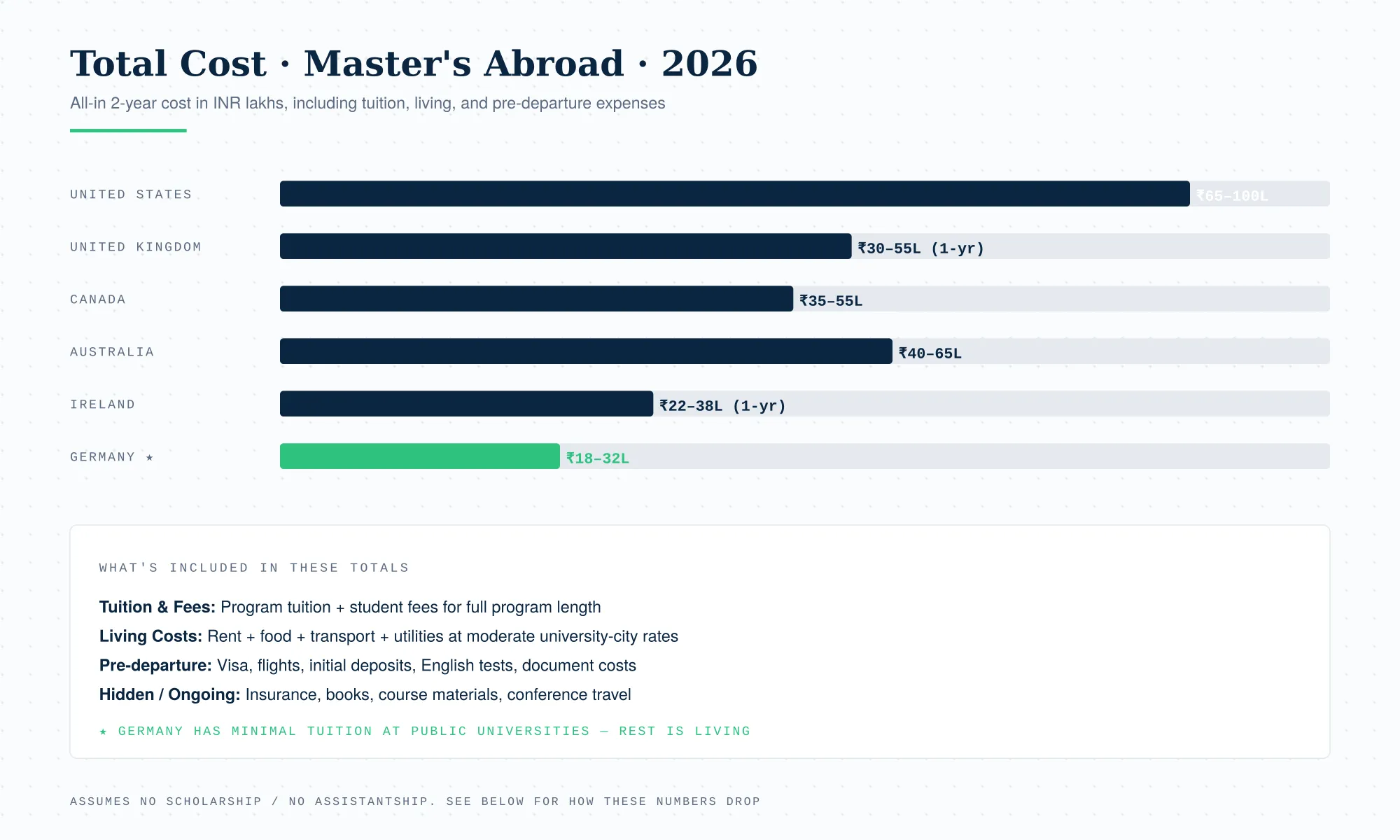
The numbers below are full all-in 2-year Master's costs in INR lakhs, assuming no scholarships and moderate university-city living. Add 15–25% for high-CoL cities (NYC, SF, London, Toronto).
- United States — Total: INR 65–100L for 2-year Master's. Tuition: INR 35–70L depending on private vs public. Living: INR 25–35L. The US is the highest-cost country, but also offers the highest salary outcomes for STEM graduates. The premium is real, but so is the post-graduation earning potential.
- United Kingdom — Total: INR 30–55L for 1-year Master's. The compressed timeline matters — you avoid a full second year of tuition and living costs. London adds 30–40% over other UK cities. Best value: programs outside London with strong sector recognition.
- Germany — Total: INR 18–32L for 2-year Master's. Almost zero tuition at public universities (often EUR 0–3,000/semester for international students at TU Munich, RWTH Aachen, KIT, etc.). Cost is almost entirely living. The cheapest credible Master's destination, by a wide margin.
- Canada — Total: INR 35–55L for 2-year Master's. Canada offers the best ratio of cost to PR outcomes — relatively reasonable cost, with a clean post-graduation work permit and Express Entry pathway.
- Australia — Total: INR 40–65L for 1.5–2 year Master's. Mid-range cost with strong post-study work visas (2–6 years depending on degree and location).
- Ireland — Total: INR 22–38L for 1-year Master's. Often overlooked, but a strong value option, especially for tech roles connecting to European HQs of Google, Meta, LinkedIn, Stripe.
How Scholarships and Assistantships Change the Math
The above numbers assume zero financial aid. In reality, most students who plan well don't pay full freight.
- Full scholarships (Fulbright, Chevening, DAAD, etc.) — Reduce total cost to near zero. Tuition, stipend, flights, insurance. Highly competitive (2–5% acceptance rates), but life-changing if won.
- Partial university aid (50–100% tuition waivers) — Common at strong US/UK universities for top applicants. Reduces total by 30–50%.
- Teaching/Research Assistantships (especially US PhD) — Tuition waived + monthly stipend. Common for US PhD students from year 1; available to some Master's students after first semester.
- Indian trust scholarships (Tata, Inlaks, KC Mahindra) — Cover INR 5–25L portions of total cost. Stack-able with other aid.
- Education loans — INR 25-40L is the typical sweet spot for Indian student loans, with manageable EMIs against post-graduate salaries. Common providers: HDFC Credila, Avanse, ICICI Bank, public sector banks.
The Hidden Costs Most Students Forget
- Visa fees — INR 12,000–30,000 depending on country.
- Health insurance — Mandatory. INR 50,000–1,50,000/year, depending on the country and provider.
- Pre-departure setup — Mattress, basic kitchen, winter clothes for cold-climate countries. INR 50,000–1,50,000.
- Bank account opening / blocked account (Germany) — Germany requires EUR 11,208 in a blocked account for visa. Other countries have similar deposit requirements.
- Language tests — IELTS/TOEFL/GRE/GMAT fees. INR 15,000–25,000 per test, sometimes taken multiple times.
- Application fees — INR 5,000–10,000 per university × 6–8 universities = INR 30,000–80,000.
- Currency conversion losses — 1–3% per remittance. Use Wise, Niyo, or similar services to minimize.
- Flights & moving costs — INR 50,000–1,20,000 one-way to most destinations.
Adding these up: INR 3–6 lakh in pre-departure costs alone. Plan for them.
How to Bring Costs Down Without Cutting Corners
- Pick public universities in lower-cost cities. Munich is expensive, but Aachen and Karlsruhe are not. Toronto is expensive, but Waterloo and Montreal are not.
- Target 1-year Master's where they exist. UK and Ireland's compressed timelines save a full year of living costs.
- Apply early for scholarships. Most students miss scholarships because they apply 3 months out. Scholarships close 6–9 months before university deadlines.
- Work part-time legally. Most countries allow 20 hours/week during semester. Won't cover tuition, but meaningfully reduces living-cost burden.
- Cook, don't eat out. A student who cooks saves INR 4–6 lakh over a 2-year Master's compared to one who eats out daily. This is real money.
- Choose accommodation strategically. University housing is rarely the cheapest. Shared apartments off-campus are often 30–40% less.
How LiftmyGrade Supports Financial Planning
Cost planning is built into every LiftmyGrade engagement. Our mentors work with applicants on:
- Country-specific cost mapping — what your real budget needs to be for your target programs
- Scholarship calendar — eligible scholarships, when they open, deadlines that beat university deadlines
- Assistantship strategy — which programs offer TA/RA positions and how to position for them
- Loan-vs-savings strategy — how much to borrow, what EMI is sustainable post-graduation
- Hidden cost checklist — the pre-departure items that almost every student forgets
We don't sell loans or financial products. We help families plan around real numbers — so the decision to study abroad is made with eyes open.
Frequently Asked Questions
Germany — by a wide margin for Master's. Public university tuition is often EUR 0–3,000/semester for international students. Total 2-year cost typically INR 18–32L, almost entirely living expenses.
Yes, if the post-graduation salary in your field justifies the EMI burden. STEM Master's in the US, finance Master's in the UK, and engineering Master's in Germany typically pay off. Non-STEM Master's in high-cost countries are harder to justify on loan alone — pair with scholarships.
Varies. Germany requires ~EUR 11,208 in a blocked account. UK requires 9 months of living costs + tuition. US requires 1 year of total costs. Canada requires GIC of CAD 20,635 + tuition. Plan well ahead — these aren't last-minute documents.
Generally no, while school is in session. Most student visas allow 20 hours/week during semesters and full-time during breaks. Working beyond these limits is a visa violation.
Rough monthly student budgets: USA INR 90K–1.5L; UK INR 80K–1.4L (London higher); Germany INR 50K–80K; Canada INR 60K–1L; Australia INR 70K–1.1L; Ireland INR 65K–1L. Always verify by city.
Ready to Plan Your Real Budget?
The decision to study abroad is too important to make with rough estimates. The students who plan with real numbers — including hidden costs and realistic scholarship odds — make better decisions and end up with less financial stress.
Explore LiftmyGrade's pathways for Bachelor's, Master's, and PhD applicants. Financial planning is built into our process from day one.
Numbers don't lie. Plan with real ones.