
Germany vs Canada for Indian Students: Which Is Better for Studying Abroad in 2026?

For Indian students who don't want the US visa lottery and don't need the UK's one-year compression, the choice has narrowed to two: Germany or Canada. Both offer high-quality universities, manageable costs, clear post-graduation work options, and credible PR pathways. Both are increasingly chosen by Indian Master's applicants over more expensive alternatives.
The question isn't "which is better." It's "which is better for what." Engineering students should think differently than healthcare applicants. PR-focused students should weigh different factors than career-pivoters. This guide breaks down the decision by goal.
At-a-Glance Comparison
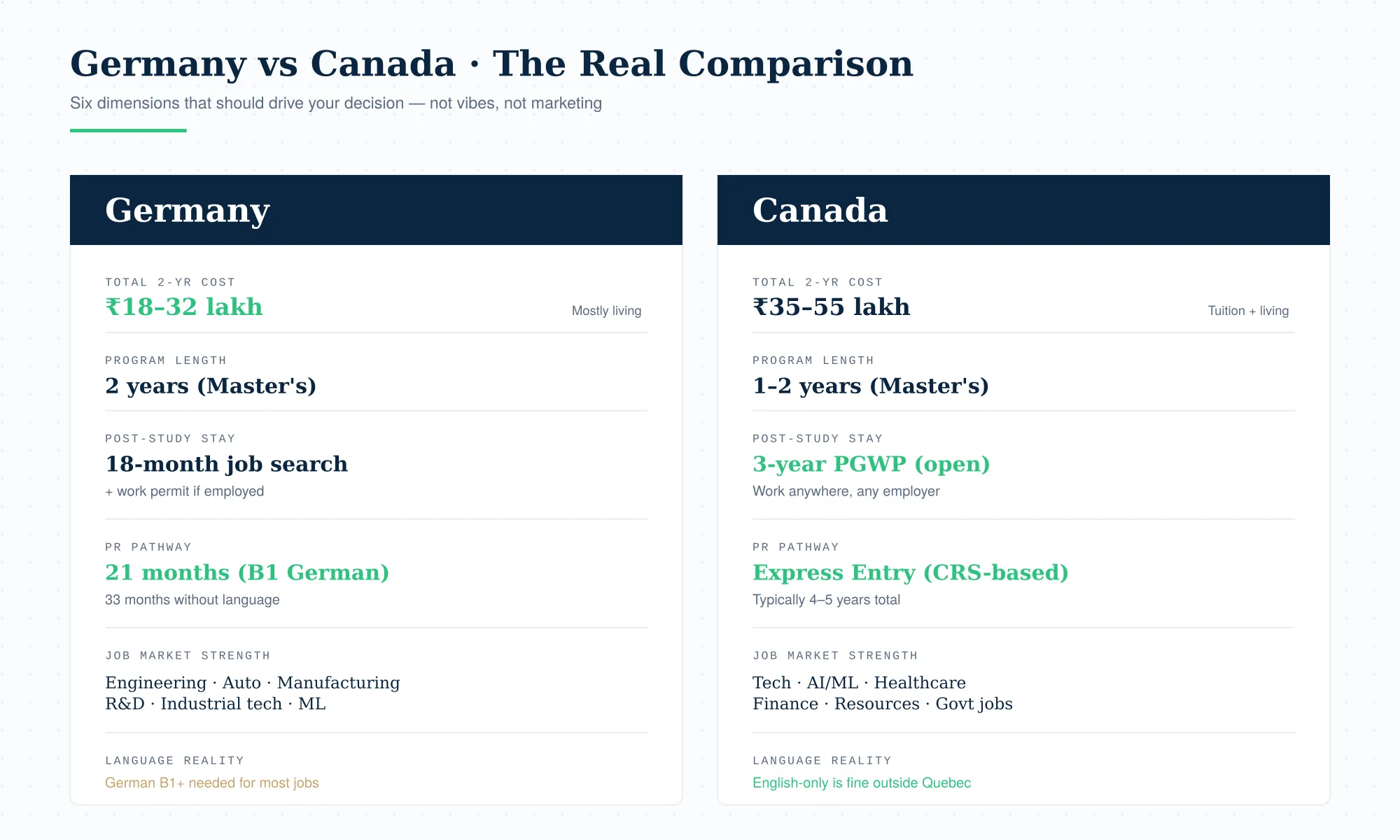
The Six Dimensions That Should Drive Your Decision
1. Cost — Germany Wins, By a Lot
The single biggest difference. Germany's public universities charge near-zero tuition (typically EUR 0–3,000/semester at TU Munich, RWTH Aachen, KIT, TU Berlin). Two years of Master's in Germany typically costs INR 18–32 lakh, almost entirely living expenses.
Canada's tuition is real money. Master's tuition typically runs CAD 18,000–35,000 per year, with total 2-year cost (with living) of INR 35–55 lakh — 2x Germany's bill.
For cost-constrained applicants, Germany isn't a tie. It's a runaway winner.
2. Language — Canada Wins for English-Only Students
Canada's job market is English-first outside Quebec. Your degree, your job interviews, your work environment — all English. No language barrier to becoming employable.
Germany's reality is harder. Programs are increasingly offered in English (especially STEM Master's at top universities). But the job market still expects German for most non-tech positions. Working in BMW R&D doesn't require German; working at a German SME or in client-facing roles usually does. Expect to invest in B1 German if you plan to stay long-term.
If you don't want to learn a new language to work, Canada is the safer pick.
3. PR Pathway — Both Win, Differently
Both countries have credible PR pathways, but the mechanics differ significantly.
Germany's "Niederlassungserlaubnis" (settlement permit) requires 33 months of skilled employment as a Blue Card holder (or 21 months with German B1). Among the fastest PR timelines globally for skilled workers — but contingent on actually getting and keeping employment in Germany.
Canada's Express Entry uses a Comprehensive Ranking Score (CRS) that rewards Canadian education, Canadian work experience, English proficiency, and skilled employment. The pathway is highly predictable but typically takes 4–5 years from arrival.
Germany is faster if you can clear the language and employment bars. Canada is more predictable but slower.
4. Job Market — Different Strengths
Germany excels in: mechanical engineering, automotive R&D, manufacturing tech, industrial automation, electrical engineering, materials science, increasingly AI/ML in industrial contexts (Siemens, Bosch, BMW, SAP), pharma research.
Canada excels in: software engineering, AI/ML research (Toronto/Vector Institute, Montreal/MILA), data science, healthcare (especially nursing and allied health), finance (Toronto), natural resources, government and public-sector tech.
The honest pattern: if you're a hardcore engineer or industrial researcher, Germany. If you're tech, data, healthcare, or finance, Canada.
5. Lifestyle and Climate
Germany: Continental Europe, central time zone, well-positioned for travel across Europe. Long bureaucratic processes. Strong public transit. Lower crime in most cities. Cultural integration takes effort — German society is welcoming but not instantly warm to outsiders.
Canada: Large country with regional variation. Long, very cold winters in most cities (less so in Vancouver and Toronto). Highly multicultural — Indian communities are large and active in Toronto, Vancouver, Calgary. Faster cultural integration for most Indian students.
This dimension matters more than people credit. A student who struggles with cold or cultural distance can have an academically successful program and a personally miserable one.
6. Family and Settlement Considerations
Germany: Family reunification visa for spouse is straightforward once you have a stable work permit. Spouse can work full-time on dependent visa. Kindergeld (child benefits) available for residents.
Canada: Open work permit for spouse during your Master's (one of the strongest spouse-work policies globally). PR application can include spouse and dependent children. Healthcare and education for children free for residents.
For students with families, both are strong. Canada has a slight edge on spouse work rights during study.
Which One Is Better For You?
Choose Germany if:
- You want to minimize cost (this is the single best reason)
- You're in engineering, automotive, manufacturing, industrial tech, or pharma research
- You're willing to learn German to B1 or higher
- You want one of the fastest credible PR timelines (with the language investment)
- You value travel access across Europe
Choose Canada if:
- You want to work in tech, data, AI/ML, healthcare, or finance
- You're not interested in learning a new language
- You want the cleanest, most predictable PR pathway
- Your family situation benefits from open spouse work rights
- You want a large existing Indian community for cultural support
Common Misconceptions to Drop
- "Germany is free." Tuition is near-zero at public universities. Living costs are not. Total 2-year cost is still INR 18–32 lakh.
- "Canada is easier to get into." Not necessarily. Both have rigorous admissions. Canada has more programs that admit broadly, but top Canadian universities (UofT, McGill, UBC, Waterloo) are competitive.
- "Canada always leads to PR." No — Express Entry is competitive, and CRS cutoffs have risen significantly in 2024–2026. PR is achievable but not guaranteed.
- "Germany requires fluent German." Programs increasingly run in English. The job market requires German for most non-tech roles, but English-only careers exist in tech and research-heavy positions.
How LiftmyGrade Supports the Germany vs Canada Decision
At LiftmyGrade, our Master's Abroad pathway is built around this kind of strategic country choice. Our mentors work with applicants on:
- Career-first country matching — what country aligns with your 5-year career goal, not just your degree
- Cost-and-aid mapping — real numbers, real scholarship eligibility, real loan needs
- Language reality check — whether your German timeline is realistic, whether your English-only path is solid
- PR pathway projection — what the next 5–7 years actually look like in each country
- Program shortlisting — narrowing from "country" to "specific 6–8 universities"
The wrong country choice can't be fixed by a great application. The right one amplifies everything that follows.
Frequently Asked Questions
Public universities in most German states charge zero tuition (sometimes a EUR 100–350 administrative fee per semester). Baden-Württemberg has reintroduced fees (~EUR 1,500/semester for non-EU students). Private universities have full tuition. The "free" applies to public universities — and only to tuition, not living costs.
It depends entirely on your field, language preferences, and life goals. For tech/data/healthcare/finance and English-only — Canada. For engineering/automotive/industrial R&D and willingness to learn German — Germany.
Both are competitive. Canada's public universities admit broadly for many Master's programs (acceptance rates 30–50% at non-top-5 universities). Germany's top engineering universities are highly selective (often 10–20% acceptance). The "easier" pick depends on what tier you're targeting.
Very difficult — you'd typically need to restart applications. Choose carefully upfront.
Canada generally pays better in early-career tech roles (CAD 70K–100K starting in tech hubs). Germany pays competitively in engineering and industrial roles (EUR 50K–70K starting). Both are lower than US benchmarks but with significantly lower cost of living.
Ready to Make the Right Country Choice?
Germany vs Canada isn't a coin flip. It's a structured decision based on your career field, language tolerance, financial reality, and 5-year life vision.
Explore LiftmyGrade's Master's Abroad pathway — we help students make this choice with real data, not marketing brochures.
Pick the right country once. Build the rest of your career on it.