
Germany, the US or Canada: A Decision Framework Instead of a Ranking

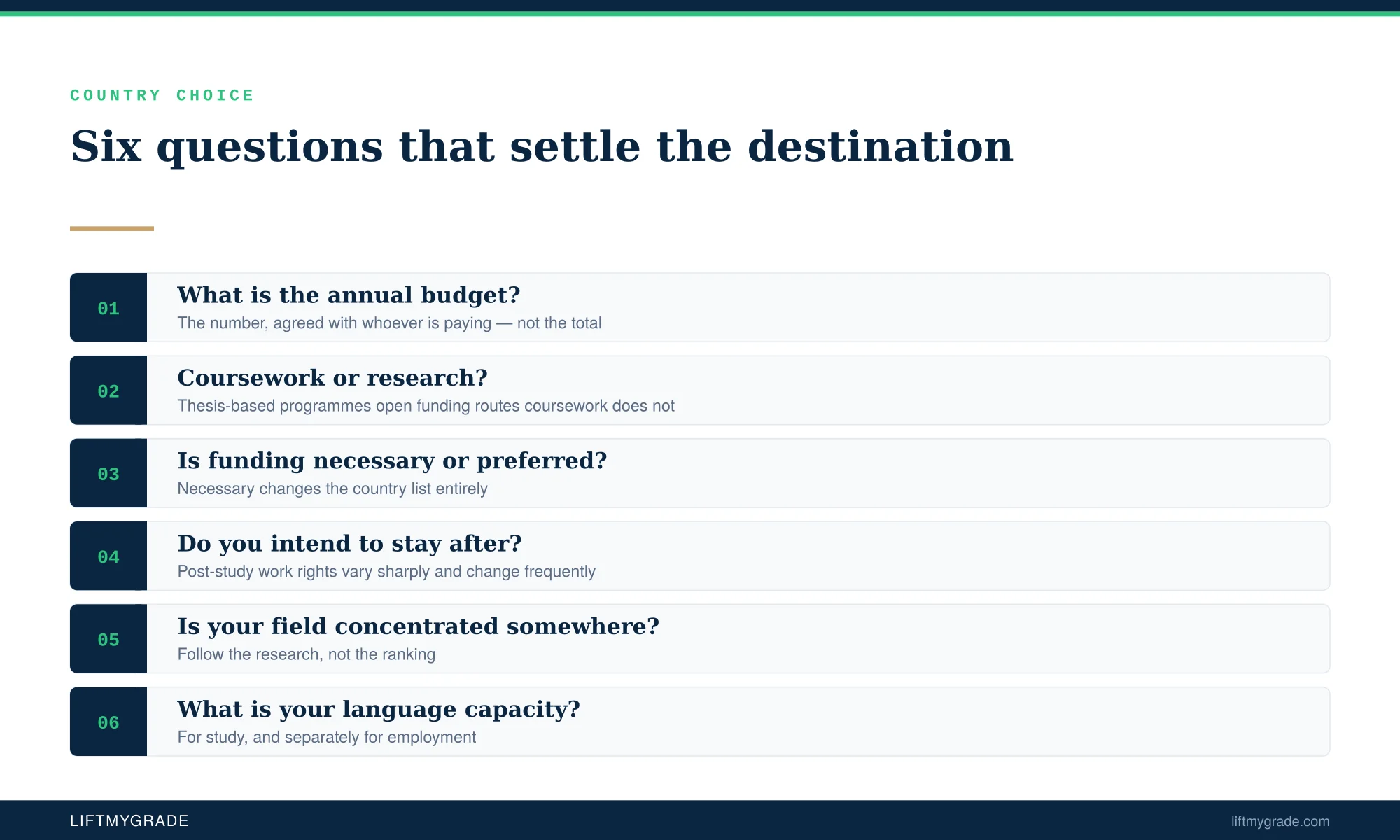
"Which country is best for a Master's?" is the most common question in this industry and the least answerable one. It is a bit like asking which shoe is best without mentioning the foot.
A more productive approach is to work from constraints. Six questions, answered honestly, will usually narrow three continents to one or two realistic destinations — and they do it before you have wasted months on applications you cannot fund.
Question 1 — What is the annual budget?
Annual, not total, and agreed with whoever is actually paying. This single number does more filtering than everything else combined.
The structural differences are large:
| Factor | Germany (public) | United States | Canada |
|---|---|---|---|
| Tuition | No tuition fee at most public universities; semester contribution applies | The largest single cost; varies enormously by institution | Substantial, and international rates are well above domestic |
| Living cost | Moderate, city-dependent; Munich and Frankfurt far above smaller towns | High in major metros, moderate elsewhere | Moderate to high; Toronto and Vancouver at the top |
| Mandatory financial proof | Blocked account for the visa, funded in advance | Financial documentation at visa stage | GIC plus proof of funds |
| Typical funding route | Scholarships (DAAD and others); research assistant roles at chairs | Assistantships and departmental funding, common in research programmes | Supervisor-linked funding in thesis-based programmes |
The practical consequence: a budget that is tight makes Germany's public universities the most structurally viable destination, because the largest cost line is removed rather than reduced. It does not make Germany easy — living costs, the blocked account and the language barrier for employment are all real — but the arithmetic is different in kind, not degree.
A tight budget aimed at the US or Canada is workable only through funding, and funding is not something you can plan on receiving.
Question 2 — Coursework or research?
This decides more than most applicants realise.
Thesis-based and research-track programmes involve a supervisor, a project, and often a funding package attached to that supervisor's grant. They are harder to enter, take longer, and open the door to assistantships. They are also the natural route into a PhD.
Coursework programmes are faster, more predictable, more employment-oriented, and generally unfunded.
If your budget requires funding, you are effectively required to target research programmes — which means supervisor outreach, a research proposal and, ideally, some research output. That is a months-long process, and it is why the budget question has to be answered in August rather than in January.
Question 3 — Is funding necessary or merely desirable?
Be precise with yourself here, because the two answers produce different strategies.
- Desirable: apply broadly, treat scholarships as upside, choose on fit.
- Necessary: the country list narrows to places where funding mechanisms are structurally available to international Master's students, the programme list narrows to thesis-based options with supervisors who currently have money, and the timeline extends because supervisor relationships take months to build.
The honest note that most consultancies avoid: research and teaching assistantships are contingent on a supervisor or department accepting you. They are not guaranteed by admission, and an offer letter is not a funding letter. Any plan that depends on funding must have a stated fallback for the case where it does not arrive.
Question 4 — Do you intend to stay and work afterwards?
Post-study work rights are a major part of the return on the investment, and they change with government policy — sometimes at short notice, in all three countries.
Rather than relying on any figure you read, including in this article, check the current position directly with the relevant immigration authority before committing. What is worth understanding is the shape of each system:
- Germany provides a route to remain and seek qualified employment after graduation, and pathways from there to longer-term residence. The practical constraint is usually language: many employers outside a handful of sectors expect German, even when the degree was taught in English.
- The United States links post-study work to visa categories with annual caps and lottery mechanisms, which introduces uncertainty that is entirely outside your control.
- Canada has historically offered comparatively accessible post-study work and permanent residence pathways, though eligibility rules have been revised in recent years and warrant direct verification.
If staying is central to the plan, this question should carry more weight than institutional prestige.
Question 5 — Where is your field concentrated?
For research-oriented applicants, this can override everything above. Follow the work, not the ranking.
Build the list from recent publications in your subfield — the last two or three years — and see where the active groups are. A well-funded group at a mid-ranked university is a better outcome than a famous university with nobody working on your problem.
Question 6 — What is your language capacity?
Two separate questions that get conflated:
- For study: English-taught Master's programmes are widely available in Germany, so German is often not required for the degree itself.
- For employment and daily life: a different matter entirely. This is where the honest advice diverges from the marketing.
If you intend to work in Germany afterwards, begin German now — A2 before departure and B1 within the first year is a reasonable target for most fields. Treating it as something to sort out later is the most common regret we hear from students already there.
Three profiles, three answers
Profile A — life sciences, budget around ₹10 lakh per year, no publications yet.
This budget does not support unfunded study in Canada or the US. The realistic routes are Germany's public universities, or funded thesis-based Master's programmes in Canada where an RA position is attached — with the explicit understanding that the funding is contingent on a supervisor accepting the student, not guaranteed. The plan has to state that constraint rather than obscure it, and it needs a defined fallback. Publication work should begin immediately, because it is what makes the funded route plausible.
Profile B — computer science, comfortable budget, aiming for research and eventually a PhD.
Here the US becomes viable and, in several CS subfields, is where the concentration of active groups sits. Assistantship-funded research programmes are the target; the work is supervisor outreach and a proposal, starting a year ahead. Canada is a strong parallel track with a clearer immigration pathway.
Profile C — career switch, six years of work experience, employment-focused, moderate budget.
A taught, coursework-based programme with an industry placement, chosen for post-study work rights rather than research reputation. Canada and Germany both work; the deciding factor is usually language capacity and whether the target industry hires in English. Research output is irrelevant here, and pursuing a publication would be wasted effort.
The question nobody asks
What happens if the funding does not come through, the visa is delayed, or the offer arrives from the university that was fourth on your list?
A country choice that only works in the best case is not a plan. Before committing to a destination, know what you would do in the ordinary case where one or two things go differently than hoped — and make sure whoever is paying knows it too.
Frequently asked questions
Which country is cheapest for an Indian student to do a Master's?
Among these three, Germany's public universities have the lowest structural cost because tuition is largely removed at public institutions, leaving living costs and the blocked account requirement. Cheapest is not the same as easiest — language, accommodation scarcity and the upfront financial proof are real constraints.
Can I get a fully funded Master's in Canada?
Funded thesis-based Master's positions exist, typically through a supervisor's research grant or a departmental assistantship. They are competitive and contingent on a supervisor accepting you. Coursework Master's programmes are rarely funded, so the programme type matters as much as the country.
Do I need German to study in Germany?
For many English-taught Master's programmes, no. For working in Germany afterwards, in most sectors, yes. The two questions are frequently conflated, and treating language as a post-arrival problem is a common and costly mistake.
Is the US worth it given the cost?
It depends entirely on whether funding is available in your field and whether you intend to stay. For funded research programmes in fields where the leading groups are US-based, the case is strong. For an unfunded coursework Master's taken on loans, the arithmetic needs examining carefully against alternatives.
How many countries should I apply to?
One or two, done properly. Applications are country-specific in documents, tests, deadlines and financial requirements, and spreading across four countries generally produces four weaker sets rather than four chances.
Country shortlisting, costed against your actual budget
Our free roadmap includes country shortlisting done against a real annual figure, with the constraints stated plainly — including when a budget rules out a destination you had assumed was possible.
Start the readiness form at liftmygrade.com