
Ninety Thousand Words and Nobody Got Past Page Three: Why Proofreading Was Never the Problem
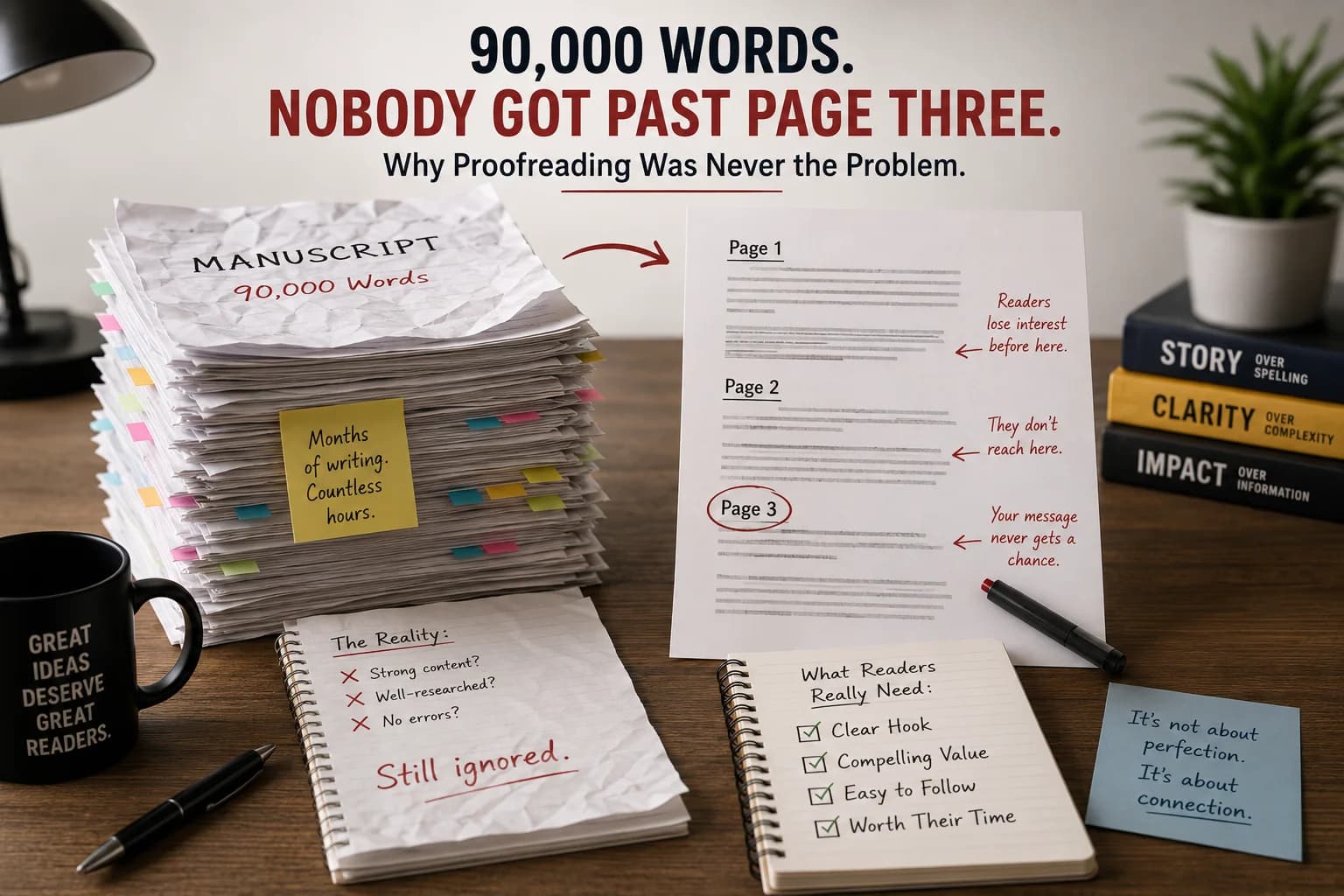
A manuscript is finished, professionally proofread, and formatted cleanly. It goes to beta readers, agents or a publisher. The responses come back polite and vague, and the pattern in them is unmistakable: nobody finished it. Several did not get past the opening chapter.
The instinct is to conclude the writing is weak. Usually it is not. What has happened is that the manuscript received the cheapest, last-stage service when it needed the first-stage one — and no amount of comma correction addresses a book that starts in the wrong place.
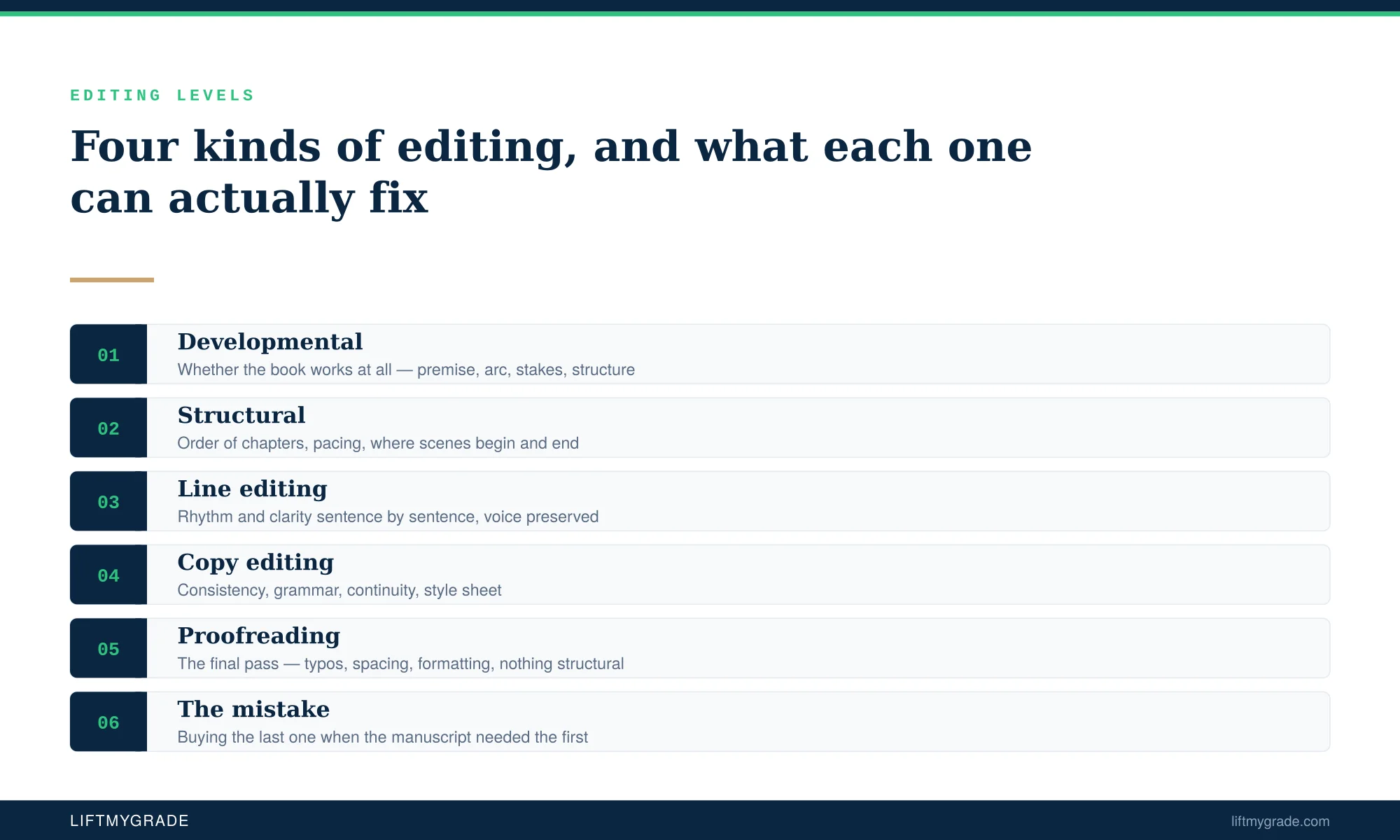
The four levels, in the order they should happen
1. Developmental editing
The highest-level pass. It asks whether the book works: is the premise strong enough to carry the length, does the protagonist want something concretely, do the stakes escalate, is there a reason for the reader to turn each page. In non-fiction, it asks whether the argument holds and whether the structure serves the reader's need rather than the author's filing system.
Developmental feedback comes as an editorial report, not as marks on the page. It may recommend cutting a subplot, moving the opening forward by four chapters, or merging two characters who serve the same function. It is uncomfortable and it is where the largest gains are.
2. Structural editing
Closer in, but still architectural. Chapter order, pacing across the whole, where scenes start and stop, whether the middle sags, whether the ending is earned. Often bundled with developmental work.
3. Line editing
Sentence by sentence, for rhythm, precision and clarity — while preserving the author's voice. This is where a paragraph of 42 words becomes 19 with the same meaning and better momentum. A line edit is not a rewrite: a good line editor makes the sentence sound more like you, not less.
4. Copy editing and proofreading
Copy editing handles grammar, consistency, continuity errors and a style sheet. Proofreading is the final pass on a typeset or near-final file — typos, spacing, page breaks, stray formatting. Neither touches structure. Both are essential; both are last.
The order matters more than the labels. Proofreading a manuscript that will be restructured is money spent on sentences that will be deleted.
The three things that stop readers on page three
1. The book starts too soon
The most common structural problem in first manuscripts. The author begins where the story begins for them — the character waking up, the world being explained, the background being established — rather than where it begins for the reader, which is the moment something changes.
The test is blunt: delete the first chapter. Then the second. Does the book still make sense? Very often it makes more sense, because the necessary information was repeated later anyway. Openings that survive this test usually start in motion, with a concrete situation already under way and the explanation arriving afterwards, in fragments, as it becomes needed.
2. Dialogue that is carrying exposition
"As you know, Ravi, our father left the business to us both after the accident in 2019." Nobody speaks like this, and readers detect it instantly. Characters explaining to each other things they both already know is the clearest signal of an unedited draft.
The fix is usually to distribute the information — some into narration, some into what characters do, some cut entirely because the reader can infer it. Dialogue works when it is people wanting different things from each other, not people delivering context.
3. A middle with no escalation
Chapter twelve costs the protagonist roughly what chapter four cost them. Things happen; nothing tightens. This is the reason readers who did get past the opening stop somewhere around the 40 per cent mark.
Escalation does not require more dramatic events. It requires the options narrowing — each choice closing off alternatives until only difficult ones remain.
A worked example of a line edit
Before (42 words):
"She walked slowly across the room and over to the window, where she then proceeded to look out at the garden below, which was, she noticed with some considerable degree of surprise, in a state of complete and total disrepair."
After (19 words):
"She crossed to the window. The garden below had gone to ruin, and it surprised her how fast."
The information is identical. What changed: hedging removed, one verb doing the work of three, the surprise placed at the end of the sentence where it lands rather than buried mid-clause. Multiply this across ninety thousand words and it is the difference between a manuscript that reads and one that drags.
Which level does your manuscript need?
An honest self-diagnostic:
- Beta readers stop early or say they "couldn't get into it" — developmental. The problem is structural, not sentence-level.
- Readers finish but cannot say what it was about — developmental. Premise and argument.
- Readers finish and enjoy it, but the prose feels effortful — line editing.
- Readers finish, enjoy it, and the prose reads well — copy editing, then proofreading.
- The manuscript is typeset and about to be published — proofreading only.
If you are unsure, a sample edit on ten pages will tell you more than any description. Any editor willing to work on a full manuscript should be willing to demonstrate on a small piece of it first.
What to expect from an editorial process
- A sample edit first, so you can see the editor's judgement before committing.
- A written editorial report for developmental work — typically several thousand words, addressing structure, character, pacing and argument, with specific recommendations rather than general praise.
- Tracked changes for line and copy editing, so every alteration is visible and reversible. An editor who returns a clean file has made your decisions for you.
- A style sheet at copy-edit stage, recording spellings, capitalisation, character details and timeline facts.
- Your right to reject any change. It is your book. A good editor argues for a change once and then respects the decision.
The cost question, answered plainly
Developmental editing is the most expensive level and proofreading the least, which is exactly why the sequence gets inverted. Authors buy what they can afford rather than what the manuscript needs.
If the budget covers only one level, the honest recommendation is a developmental assessment — an editorial report without a full line pass. It costs less than full developmental editing, it tells you whether the structure holds, and it prevents the far more expensive mistake of polishing a draft that needs rebuilding.
Editing in the wrong order is not a small inefficiency. It is paying twice for the same manuscript.
Frequently asked questions
What is the difference between editing and proofreading?
Editing covers everything from the structure of the book down to the rhythm of individual sentences, and it changes the text substantively. Proofreading is the final quality check on a near-final file — typos, spacing, formatting and consistency — and changes nothing structural.
Do I need a developmental edit if I have already had beta readers?
Beta readers tell you where they lost interest, which is valuable. They usually cannot tell you why, or what to do about it. A developmental editor diagnoses the cause and proposes specific structural remedies.
How long does editing a full manuscript take?
It varies with length, condition and level. A developmental read and report on a full-length manuscript typically takes several weeks; line and copy editing take longer because the work is line by line. Any editor should give you a specific schedule before starting.
Will an editor change my voice?
A good line editor works to make the prose sound more like you by removing what is obscuring the voice — hedging, redundancy, inconsistent register. Tracked changes exist so you can see and reject anything that does not sound right.
Should I edit before or after querying agents and publishers?
Before. Agents and commissioning editors read the opening pages and stop when they stop. A manuscript that is structurally sound before it goes out gives you one clean chance with each recipient, and most do not accept resubmissions of the same project.
Start with a sample edit
We work across developmental, line and copy editing, with PhD-level editors and graduates of foreign-university English programmes. A sample edit on your opening pages will tell you which level your manuscript actually needs.
Book an editing consultation at liftmygrade.com