
The Complete Germany Application Timeline for Indian Students (2026 Intake)

Most study-abroad application timelines assume a straightforward workflow: research universities, write SOPs, submit applications, wait for decisions. Germany doesn't work that way.
Germany layers four separate process tracks on top of your core application: the APS Certificate, uni-assist processing (for some universities), the Sperrkonto (blocked account), and the visa slot. Each has its own timeline, its own bottleneck, and its own way of derailing an otherwise ready applicant.
This guide gives you the complete 15-month timeline — reverse-engineered from your intended intake — that keeps all four tracks on schedule.
The Two Timelines to Plan Around
Germany has two intake semesters, and your timeline depends entirely on which one you target.
Winter Semester (WiSe) — Starts in October. Application deadline: typically July 15 for most public universities. Some top programs close earlier (May–June). This is the primary intake with more programs, larger cohorts, and better scholarship coverage.
Summer Semester (SoSe) — Starts in April. Application deadline: typically January 15 for most public universities. Smaller intake, fewer program options — many Master's are Winter-only.
The timeline below assumes a Winter Semester (October 2027 intake) target. For Summer Semester, shift every milestone by six months.
The 15-Month Reverse Timeline
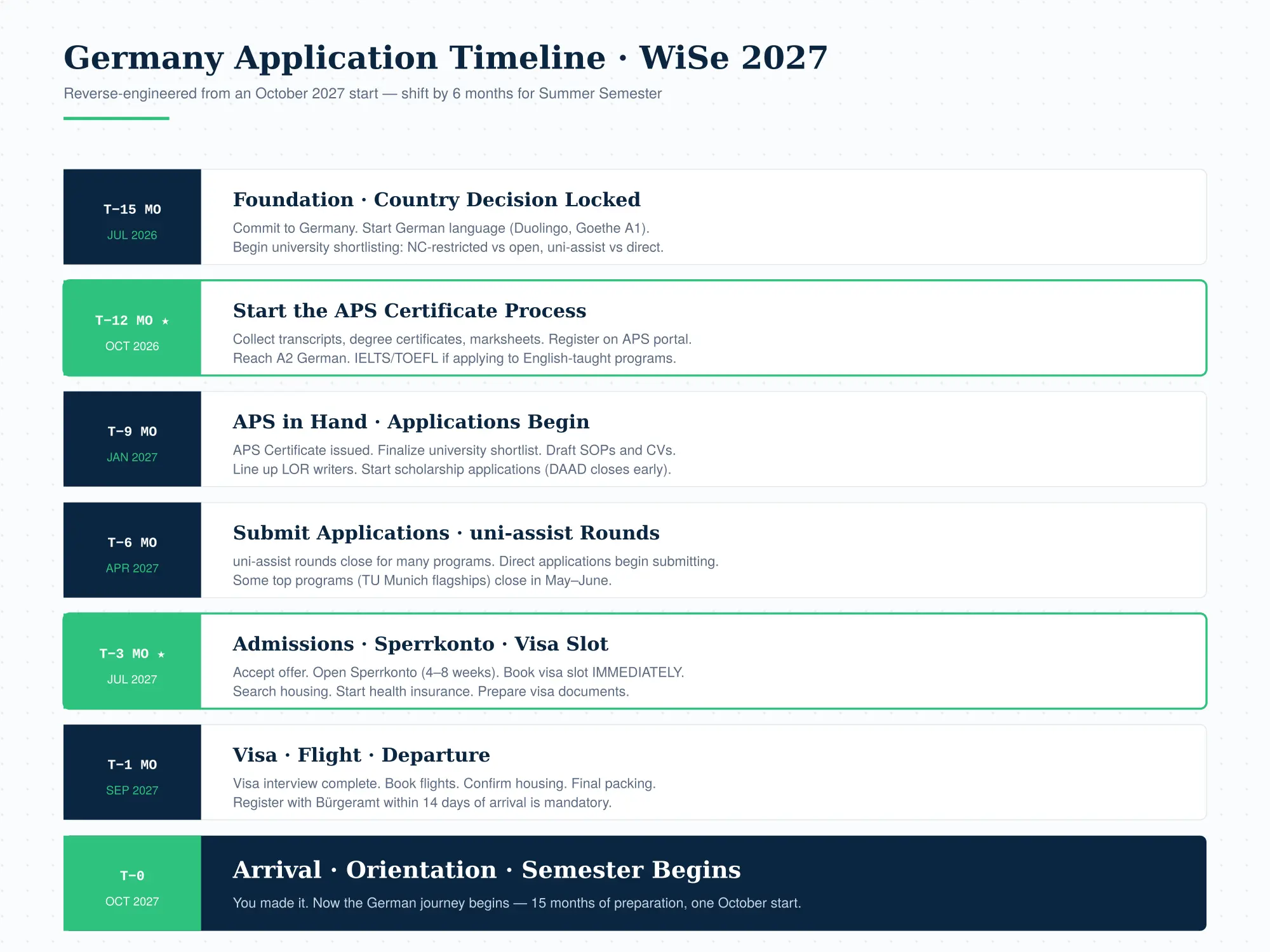
Phase-by-Phase Detail
T-15 to T-12: Foundation (July–October 2026)
Country decision locked. You've committed to Germany over other destinations. Reasons should be specific: cost, engineering strength, PR pathway, or field-specific fit. Second-guessing at T-9 is expensive.
Language investment begins. German is a 12–18 month project to reach B1. Even for English-taught programs, arriving with A2 makes early life dramatically easier. Start with structured resources: Goethe-Institut online, Deutsch Perfekt, Babbel, or in-person classes.
Test decisions. IELTS or TOEFL for English-taught programs. Book tests 3–4 months in advance during peak seasons.
Initial university landscape research. Understand the split between:
- Excellence Universities (TU Munich, LMU, Heidelberg, Berlin cluster, RWTH Aachen, KIT, Hamburg, Tübingen — the flagships)
- Strong technical universities (TU Berlin, TU Darmstadt, TU Dresden, TU Chemnitz, TU Braunschweig)
- Solid research universities in Tier 2 cities (Freiburg, Konstanz, Bonn, Göttingen)
- Universities of Applied Sciences (Fachhochschulen) — different focus, often better job connections
T-12 to T-9: APS Certificate Track (October 2026–January 2027)
This is the phase most students skip — and pay for later.
Collect documents. Every transcript, marksheet, degree certificate you have. Attested copies where required. If your university takes weeks to issue transcripts, start now.
Submit to APS. Register on the APS Germany India portal, pay the fee, upload documents.
Interview. Scheduled 2–4 weeks after submission. 15–20 minutes, English.
Certificate issuance. 1–2 weeks after interview.
Language milestones. A2 completion by January 2027 is realistic if you started at T-15.
T-9 to T-6: Application Preparation (January–April 2027)
APS in hand. Now the core application work begins.
Finalize university shortlist. 6–10 universities across three tiers:
- 2–3 reach (top flagships that align with your profile)
- 3–4 target (strong programs where you're competitive)
- 2–3 safety (solid programs likely to admit you)
For each, note: application portal (uni-assist or direct), specific deadline, program-specific requirements (English test scores, portfolio, motivation letter length).
Draft SOPs and Motivation Letters. German applications often require Motivation Letters that are subtly different from US-style SOPs — more direct about program fit, less narrative flourish.
Line up LOR writers. Brief them thoroughly. Give them 8+ weeks lead time.
Scholarship applications. DAAD scholarships close well before university deadlines. Some as early as October–December for the following Winter Semester. Track these separately.
CV in academic format. Not job resume format.
T-6 to T-3: Submission (April–July 2027)
uni-assist submissions. Note: uni-assist typically has 2–4 week processing time between submission and forwarding to the university. If a university's deadline is July 15, your uni-assist submission ideally happens by mid-June at the latest.
Direct applications. Some universities let you apply through their own portals. Check per program.
Follow-up on LORs. Polite reminders at T-3 weeks before deadline.
Program-specific requirements. Some Master's programs require additional documents: a research proposal, GRE scores, sample of academic writing, portfolio (for design/architecture).
T-3 to T-1: Post-Admission Process (July–September 2027)
Admission decisions arrive. Most public universities issue decisions between June and August for Winter Semester. Some rolling, some batched.
Accept offer. Formal acceptance opens the next tracks.
Open Sperrkonto. 4–8 weeks to fully verified. Providers include Fintiba, Expatrio, Coracle. Choose based on fees and processing speed for your situation.
Book visa slot. Do this immediately after admission is confirmed. Slots at Delhi, Mumbai, Chennai, Kolkata, Bengaluru consulates fill fast during peak seasons.
Health insurance. Public (TK, AOK, Barmer, DAK) or private (Mawista, DR-WALTER) for the first months. Public typically required after enrollment.
Housing search. Student accommodation via Studentenwerk (long waits), WG-Gesucht for shared apartments, or private rentals. Berlin, Munich, Frankfurt, Hamburg are the tightest markets. Start early.
Flight bookings. Book once visa is confirmed, not before.
T-1 to T-0: Departure and Arrival (September–October 2027)
Visa interview and stamping. Bring every document (admission letter, Sperrkonto confirmation, APS Certificate, health insurance, accommodation proof, financial documents).
Final logistics. Winter clothing (October in Germany is already cold in most cities). International driving permit if applicable. Bank account setup in advance where possible.
On arrival. Register with the Bürgeramt within 14 days — this is a legal requirement. Enrollment at the university. Open a regular German bank account. Health insurance activation.
The Program-Specific Timing Nuances
Not every German university follows the July 15 default. Common variations:
- TU Munich: Many flagship English-taught Master's have earlier deadlines, sometimes as early as May 31 for Winter intake. Verify per program.
- RWTH Aachen: Some programs have March or April deadlines for Winter intake, particularly excellence-cluster programs.
- Heidelberg: Life sciences and select humanities programs have varied deadlines.
- LMU Munich: Program-specific deadlines, often not aligning with July 15.
- KIT (Karlsruhe): Engineering Master's often have variable deadlines depending on the department.
- Berlin cluster (TU Berlin, FU Berlin, HU Berlin): Individual program deadlines, some earlier than the standard.
The rule: never assume July 15. Check every program you're applying to individually.
How LiftmyGrade Manages the Germany Timeline
At LiftmyGrade, the Master's Abroad and Bachelor's Abroad pathways build Germany-specific timeline management into every engagement. We work with applicants on:
- APS process kickoff from month one — not treated as an afterthought
- Program-specific deadline mapping — a per-program spreadsheet with real deadlines, not the assumed default
- uni-assist vs direct routing — for every shortlisted program
- Scholarship-first calendar — DAAD and government scholarship deadlines slotted ahead of university deadlines
- Sperrkonto and visa slot coordination — planned into the admission decision timeline, not tacked on after
- Language milestone tracking — A2 by application, B1 for arrival
Germany rewards process discipline. The students who get it right have their applications submitted on time, their scholarships secured, their visa slots booked, and their housing sorted — all before the students who skipped the timeline even know what APS is.
Frequently Asked Questions
Can I apply to German universities before I have my APS Certificate?
Almost no. Since November 2022, the vast majority of German universities require the APS Certificate reference number as part of the initial application. Applying without it typically results in your application being held or rejected without review.
What if I'm still completing my Bachelor's degree at the time of application?
Most German universities accept provisional transcripts and expected-graduation certificates. You'll be admitted conditionally, and asked to submit final documents once available. APS accepts provisional documents too — you may need to update once the final certificate arrives.
Should I apply for the Winter Semester or Summer Semester?
Default to Winter unless you have a specific reason (missing Winter deadlines, timing off from graduation, program only offered in Summer). Winter has more programs, more scholarships, larger cohorts, better orientation coverage.
How many German universities should I apply to?
For public universities: 6–10 is typical. uni-assist fee structures make broader applications relatively cost-effective (per additional program after the first). For direct-apply universities, each application fee adds up separately.
Can I switch my intake if I miss a deadline?
Yes — but you'll effectively be applying to the next intake (usually 6 months later). Most students who miss WiSe apply to the following SoSe or the next WiSe rather than trying to salvage the current cycle.
Ready to Build a Germany Application on the Right Timeline?
The students who make Germany happen aren't smarter or better-connected. They're just further ahead on the timeline. Fifteen months of planning, executed properly, is what separates admitted-with-scholarship students from waiting-for-next-intake students.
Explore LiftmyGrade's Master's Abroad and Bachelor's Abroad pathways — the Germany-specific timeline is built into our workflow from day one.
Every October, students arrive in Berlin, Munich, Aachen, and Karlsruhe. Fifteen months earlier, they made a decision to start. The best time to start yours is now.