
How to Choose Between Multiple University Admission Offers: A Decision Framework

The moment you've worked toward for 12 months finally arrives — and it arrives as a problem. Three admissions offers. Three cities. Three financial packages. Three different lives on the other side of one decision.
Most students make this decision emotionally, based on ranking prestige or the enthusiasm of the first offer that arrived. That's expensive. The choice between two admits isn't just about which university sounds better — it's about which one produces the better version of your five-year life. And those two things are not the same thing.
This guide walks you through the decision framework we use with students who arrive at LiftmyGrade with multiple offers in hand.
First, Rank Only the Offers You'd Actually Accept
Before you compare, filter. Not every offer is a real option.
Reject upfront:
- Any offer that requires more debt than your realistic post-graduation salary can service. Rough rule: total education loan should not exceed 2× your realistic post-graduation salary in year one.
- Any offer at a program you wouldn't actually enjoy. A Master's you resent will produce weaker grades, weaker networks, weaker LORs for what comes next.
- Any offer whose degree wouldn't be recognized where you plan to work. Rare but real — verify degree accreditation in your target job market.
You should be comparing 2–3 offers you'd genuinely accept. Not 5–6 that includes stretch fantasies and safety fallbacks you'd resent.
The Six Dimensions to Compare
Rank each offer on these six dimensions. Don't average — different weightings suit different students.
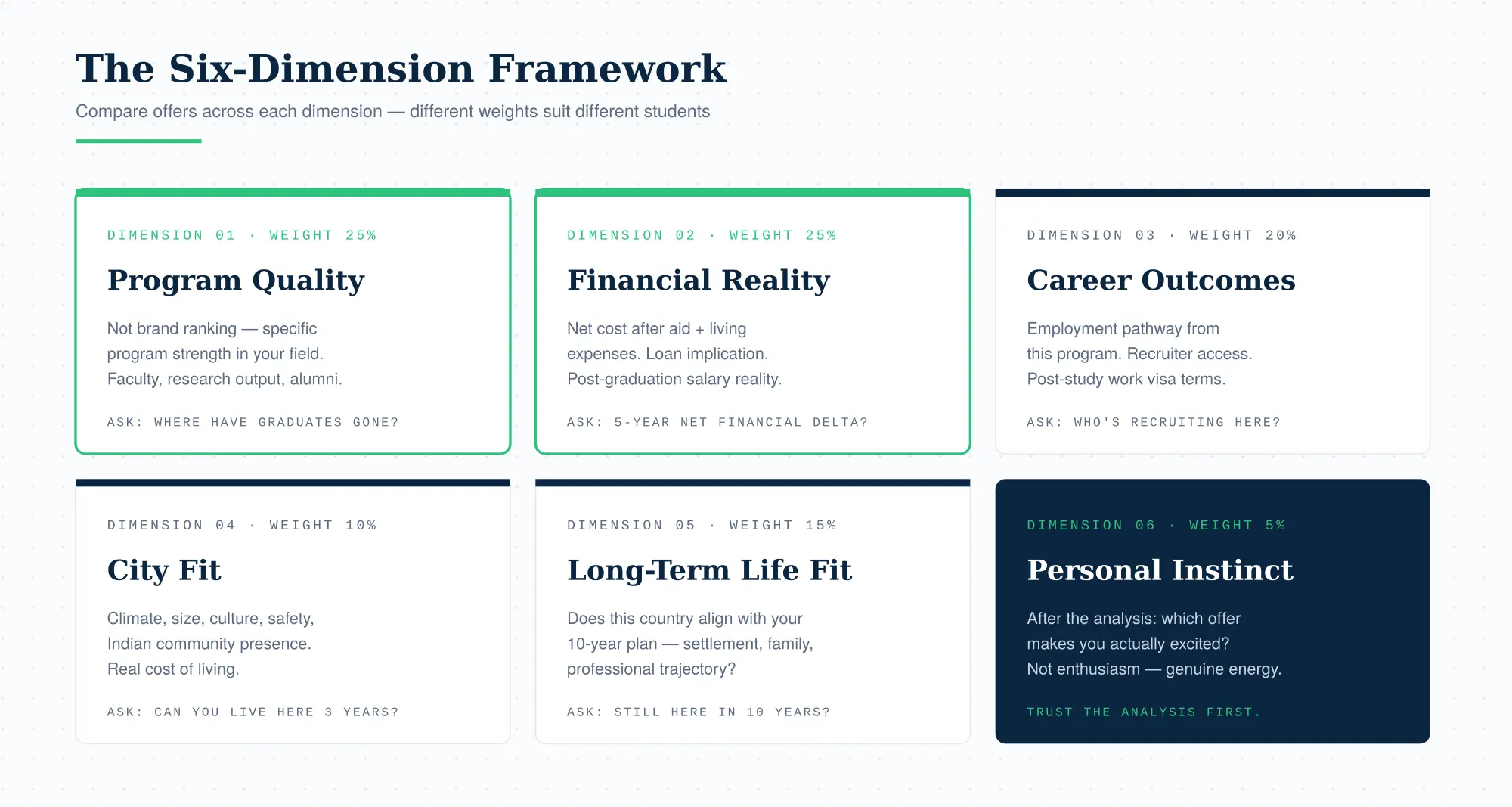
Dimension 1: Program Quality (25%)
Rankings are heuristics. The signal you actually want: what has this specific program produced?
Ask three questions:
- Where have the last three years of graduates gone? Employers, PhD programs, industries?
- What's the faculty producing that's relevant to your interests? Published papers, active grants, current projects?
- What's the intellectual density of the cohort? Are you surrounded by strong peers who will push you?
A program ranked #35 in the world where every graduate lands in your target industry is more valuable than a program ranked #12 where graduates scatter into weak outcomes.
Check university websites for placement statistics. LinkedIn is your friend — search "[University Name] Master's [Your Program]" and see where recent graduates work.
Dimension 2: Financial Reality (25%)
Not the sticker price. The net five-year financial outcome.
For each offer, calculate:
- Total program cost (tuition + living × program length)
- Minus financial aid (scholarships, TA/RA positions, assistantships)
- Plus loan interest over the repayment horizon
- Divided by realistic post-graduation salary in your field × 3–5 years
An offer at a program costing INR 60L with realistic INR 15L/year starting salary produces different math than an offer at INR 30L with INR 10L/year starting salary. Do the math for each.
The uncomfortable truth: sometimes the "better" ranked school produces worse net financial outcomes. Sometimes it's the reverse. Only your calculation tells you.
Dimension 3: Career Outcomes (20%)
Different from program quality. This dimension is specifically about the pipeline from graduation to employment.
Ask:
- Which employers actively recruit from this program? Do career fairs happen on campus?
- What's the alumni network strength in your target industry?
- What's the post-study work visa duration? (Canada 3 years, US 1–3 years depending on STEM, UK 2 years, Germany 18 months job-search, Australia 2–6 years.)
- Are internships/co-ops built into the program?
Programs with structured internship pipelines and strong on-campus recruiting produce dramatically better career outcomes than programs where you graduate and hunt for jobs alone.
Dimension 4: City Fit (10%)
Underweighted by most students. Overweighted after arrival.
Real considerations:
- Climate. Winnipeg winters are severe. Miami summers are brutal. If you've never experienced -15°C or +40°C sustained heat, this matters.
- City size. Boston and Toronto are urban, transit-connected, culturally rich. Ithaca (Cornell) and Ann Arbor (Michigan) are small university towns with limited nightlife or professional job diversity.
- Indian community. Larger communities offer cultural continuity and easier landing. Smaller communities force faster integration — a trade-off.
- Safety. Some US and European cities have higher street-crime rates that affect quality of life. Verify honestly.
- Real cost of living. San Francisco, London, Zurich are dramatically more expensive than published averages suggest.
Dimension 5: Long-Term Life Fit (15%)
Where does this country align with your five- to ten-year plan?
- PR pathway strength. Countries with clear PR routes (Canada Express Entry, Australia skilled migration, Germany Blue Card) offer settled outcomes. Countries with harder PR pathways (US, UK) offer strong degrees but uncertain long-term residence.
- Family and cultural distance. Home visits are expensive. Some students underestimate the emotional weight of 8,000 miles for years at a stretch.
- Industry maturity. Countries with mature industries in your field offer long career runways. Emerging markets in your field mean early-career pioneering.
Dimension 6: Personal Instinct (5%)
Only at the end. If your analysis produces two closely-tied options, personal enthusiasm can break the tie. But instinct without analysis is how students pick brand names over better fits.
Weighing the Framework Differently by Priority
Not every student should apply the standard weights. Adjust for your priorities:
- Career-first students: Program Quality 20% · Career Outcomes 30% · Financial 20% · Long-Term Fit 15% · City 10% · Instinct 5%
- Cost-first students: Financial 40% · Program Quality 20% · Career 15% · Long-Term Fit 15% · City 5% · Instinct 5%
- Settlement-focused students: Long-Term Fit 30% · Career 20% · Financial 20% · Program 15% · City 10% · Instinct 5%
- Research/PhD-track students: Program Quality 40% · Career 15% · Financial 20% · Long-Term Fit 15% · City 5% · Instinct 5%
The Common Mistakes in This Decision
- Chasing brand. "Harvard" is better than "Wisconsin" — for undergraduate laypeople. In graduate programs, the specific department matters far more than the school brand. A top-3 department in a #30 university outperforms a middling department at a top-10 university.
- Overweighting on visa duration. OPT extension in the US is nice, but not enough reason to choose a weaker program if career outcomes and financial math favor a different offer.
- Underweighting on financial aid. A full scholarship at a strong program almost always beats partial aid at a slightly stronger one. The debt-free trajectory compounds for years.
- Choosing based on partner/family opinion. Everyone will have opinions. The person living the next 5–7 years in that country is you. The decision needs to be yours.
- Overthinking beyond the analysis. If you've done the analysis honestly, the answer usually emerges. Continued agonizing after that is usually resistance to the answer, not lack of clarity.
How LiftmyGrade Structures Multi-Offer Decisions
At LiftmyGrade, decision support is included in our pathways for Bachelor's, Master's, and PhD students. Our mentors work with applicants who arrive at multi-offer moments on:
- Structured comparison across the six dimensions
- Real financial modeling — not just tuition, but full 5-year net outcomes
- Career pathway mapping per program
- Reality checks on lifestyle, city fit, family plans
- Post-decision transition planning — accepting, deferring, or negotiating aid
The best decision isn't just picking the right offer. It's arriving at the right offer with clarity, so you don't second-guess for the next three years.
Frequently Asked Questions
Can I negotiate financial aid after admission?
Yes, in many cases. If you have a stronger offer from another university, some programs will match or improve their aid to retain you. Be diplomatic — frame as "I'd love to attend, but the financial gap between offers is significant."
Should I visit campuses before deciding?
If time and budget allow, yes. Even virtual campus visits (many universities offer these) help. Meeting with current students or recent alumni is even more valuable.
Is it okay to decline all my offers and reapply next year?
Yes — if none of your current offers fit financially or academically, and you have a credible plan to strengthen your application in 12 months. Common reasons: profile improvements possible, better scholarship year expected, family circumstances changing.
How much should I weight rankings?
Directionally useful, individually misleading. Use rankings to filter (avoid unranked or very low-ranked programs unless they're specifically excellent). But don't decide based on a #17 vs #23 delta between comparable programs.
What if my parents want me to choose a different school than my analysis suggests?
Have the conversation with your framework in hand. Show the analysis. Explain your reasoning. Often, parents are worried about the wrong things (rankings, brand) but respond to well-argued analysis (career outcomes, financial math, real life fit).
Ready to Make the Right Decision?
The right offer isn't always the highest-ranked one. It's the one that produces the best version of your five- to ten-year life, with financial math that adds up and a program that actually delivers on your goals.
Explore LiftmyGrade's pathways for Bachelor's, Master's, and PhD — decision support is built into the entire journey, from application to acceptance.
You did the work to earn the offers. Now do the work to pick the right one.