
The APS Certificate: The One Application Mistake That Delays Most Indian Students Applying to Germany
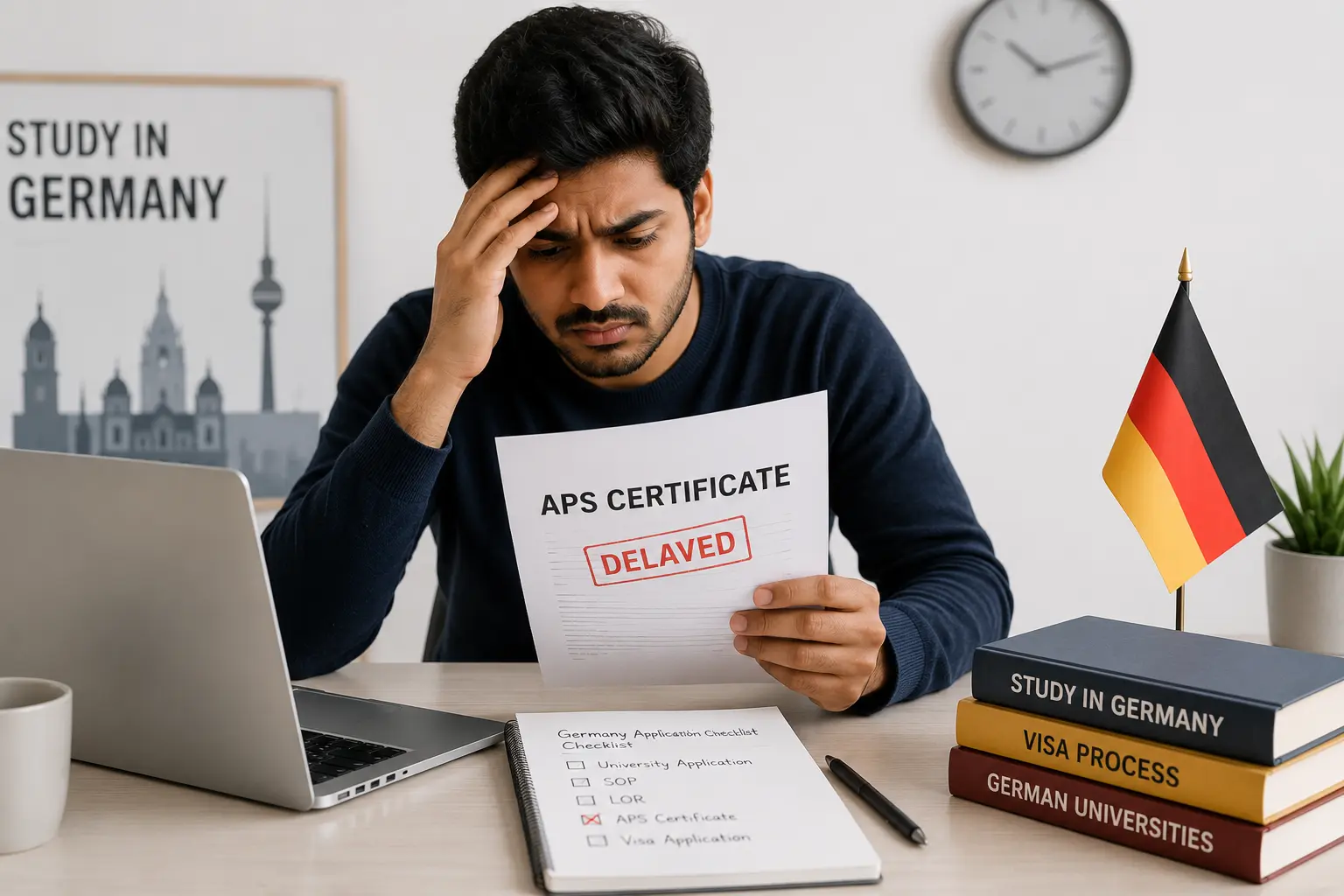
Everyone talks about studying in Germany. Almost no one talks about the one document that quietly derails a majority of Indian applications every intake cycle. Students spend months on SOPs, LORs, and university shortlists — then get their entire timeline pushed back six months because they didn't know about a certificate that takes several weeks to obtain and that most universities won't even review your application without.
The document is the APS Certificate (Akademische Prüfstelle), and since November 2022, it has been mandatory for Indian citizens applying to German universities at any level. If you're planning to study in Germany and haven't heard of it, this guide is the reset your application timeline needs.
What Is the APS Certificate?
The APS Certificate is issued by the Akademische Prüfstelle — the Academic Evaluation Centre operated jointly by the German Embassy in New Delhi and the DAAD. Its purpose is straightforward: to verify that the Indian academic credentials you submit to German universities are genuine.
Before November 2022, individual German universities verified Indian transcripts themselves — slowly, unevenly, and often mid-application. The APS process centralizes and standardizes that verification, and issues a certificate that German universities now treat as a mandatory precondition for evaluating your application.
You submit your academic documents to APS. They interview you (either in person or virtually). They issue you an APS Certificate that includes a unique reference number. Every German university you apply to will ask for this certificate — and your application will not be processed without it.
Who Needs the APS Certificate?
Every Indian citizen applying to a German university needs one, regardless of whether you're applying for:
- Bachelor's programs
- Master's programs
- PhD programs
- Preparatory studies (Studienkolleg)
- Language courses that lead to degree study
There are limited exceptions — for example, if you completed your higher education in a country other than India, or if you're applying for very short exchange programs. But for the overwhelming majority of Indian applicants, the certificate is non-negotiable.
Why This Is the Number-One Application Mistake
Three reasons this quietly kills more Indian Germany applications than any other single factor:
- Students don't know it exists. The requirement is relatively new (November 2022), and older study-abroad guides — including many written by consultancies that haven't updated — don't mention it. Students following outdated advice submit applications that go straight to rejection without review.
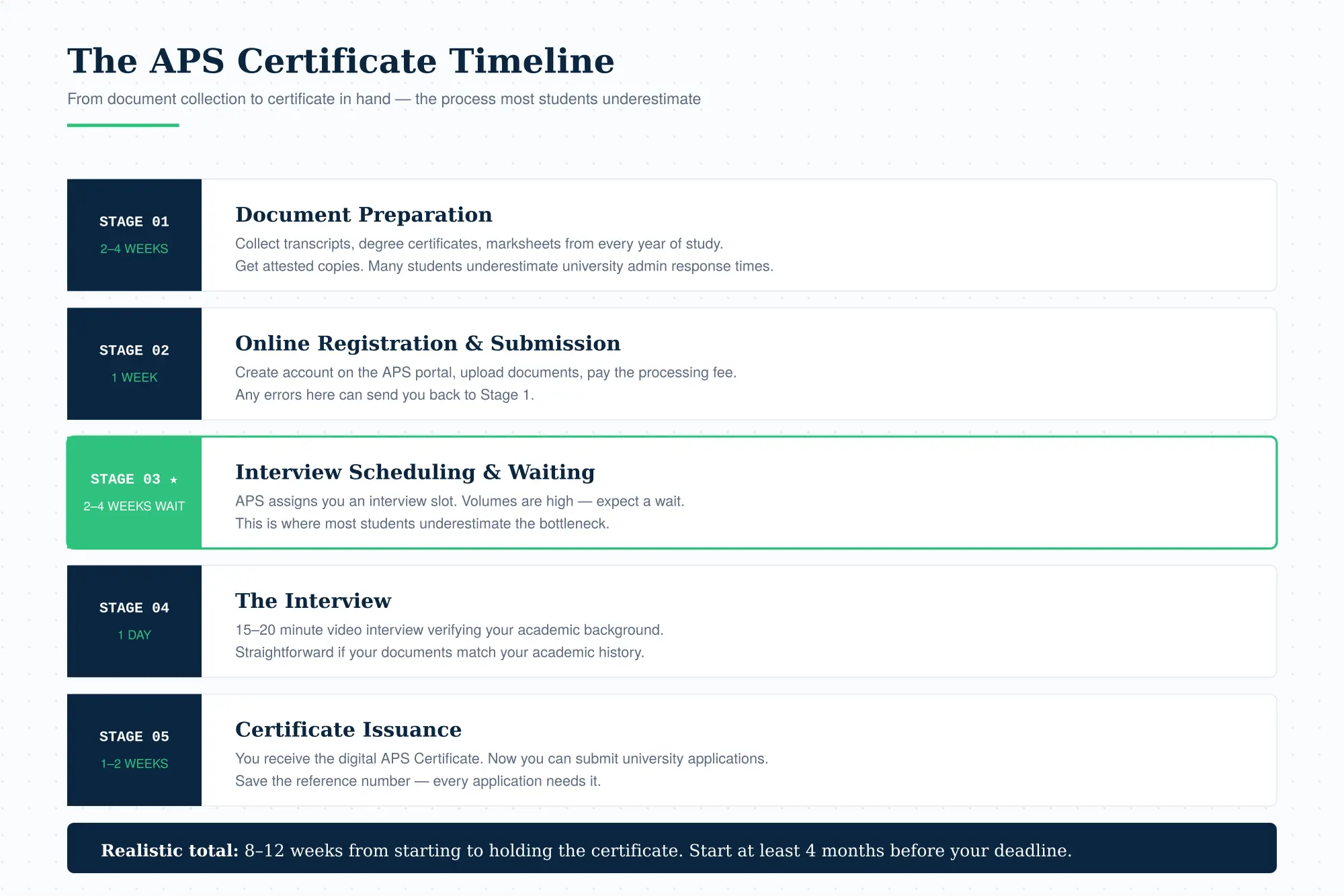
- The processing time is longer than most students plan for. From document submission to certificate issuance, the typical timeline is 4–8 weeks. Add document collection time before that, and you're looking at 2–3 months minimum from starting the APS process to holding the certificate.
- University deadlines don't wait. German universities have hard deadlines — July 15 for Winter Semester (WiSe), January 15 for Summer Semester (SoSe) at most public universities. If you start the APS process in June for a July 15 deadline, you're already too late.
The mistake isn't complicated. It's just timing. And it costs students an entire semester — sometimes an entire year — while they wait for the next intake cycle.
The Documents You Need to Prepare
The APS process requires original documents that many Indian students haven't systematically collected in years. Getting these together is often the slowest part of the process — not the APS interview itself.
- Academic transcripts for all years of higher education (Bachelor's, and if applying for Master's/PhD, the completed higher degree as well). Semester-by-semester transcripts, not just aggregated marksheets.
- Degree certificates — provisional and final. If your university hasn't issued the final degree yet, provisional certificates are acceptable, but you'll need to update once the final arrives.
- Class 12 (higher secondary) certificate and marksheet.
- Class 10 certificate and marksheet.
- Valid passport with a minimum of six months' validity.
- Recent passport-size photograph in the required format.
- Application form and fee — the fee changes periodically, so check the current amount on the APS Germany India portal.
For students still completing their final year at the time of applying: you can submit APS with provisional documents, but be prepared to update as your final documents arrive.
What Happens at the APS Interview?
The interview is not academically rigorous. APS is not testing whether you deserve to study in Germany. They're verifying that the person on the video call is the same person named on the documents, and that your academic history is consistent with what you've claimed.
Typical questions:
- Which university did you attend, and when did you graduate?
- What was your primary subject of study?
- Can you briefly describe your major courses?
- Did you have a final year project or thesis? What was it about?
- What are your plans for study in Germany?
The interview usually takes 15–20 minutes. Answer honestly, be prepared to explain any gaps or unusual patterns in your academic record (career switches, extended breaks, transfers between institutions).
The vast majority of applicants clear the interview without issue. The certificate is issued 1–2 weeks after.
When You Actually Need to Start the APS Process
Work backwards from your target intake.
- For Winter Semester (October start) with a July 15 university deadline: Start the APS process no later than February–March. Ideally earlier.
- For Summer Semester (April start) with a January 15 university deadline: Start the APS process no later than August–September of the previous year.
Students who start APS 6+ months before their university deadline have zero timeline stress. Students who start 3 months before are cutting it close. Students who start 6 weeks before have already lost that intake cycle — they just don't know it yet.
The Other "Small Mistakes" That Delay Germany Applications
APS is the biggest. But there are five others that quietly cost applicants their intake:
- Not knowing about uni-assist. Many German universities require applications through the uni-assist portal rather than direct university applications. Fees, processing time (2–4 weeks per university), and document requirements are all different. Applying "direct" when uni-assist is required means your application never reaches the university.
- The blocked account (Sperrkonto) timing. For your visa, you need to demonstrate financial resources — typically over €11,000 held in a German blocked account. Opening this account takes 4–8 weeks. Many students book visa slots before their Sperrkonto is confirmed and lose the appointment.
- Underestimating language requirements even for English programs. Many "English-taught" Master's programs at German universities still require A1 or A2 German for enrollment, and B1 for the residence permit renewal. Students who arrive with zero German find themselves scrambling in the first semester.
- Missing the specific university deadline within the standard window. July 15 and January 15 are common, but not universal. Top programs at TU Munich, RWTH Aachen, and others have earlier or program-specific deadlines. Check every program individually.
- Visa slot booking delays. Slots at the German consulates in Delhi, Mumbai, Chennai, Kolkata, and Bengaluru fill quickly, especially during peak intake seasons. Even with all documents ready, you may be waiting 6–10 weeks for a slot. Plan accordingly.
How LiftmyGrade Handles the Germany Application Timeline
At LiftmyGrade, our Master's Abroad pathway and Bachelor's Abroad pathway both incorporate Germany-specific workflow. For students targeting Germany, we build the APS process into the very start of the engagement — not the middle or end. Our mentors work with applicants on:
- Document audit at T-6 months — do you have every document APS will need? What's missing?
- APS interview preparation — walking through the typical questions, matching your answers to your document trail
- uni-assist vs direct application mapping — for every university on your shortlist, which submission channel applies
- Sperrkonto and visa slot timeline — ensuring these are set up before you need them, not after
- Program-specific deadline tracking — because "January 15" is a guideline, not a universal rule
Germany is one of the strongest study-abroad destinations in the world — high quality, low cost, credible PR pathway. But it demands more upfront process discipline than any other country. Get the process right, and Germany becomes the highest-value degree you can access. Get it wrong, and you lose a full year.
Frequently Asked Questions
How much does the APS process cost?
The APS processing fee is set by the German Embassy in New Delhi and updates periodically. Verify the current fee on the official APS Germany India portal before applying. Note: this does not include courier, attestation, or document preparation costs.
Can I apply to universities before I have the APS Certificate?
No. Almost all German universities will reject or hold applications from Indian students who don't include a valid APS Certificate reference number. Complete APS first, then apply.
Is the APS interview conducted in English or German?
For most Indian applicants, the interview is conducted in English. If you're applying to a German-taught program, the interview may test your language proficiency briefly, but the core verification is in English.
What if I fail the APS interview?
Failing outright is rare — it typically happens only when there's a mismatch between documents and claimed academic history (fraud concerns). If you're honest and prepared, you'll clear the interview. If there's a concern, APS will request additional documentation rather than issue a blanket rejection.
Does the APS Certificate expire?
The certificate remains valid indefinitely once issued, as long as your academic history hasn't materially changed. If you complete a new degree after your APS certificate is issued, you may need to update or re-obtain it for that new degree.
Do PhD applicants need APS too?
Yes. All Indian citizens applying to German universities at any level need APS, including PhD applicants.
Ready to Build a Germany Application That Doesn't Get Delayed?
The APS Certificate isn't complicated. It's just a process — one that rewards early starters and quietly punishes late ones. The students who plan for it from the beginning have their Germany application submitted on time, with a full semester of runway to spare. The students who don't lose their intake cycle.
Explore LiftmyGrade's Master's Abroad and Bachelor's Abroad pathways — Germany-specific process planning is built into every engagement.
The best time to start the APS process was six months ago. The second-best time is today.